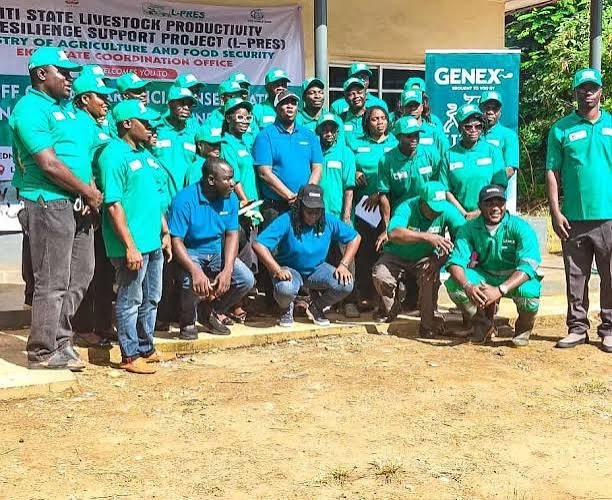
The Taraba State government, through the Livestock Productivity and Resilience Support Project (L-PRES), has begun a five-day step-down training on artificial insemination for livestock farmers and other stakeholders in the agricultural sector.
The training is aimed at equipping participants with practical knowledge and skills to adopt artificial insemination technology as a means of improving animal breeding and livestock productivity across the state.

Speaking at the training, the L-PRES State Project Coordinator, Mr. Hananiah Albert, described artificial insemination as an important reproductive technology capable of significantly improving livestock production.
Albert, represented by the State ITC and Communication Officer, Mr. Ezra Atima, explained that artificial insemination involved introducing semen from a selected male animal into the reproductive tract of a female at the appropriate time to achieve pregnancy.
He said the technology would enable farmers to access desirable genetic traits without the need to keep breeding males on every farm.
Read Also:
- Taraba CSOs Urge Dialogue and Accountability Over SEMA Humanitarian Operations
- Taraba PDP Unveils 281-Member Campaign Council Ahead 2027 Governorship Election
- Taraba NDC Leadership Crisis Deepens as Tiuda Rejects Richard Dauda’s Emergence
According to him, improved livestock productivity would contribute to food security, increase household income, create employment opportunities and promote rural development in Taraba State.
He noted that appropriate breeding programmes could help farmers produce animals with desirable characteristics, including improved milk and meat production, better growth performance and adaptability to local production conditions.
The project coordinator, however, stressed that successful artificial insemination required more than merely introducing semen into female animals, noting that proper animal identification, heat detection, semen handling, hygiene, accurate timing and record keeping were critical to achieving positive results.
He urged participants to take the practical sessions seriously, ask questions and share their experiences with the facilitators.
Albert also advised farmers to prioritise animal welfare, biosecurity, proper hygiene and accurate record keeping when applying the technology.
He encouraged livestock farmers to work closely with veterinary professionals, livestock extension officers and trained artificial insemination technicians to ensure effective application of the technology and safeguard animal health.
He said the success of the initiative would depend on effective collaboration among government agencies, development partners, extension personnel, technicians and livestock farmers.
Albert further urged participants to take the knowledge and skills acquired during the training back to their communities and share them with other farmers.
Also speaking, the Commissioner for Agriculture and Food Security, Prof. Nicholas Namessan, represented by the Director of Livestock, Mr. Buhari Dame, said the training would contribute to improving livestock productivity across the state.
Namessan urged participants to maximise the opportunity provided by the five-day training and replicate the knowledge and skills gained in rural communities to ensure wider impact.