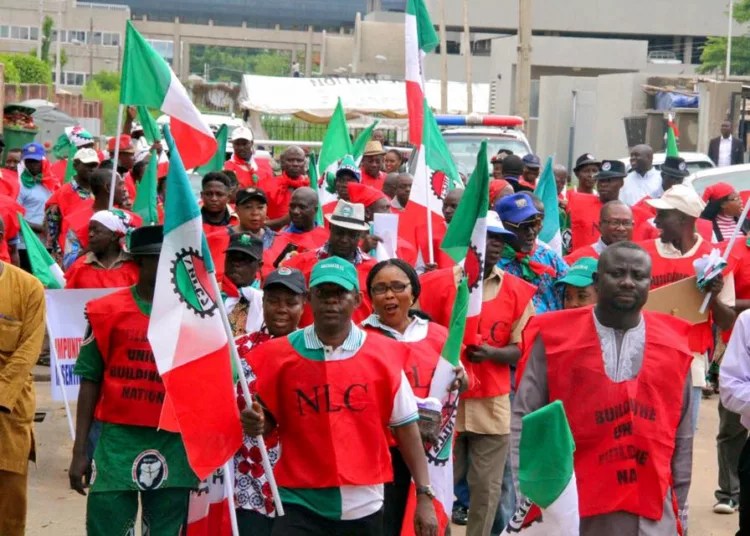
The Nigeria Labour Congress (NLC) has demanded an immediate reduction in petrol prices, a nationwide wage award and the commencement of negotiations for a new national minimum wage, saying rising living costs have severely eroded the purchasing power of Nigerian workers. The demands were contained in the union’s Independence Day statement as Nigeria marked its 66th anniversary on October 1, 2026.
Key Highlights
- NLC demands immediate reduction in petrol prices.
- Labour calls for a nationwide wage award for federal, state and local government workers.
- Union demands immediate negotiations for a new national minimum wage for 2027.
- NLC says petrol sells for ₦1,430 per litre or higher in major cities.
- Labour says inflation has significantly reduced the real value of workers’ wages.
- NLC recalls the ₦35,000 monthly wage award agreed after the 2023 petrol subsidy removal.
- Union also calls for implementation of tax relief measures agreed with the Federal Government.
- NLC links high transport costs to rising food, rent and education expenses.
NLC Demands Immediate Relief for Workers
The statement, signed by NLC President Joe Ajaero, said Nigerian workers and other citizens were facing sustained pressure from rising prices of essential goods and services.

The union linked the hardship largely to the increase in petrol prices following the removal of the fuel subsidy in 2023.
According to the NLC, petrol now sells for about ₦1,430 per litre or higher in major cities, with prices reportedly higher in some remote areas. The union said increased fuel costs had pushed up transportation expenses and, in turn, the prices of food, school fees, rent and other necessities.
Labour Calls for Nationwide Wage Award
A major demand in the NLC statement is the immediate implementation of a wage award for workers across the federal, state and local government levels.
The union described the wage award as an emergency intervention designed to cushion the impact of declining real incomes rather than a permanent replacement for salary negotiations.
“A wage award is not charity. It is an emergency intervention against the collapse of real income,” the NLC said.
The demand recalls the October 2023 agreement between the Federal Government and organised labour following the removal of the petrol subsidy.
Under that agreement, federal workers were to receive a monthly wage award of ₦35,000, while states and local governments were encouraged to consider similar relief measures.
Read also:
- Public Servants Threaten October 2 Warning Strike Over Fuel Price, Wage Award
- Ajaero: Nigeria Has No Development Plan, Energy, Food Policies 66 Years After Independence
- Repair State Refineries to Cut Petrol Prices to ₦435–₦687, Agbon Tells Government
- Opposition Figures Fault Tinubu Independence Day Address Over Economic Hardship
NLC Seeks New Minimum Wage for 2027
The labour union also called for the immediate constitution of a tripartite committee to negotiate a new national minimum wage ahead of 2027.
The NLC said the current ₦70,000 national minimum wage had already lost substantial purchasing power because of inflation.
The union wants the negotiation process to begin immediately so that a new wage standard can be formulated and legislated before the end of the year.
The current ₦70,000 minimum wage was approved by President Bola Tinubu in July 2024.
NLC Links Petrol Prices to Cost of Living
The NLC argued that reducing petrol prices is essential to addressing the wider cost-of-living crisis because fuel prices affect transportation and the cost of moving goods across the country.
The union said high transport costs feed into the prices of food, education, housing and other basic services.
“Without cutting this chain, any effort to ease the suffering of the people is futile,” the NLC said.
The union therefore called for measures that would reduce the cost of petrol and strengthen domestic refining capacity.
Labour Questions Use of Subsidy Savings
The NLC also questioned the use of savings generated from the removal of the petrol subsidy.
The union recalled the Federal Government’s earlier argument that subsidy removal would release resources for infrastructure, social services and other interventions designed to cushion the impact of the policy.
Three years after the subsidy removal, the NLC called for greater transparency over how those savings have been used and questioned whether Nigerians have seen sufficient improvements in infrastructure and social services.
NLC Demands Tax Relief Implementation
Beyond wages and petrol prices, the labour union called for the implementation of tax relief measures agreed during the October 2023 dialogue between the government and organised labour.
The NLC said the measures were part of the broader package intended to cushion workers from the economic effects of subsidy removal.
The union also called for a reduction in the cost of governance and greater transparency in public spending.
Labour Calls for More Domestic Refining
The NLC criticised Nigeria’s continued dependence on imported refined petroleum products despite the country’s status as a major crude oil producer.
The union called for greater investment in domestic refining capacity, arguing that increased local refining could help reduce pressure on petrol prices and limit exposure to international market conditions.
It also called for policies that would support domestic refineries and improve the availability of refined petroleum products.
NLC Raises Concerns Over Jobs and Insecurity
The union also linked economic hardship to unemployment, insecurity and youth migration.
The NLC said insecurity has disrupted farming, education and healthcare delivery in affected communities, while unemployment and limited economic opportunities continue to place pressure on young Nigerians.
It called on the government to create more opportunities for young people and strengthen social infrastructure, including public education, healthcare and roads.
NLC Sets Out Workers’ Position Ahead of 2027
With Nigeria heading towards the 2027 general elections, the NLC also addressed the political environment.
The union said workers should retain the freedom to make independent political choices and warned against electoral manipulation, voter intimidation and rhetoric capable of deepening ethnic or religious tensions.
Ajaero said the NLC would, at the appropriate time, use its Workers’ Charter to articulate its positions on policies and candidates.
The union, however, said workers’ organisations should not be treated merely as electoral tools.
The NLC’s Independence Day message therefore combines immediate demands for lower living costs and wage relief with longer-term calls for a new minimum wage, stronger public services, domestic refining and improved economic opportunities. For more updates on this and other stories, follow us on X.