Nigeria could significantly reduce petrol prices by reviving its government-owned refineries and pricing domestically refined fuel according to production costs rather than import-parity benchmarks, petroleum engineer and economist Prof. Izielen Agbon has said.
Agbon, speaking on Channels Television’s Politics Today, argued that the rehabilitation and reliable operation of Nigeria’s state-owned refineries should form the foundation of a lower-cost domestic fuel supply system. He said a production-cost pricing model could potentially put petrol at between ₦435 and ₦687 per litre.

Key Highlights
- Prof. Izielen Agbon says repairing Nigeria’s state refineries could help reduce petrol prices.
- He proposed a production-cost pricing model of ₦435 to ₦687 per litre.
- Agbon said Nigeria’s 445,000 barrels per day domestic crude allocation should support local refining.
- He criticised reliance on import-parity pricing for domestically produced petroleum products.
- NNPC says it is pursuing technical equity partnerships to revive its refineries.
- Chinese companies are conducting technical assessments of the Port Harcourt and Warri refineries.
- NNPC says no final agreement has yet been reached with the potential Chinese partners.
- The Kaduna Refinery has not yet reached the same stage of rehabilitation discussions.
Agbon Calls for Production-Cost Petrol Pricing
Agbon’s proposal centres on using Nigeria’s domestic crude allocation to support local refining and pricing the resulting petroleum products according to the cost of producing, refining, transporting and distributing them within the country.
He argued that this approach would differ from import-parity pricing, which benchmarks domestic petroleum products against the economics of importing refined fuel.
Agbon has estimated Nigeria’s crude production cost at between $31 and $48 per barrel, attributing the relatively high cost to factors including ageing infrastructure, insecurity, oil theft, sabotage and the cost of imported inputs. He has argued that even with these costs, domestic production-cost pricing could support a significantly lower petrol price.
Four State Refineries at the Centre of Debate
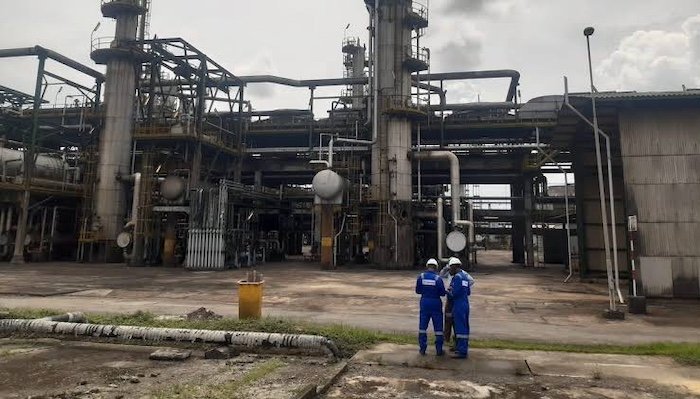
Agbon’s proposal places Nigeria’s state-owned refining infrastructure at the centre of the debate over petrol prices.
Nigeria’s government refining assets are commonly described as four refineries because the two plants at Port Harcourt are counted separately, alongside the Warri and Kaduna refineries.
However, the facilities have struggled to maintain sustained commercial production despite several rehabilitation efforts.
The Minister of State for Petroleum Resources (Oil), Heineken Lokpobiri, said in September that the Port Harcourt, Warri and Kaduna refineries were not producing petroleum products at the time of his remarks. He also said new partnerships with Chinese companies were being negotiated to rehabilitate the facilities.
NNPC Changes Approach to Refinery Rehabilitation
The Nigerian National Petroleum Company Limited has said it will no longer rely solely on the previous model of paying contractors to rehabilitate its refineries without ensuring that those responsible have a direct interest in their performance.
NNPC Group Chief Executive Officer, Bayo Ojulari, said the company is now pursuing technical equity partnerships with experienced refinery operators.
Under the proposed model, technical partners would take equity stakes and have a financial interest in ensuring that the facilities operate sustainably and profitably.
NNPC has identified two Chinese companies, Sanjiang Chemical Company Limited and Xinganchen (Fuzhou) Industrial Park Operation and Management Co. Ltd, as potential technical equity partners for the Port Harcourt and Warri refineries.
The company signed a memorandum of understanding with the firms in April 2026 covering potential collaboration on completing, operating and expanding the two facilities.
Read also:
- Nigeria Urges Private Sector Investment to Drive Oil Refining, Gas Development
- NNPCL Posts ₦7.2 Trillion Profit After Tax in 2025 Despite 24% Revenue Drop
- Dangote Breaks Ground on $16 Billion Kenya Refinery, Targets 700,000 Barrels Per Day
- Nigeria’s CNG Transport Promise Faces Nationwide Reach Challenge as October 1 Target Begins
- Ogun, NNPC Move to Revive Olokola LNG Project as bn Coastal Corridor Takes Shape
- NLC Demands Lower Petrol Prices, Wage Award, New Minimum Wage on Independence Day
t
Chinese Firms Assess Port Harcourt and Warri Refineries
Ojulari said NNPC considered more than 50 potential partners during a nine-month selection process before narrowing the field to about 20 firms.
The two Chinese companies subsequently emerged as potential partners for the Port Harcourt and Warri facilities.
NNPC said the Chinese team had deployed engineers to conduct technical studies, with the findings expected to form the basis for any subsequent commercial and technical negotiations.
Ojulari stressed that no final agreement had been concluded and that the outcome of the technical assessments would determine the next steps.
Agbon Challenges Import-Parity Model
Agbon has also criticised what he describes as Nigeria’s long reliance on import-parity pricing for petroleum products.
Under a production-cost approach, he argues that the price of locally refined petrol should reflect the cost of Nigerian crude, refining, transportation, distribution, marketing and applicable taxes.
By contrast, import-parity pricing reflects the cost associated with obtaining petroleum products from international markets.
Agbon maintains that using domestic crude for domestic refining could provide a different pricing benchmark and reduce the impact of international petroleum market conditions on Nigerian consumers.
Lower Fuel Costs Could Affect Businesses and Households
Agbon has linked lower petrol prices to wider economic issues, including transportation costs, food prices, household expenses and the operating costs of small businesses.
He has argued that cheaper energy is important for industrial development and the survival of small and medium-sized enterprises.
His proposed price range of ₦435 to ₦687 per litre, however, remains an estimate based on his production-cost model rather than an existing pump-price policy adopted by the Federal Government or NNPC.
NNPC Focuses on Commercial Viability
While Agbon advocates refinery rehabilitation as a route to lower petrol prices, NNPC has placed strong emphasis on commercial viability and sustainable operations.
Ojulari said the company had learned from previous rehabilitation efforts and wanted future arrangements to ensure that technical partners have a direct financial stake in refinery performance.
NNPC has also said the new model is intended to improve governance, accountability and operational efficiency across its refining assets.
The debate therefore extends beyond simply repairing the refineries. It also involves the cost of crude production, refinery efficiency, security, logistics, financing, governance, market structure and the pricing framework applied to petroleum products.
Nigeria’s Petrol Price Debate Continues
Agbon’s proposal has added another dimension to Nigeria’s continuing debate over petrol prices and the future of government-owned refineries.
His position is that functioning state refineries supplied with Nigeria’s domestic crude could provide a lower-cost source of petrol and create a benchmark for the wider downstream market.
NNPC, meanwhile, is pursuing a technical equity model and potential partnerships with Chinese companies for the Port Harcourt and Warri refineries, while the Kaduna facility remains at an earlier stage.
Whether the proposed model can deliver petrol within Agbon’s estimated ₦435 to ₦687 per litre range will depend on the actual cost of crude production, refinery operations, infrastructure, security, financing, distribution and the eventual pricing framework adopted for locally refined products.
For more updates, follow us on X.