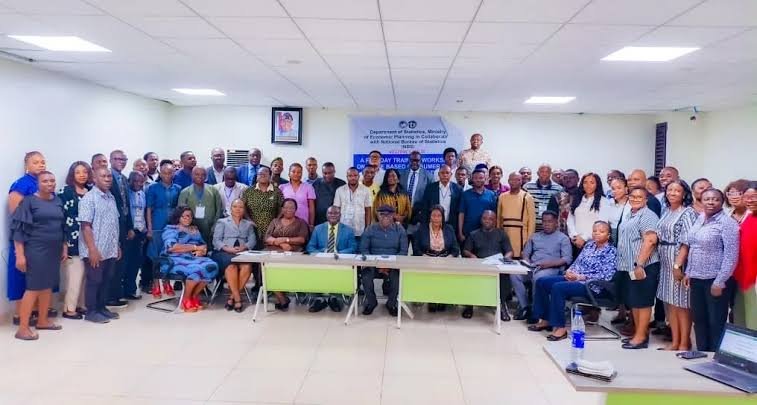
Delta State has begun compiling its first State-Based Consumer Price Index as part of efforts to improve the quality of economic data available for planning, budgeting and policymaking in the state.
Key Highlights
- Delta State has begun compiling its first State-Based Consumer Price Index, or CPI.
- A five-day training workshop on the CPI compilation runs from September 22 to 26 in Asaba.
- The exercise is being conducted in partnership with the National Bureau of Statistics.
- The CPI data will support inflation monitoring, fiscal policy decisions and poverty and welfare assessments.
- The state’s CPI process will align with statistical standards promoted by the ILO, IMF and UN.
- The training follows the recent validation exercise for the Delta State Statistical Year Book.
The Commissioner for Economic Planning, Mr Sonny Ekedayen, disclosed this while opening a five-day training workshop on the compilation of the Delta State 2026 Consumer Price Index at the Professor Chike Edozien Secretariat in Asaba.

The training, which runs from September 22 to 26, is being conducted in partnership with the National Bureau of Statistics, with NBS officials providing technical guidance throughout the sessions.
Ekedayen said the initiative represented an important development in Delta State’s efforts to strengthen its statistical system and build the institutional capacity required to produce reliable economic information.
He explained that the Consumer Price Index was more than a statistical measurement, describing it as an important indicator for tracking changes in the prices of goods and services purchased by households.
According to the commissioner, the information generated through the exercise would support inflation monitoring, fiscal and monetary policy decisions, wage and pension adjustments, poverty and welfare assessments, as well as planning and budgeting at both state and national levels.
“Without accurate CPI data, our planning would be built on weak foundations,” Ekedayen said.
The commissioner urged the participants to treat the exercise with accuracy and professionalism, noting that the reliability of policy decisions would depend significantly on the quality of the information collected and processed.
Training Aligned With International Standards
He said the training was designed to strengthen participants’ knowledge of CPI concepts and methodology while improving their capacity in data collection, processing and analysis.
The programme is also expected to equip participants with the skills required to identify and address challenges that may arise during the compilation of price statistics.
Ekedayen said the state’s CPI process would be aligned with internationally recognised statistical practices and standards promoted by organisations such as the International Labour Organisation, International Monetary Fund and United Nations.
Among the NBS officials facilitating the training are Dr Emmanuel Abbah, Dr Calistius Ihemebiri and Mrs Bukola Babalola.
The commissioner also commended the NBS for providing technical support and the facilitators for contributing to the capacity-building programme.
Read also:
- Nigeria’s Inflation Slows To 15.39% As Food Price Growth Eases
- Delta Pursuing Power Sector Reforms To Attract Private Investment, Expand Supply — Commissioner
- Delta At 35: Omo-Agege, NDC, Stakeholders Lament Sufferings Of Deltans
CPI Initiative Comes Amid Inflation Concerns
Ekedayen said the CPI initiative was particularly relevant given ongoing concerns over inflation and the rising cost of living.
He observed that the prevailing inflation trend appeared to be moderating, stressing that the development underscored the need for continued policy measures aimed at improving economic conditions and household welfare.
The commissioner said having state-specific price data would give policymakers a clearer understanding of price movements within Delta and provide a stronger basis for economic interventions.
He also noted that the training followed the recent validation exercise for the Delta State Statistical Year Book, describing both initiatives as part of the ministry’s broader effort to establish a more dependable statistical framework for the state.
Technical Sessions Cover CPI Methodology
The technical sessions covered several aspects of CPI production, including the concepts and methodology behind the index, field data collection, review of questionnaires and the use of the Kobo Collect application.
Participants were also trained on the Delta State expenditure CPI basket, calculation procedures, collection of consumption-pattern information and the derivation of item weights for the state.
The appropriate treatment of missing items and other technical issues that may arise during data compilation were also discussed.
The participants, made up of statisticians and enumerators, interacted with the facilitators during the sessions, raising questions and sharing practical experiences and challenges ahead of the field data collection phase.
Ekedayen urged them to understand the importance of their responsibilities within the state’s statistical system and ensure that every piece of information gathered was accurate, consistent and properly handled.
He expressed confidence that the training would contribute to the successful production of Delta State’s first State-Based CPI and provide policymakers with more dependable information for economic planning and decision-making.
The commissioner attended the event alongside the Permanent Secretary in the Ministry of Economic Planning, Mr Augustine Itawansa; the State Director of Statistics, Mrs Nkechi Maduemezia; directors and other senior officials of the ministry. Nigeria’s national CPI methodology is published by the National Bureau of Statistics. Follow us on X for more updates from Delta State.