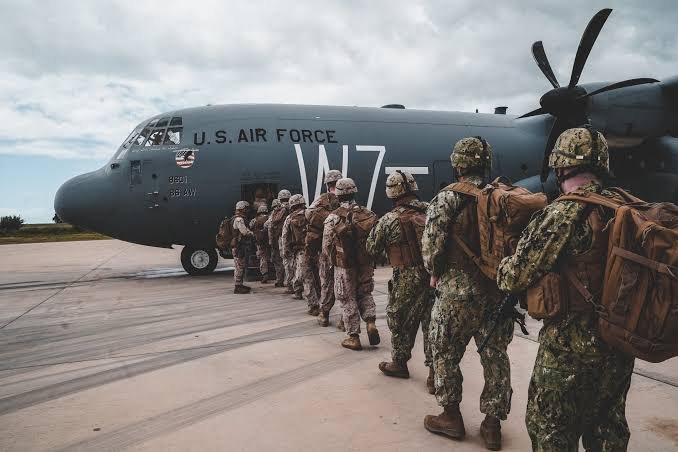
The Pentagon is preparing to withdraw about 200 US troops deployed to Nigeria for counterterrorism operations, with the pullout expected by late September 2026, according to a report by The New York Times.
The planned withdrawal would bring the months-long US military deployment to an end, although smaller teams of American trainers and intelligence personnel are expected to remain in Nigeria to support ongoing security cooperation.

US military officials said the deployment achieved notable results, including the killing of a senior Islamic State figure. However, militant attacks have continued across parts of Nigeria, highlighting the persistent security challenges facing the country.
Key Highlights
Pentagon plans to withdraw about 200 US troops from Nigeria by late September.
The troops were deployed in February 2026 to support Nigeria’s counterterrorism efforts.
US and Nigerian forces killed senior Islamic State figure Abu Bilal al-Minuki in May.
Smaller teams of US trainers and intelligence analysts are expected to remain.
Militant attacks continue despite the reported successes of the joint security operations.
The US is considering similar limited security partnerships with other West African countries.
Why US Troops Were Deployed to Nigeria
The US troops were deployed to northeastern Nigeria in February 2026, weeks after President Donald Trump publicly criticised the Nigerian government over its handling of terrorist violence.
The deployment augmented a smaller team of US personnel already working with Nigerian security forces on intelligence gathering, target identification and operational support.
The mission was primarily focused on training, advisory assistance and intelligence sharing rather than direct combat operations. Nigerian authorities retained command of military operations conducted on Nigerian territory.
The deployment followed US airstrikes carried out in late 2025 and came amid growing concerns over Islamic State affiliates, Boko Haram and other armed groups operating in northern and central Nigeria and the wider Lake Chad Basin.
US-Nigeria Counterterrorism Mission Records Major Operation
One of the major developments during the deployment occurred in May 2026, when a joint US-Nigerian operation involving personnel from the US Navy’s SEAL Team 6 killed Abu Bilal al-Minuki.
He was described by American and Nigerian officials as the de facto leader of Islamic State’s global operations.
US and Nigerian officials have pointed to the operation as evidence that intelligence cooperation and targeted military action can disrupt the leadership and networks of extremist organisations.
However, the reported success has not ended militant violence in Nigeria.
Terrorist Attacks Continue
Militant attacks have continued in different parts of the country despite intensified counterterrorism operations.
Recent attacks have claimed the lives of more than two dozen people in northwestern Nigeria, including an imam, while at least 25 people were killed in a separate attack on a village in the central region.
Militants also recently launched a major assault on a military base in northeastern Nigeria, underscoring the continued ability of extremist groups to mount significant attacks against civilian and military targets.
The developments suggest that while targeted operations may have disrupted militant networks, the broader security threat remains significant.
US Troops Withdrawal: What Happens Next?
The withdrawal of the approximately 200 US troops does not mean the end of US-Nigeria security cooperation.
Small teams of American trainers and intelligence analysts are expected to remain in Nigeria after the larger contingent leaves.
US officials are also considering whether the experience of the Nigeria deployment could provide a model for limited military and intelligence partnerships with other West African coastal countries, including Benin, Togo and Ghana.
Read also:
- Troops Arrest Suspected Gun Runners, Rescue 6 Victims From Terrorists In Zamfara
- Military Dislodge Boko Haram/ISWAP Camp In Adamawa, Kill 21 Terrorists
- Edo Illegal Revenue Collectors Busted as Taskforce Arrests Two in Uwelu Spare Parts Market
- Troops Rescue Two Kidnap Victims as Military Intensifies Operations in Plateau
These countries have faced increasing pressure from Islamic State-linked, Al Qaeda-linked and other extremist groups expanding their activities towards the Gulf of Guinea.
The planned troop withdrawal also comes as the United States manages significant military commitments in other parts of the world.
American officials have described the Nigeria mission as a low-footprint approach that delivered targeted results without requiring a large permanent US military presence.
Nigeria-US Security Partnership Continues
Nigerian and US authorities are expected to maintain intelligence sharing, training and broader security cooperation after the withdrawal.
The departure of the larger contingent by late September will therefore mark the end of the specific 2026 deployment rather than a complete termination of American security involvement in Nigeria.
For Nigeria, the continued challenge will be to translate intelligence and operational support into sustained improvements in security while strengthening the capacity of its own armed forces to confront Boko Haram, Islamic State affiliates and other armed groups.