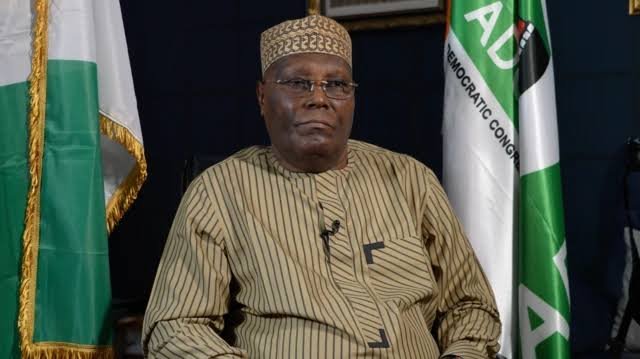
Former Vice President Atiku Abubakar has promised to tackle insurgency and insecurity in Nigeria within one year if elected president in the 2027 presidential election.
The presidential candidate of the African Democratic Congress (ADC) made the promise in an exclusive interview with the BBC, where he outlined his plans to strengthen Nigeria’s security architecture and improve cooperation among West African countries.

Atiku said Nigeria must invest significantly in the police and armed forces to address the country’s worsening security challenges. He also proposed stronger regional cooperation and the revival of an ECOWAS standing force to combat insurgency and insecurity across West Africa.
Key Highlights
Atiku Abubakar says he can control insurgency and insecurity in Nigeria within one year if elected.
He wants increased investment in the Nigeria Police Force and Armed Forces.
The ADC candidate proposed reviving stronger ECOWAS regional cooperation.
Atiku suggested establishing a standing regional force based on the former ECOMOG model.
He criticised the closure of some of Nigeria’s land borders with neighbouring West African countries.
Atiku said he would not seek another presidential term if he loses the 2027 election.
He also criticised the removal of fuel subsidy, saying it has worsened economic hardship for Nigerians.
Atiku Promises Major Investment in Security
Atiku argued that Nigeria’s security forces are inadequate for the size of the country’s population.
He cited Nigeria’s police strength and compared it with Egypt, arguing that the country needs to significantly increase investment in policing and the armed forces.
“We are over 200 million people, and yet we have less than 200,000 policemen.”
Atiku said a stronger security force would help the government guarantee peace and protect citizens.
The former vice president also said his administration would move quickly to address insecurity if elected, claiming that significant progress could be achieved within its first year.
“Believe me, within one year we can control this insurgency and insecurity we have everywhere.”
The claim is part of Atiku’s campaign proposal and would depend on the scale of resources, security reforms and operational capacity available to any incoming administration.
Atiku Blames Regional Insecurity on Weak West African Cooperation
Atiku also linked Nigeria’s security problems to instability and weak cooperation among countries in the West African sub-region.
He argued that porous borders allow armed groups and bandits to move across countries, making it difficult for individual governments to tackle the threat alone.
The ADC candidate said Nigeria should work towards rebuilding stronger regional cooperation through the Economic Community of West African States (ECOWAS).
“First of all, I will make sure that ECOWAS comes back together as one.”
He also proposed the creation of a standing regional security force modelled on the Economic Community of West African States Monitoring Group, known as ECOMOG.
According to Atiku, ECOMOG played important roles in restoring peace and supporting democratic transitions in countries including Liberia, Sierra Leone and Côte d’Ivoire.
He argued that a permanent regional force could be deployed against insurgency and insecurity across West Africa.
Atiku also criticised Nigeria for allowing some countries to leave ECOWAS, saying stronger regional integration was necessary for peace, stability and economic prosperity.
Atiku Wants Nigeria’s Northern Borders Reopened
The former vice president also criticised Nigeria’s border policies, particularly restrictions affecting trade with neighbouring countries.
He said Nigerian traders should be able to conduct legitimate cross-border business with Niger Republic, Chad and Cameroon.
“We cannot trade with Niger. We cannot trade with Chad. We cannot trade with Cameroon.”
Atiku argued that restrictions on cross-border trade have affected economic activity in northern Nigeria and contributed to hardship among traders and communities that depend on regional commerce.
His position comes amid wider political debate over Nigeria’s border management, regional trade and efforts to combat smuggling and insecurity.
Read also:
- 2027: Atiku Vows to Reopen Nigeria’s Land Borders, Expand Southern Ports
- US Court Issues FBI September Deadline To Justify Keeping Tinubu-Linked Records Secret
Atiku Says Opposition Parties Will Unite for 2027
On the possibility of opposition parties presenting a united front against the ruling All Progressives Congress (APC) in the 2027 presidential election, Atiku said discussions were still ongoing.
He expressed confidence that opposition politicians would eventually reach an agreement on strategy.
“We are still talking to ourselves. It is an issue of strategy. Don’t worry. We will come together.”
The opposition has been exploring different political alliances ahead of the 2027 election, with discussions focusing on how to challenge the APC and President Bola Ahmed Tinubu.
Why Atiku Is Contesting Again
Atiku, who has contested the Nigerian presidency several times, defended his decision to seek the office again.
He said contesting for the presidency was his constitutional right and indicated that he would not seek another presidential term if he loses the 2027 election.
The former vice president also rejected concerns about his age, saying he remains physically capable of contesting the election.
He further suggested that if age became an issue in the presidential contest, he was younger than President Bola Tinubu and said he would be prepared to demonstrate his fitness.
Atiku Criticises Fuel Subsidy Removal
Atiku also criticised the Federal Government’s decision to remove the petrol subsidy.
According to him, he had consulted economists and experts who concluded that the benefits of subsidy removal had not adequately reached ordinary Nigerians.
He argued that the policy had instead pushed more Nigerians into poverty.
“It has further thrown more Nigerians into poverty.”
The debate over fuel subsidy removal remains a major issue ahead of the 2027 presidential election, with opposition politicians calling for alternative measures to reduce the impact of rising living costs.
Atiku’s latest comments form part of his wider campaign message focused on security, regional integration, economic relief and institutional reforms as he seeks to challenge President Tinubu in the 2027 presidential election.