With less than two weeks to the August 15 governorship election in Osun State, political activities have entered a more intense phase as candidates and their parties move to consolidate their support bases and persuade undecided voters.
The contest, which has increasingly assumed a two-horse character between the incumbent Governor Ademola Adeleke and the All Progressives Congress candidate, Bola Oyebamiji, is also attracting interventions from other political parties and stakeholders seeking to influence the conduct and outcome of the poll.

The latest developments reflect the competing approaches being adopted by the political camps. While supporters of Adeleke are campaigning on the record of his administration and asking voters to return him for a second term, Oyebamiji and the APC are strengthening their structures and seeking to present the election as an opportunity for a change in government.
Against that backdrop, the Accord Party has entered the conversation with a warning to voters to resist threats and inducements and to make what it described as informed choices at the ballot box.
The party’s intervention has also placed the Independent National Electoral Commission and security agencies under renewed scrutiny, with its National Chairman, Maxwell Mgbudem, demanding neutrality and an electoral process in which every vote is counted.
The competing messages illustrate the political stakes in Osun as the state approaches another governorship eelection For the incumbent, the election is a referendum on his administration and an opportunity to secure another four years in office.
For the APC, it is an opportunity to return to power in a state where the party has maintained a significant political presence and challenge the incumbent’s record.
For smaller parties, the election presents an opportunity to expand their influence and potentially determine how the contest unfolds.
Adeleke’s re-election campaign
Governor Ademola Adeleke is seeking another term after his first tenure, with his supporters presenting his administration as one that has delivered visible changes in infrastructure, social services and workers’ welfare.
The Accord Party, despite not being the platform on which Adeleke is contesting, has publicly backed his re-election campaign.
In a statement issued by Mgbudem, the party described Adeleke as a “man of the people” and argued that his administration had improved the welfare of residents.
The party cited infrastructural development, social amenities, education, healthcare, security and workers’ welfare as areas where it claimed the governor had made significant progresth Mgbudem argued that the projects and policies implemented by Adeleke provided sufficient justification for his return to office.
“He has accelerated the development of Osun State and deserves a re-election to complete his people-centered projects and deliver more fruits of democracy to citizens,” the Accord chairman said.
The argument is central to Adeleke’s re-election strategy.
Like most incumbent governors seeking a second term, the governor’s campaign is expected to rely heavily on what his administration can point to as tangible achievements. Infrastructure, public-sector welfare, education and healthcare are particularly important in this regard because they are areas in which voters can directly assess government performance.
The administration’s supporters are therefore seeking to turn the election into a comparison between what they say has been achieved under Adeleke and what they believe the governor can accomplish with another four years.
But incumbency also comes with political risks.
An incumbent cannot campaign exclusively on promises. Voters can assess what has already been delivered, what remains incomplete and whether the government has met expectations.
This makes the coming weeks critical for Adeleke’s campaign.
His political team must convince voters that the achievements highlighted by his supporters are sufficient to warrant another mandate while also addressing criticisms from opponents.
The APC’s counter-strategy
The APC is taking a different approach.
Rather than defend the incumbent’s record, the party is presenting Oyebamiji as an alternative and has intensified its efforts to mobilise political leaders and structures across the South-West.
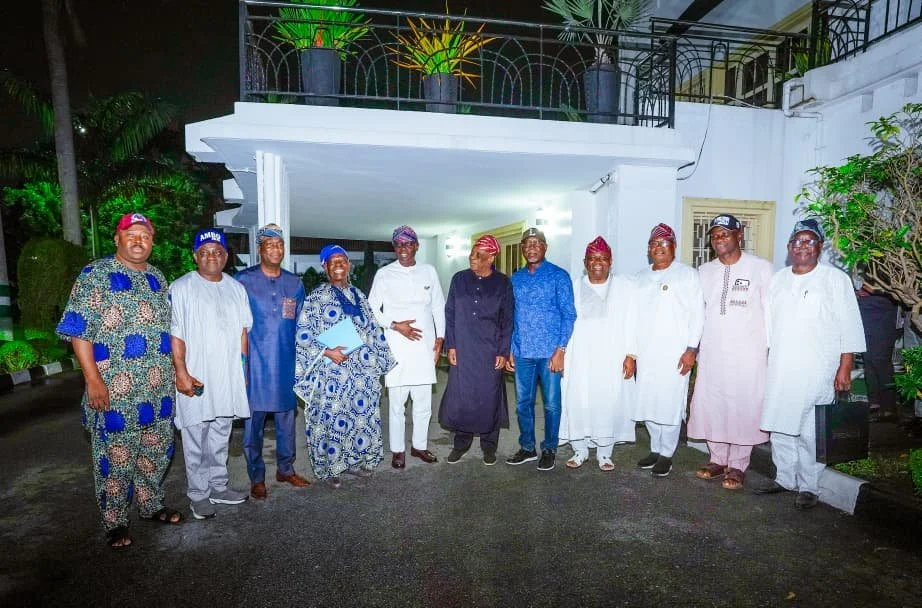
Oyebamiji’s meeting on Monday with some of the APC’s influential South-West leaders illustrates the importance the party attaches to regional political coordination.
The meeting, held at the Lagos State House, Marina, brought together Lagos State Governor Babajide Sanwo-Olu, Ondo State Governor Lucky Aiyedatiwa, former Osun State Governor Bisi Akande and APC governorship candidates from Oyo, Ogun and Lagos states.
The engagement was focused on campaign strategy, collaboration and efforts to strengthen the APC’s chances of winning the election.
For Oyebamiji, the meeting was more than a routine gathering of party members.
The presence of governors, a former governor and other candidates demonstrates the APC’s attempt to project unity and collective strength as the election approaches.
It also sends a political signal to the electorate that the APC campaign is not operating in isolation.
Oyebamiji said the meeting provided an opportunity for the leaders to review campaign plans, align their efforts and reinforce their commitment to securing victory for the party.
“At the meeting, we reaffirmed unity, effective collaboration, and shared determination as veritable pillars strengthening our party within the region,” he said.
The emphasis on unity is significant.
Political parties often face internal divisions during elections, particularly when candidates emerge from competitive primaries.
The APC’s public display of solidarity is therefore aimed at demonstrating that the party’s leaders and campaign structures are working towards a common objective.
For Oyebamiji, the support of prominent political figures may also help strengthen his campaign machinery as the election approaches.
Oyebamiji’s message to voters
The APC candidate is also seeking to differentiate his campaign through promises of economic growth, youth empowerment and responsible governance.
He has promised to prioritise sustainable economic development, create opportunities for young people and improve governance if elected.
“Our mission remains clear: to restore sustainable economic growth, create opportunities for our youth, empower our people, and deliver responsible governance that will improve the lives of every resident of Osun State,” Oyebamiji said.
The message places the economy and employment at the centre of his campaign.
This is politically significant because economic conditions remain one of the major issues shaping electoral decisions acropportunitie Young voters, in particular, are likely to scrutinise the candidates’ plans for employment, entrepreneurship and economic opportunities.
The APC candidate has also promised to continue engaging communities and stakeholders across the state.
That strategy recognises the importance of grassroots mobilisation in a governorship election.
Osun is not simply a contest between politicians in Osogbo. Its electoral outcome will depend on how effectively candidates connect with voters across local government areas, towns, villages and communities.
Campaign promises made at political rallies in urban centres must ultimately translate into a message that resonates with voters at the grassroots.
Accord’s interventions
While Adeleke and Oyebamiji remain central figures in the political contest, the Accord Party has attempted to influence the narrative by calling on voters to reject threats and inducements.
Mgbudem urged voters to make informed choices based on the candidates’ records and pprogrammes The party’s statement reflects a recurring concern surrounding Nigerian elections: the use of money, intimidation and other forms of inducement to influence voters.
The warning is particularly relevant during the final stages of an election campaign, when political parties typically intensify efforts to mobilise supporters and persuade undecided voters.
Vote-buying and other forms of inducement have remained major concerns in Nigeria’s electoral process.
The challenge is not limited to the actions of political parties.
It also raises questions about voters’ vulnerability, poverty, unemployment and the broader economic conditions that can make financial inducement attractive to citizens.
The Accord Party’s message therefore goes beyond a simple appeal to voters.
It is also a call for voters to consider the longer-term implications of their decisions.
A voter who accepts money or other inducements in exchange for support may gain an immediate benefit, but the decision can affect the quality of leadership that emerges from the election. This is why Mgbudem urged residents to protect the sanctity of the ballot.
The ballot box and the role of INEC
The Accord Party has also directed its attention to INEC, describing the Osun election as an important test of the commission’s preparedness for the 2027 general election.
Mgbudem said the electoral body must ensure that the August 15 election is free, fair, credible, transparent and inclusive.
His comments reflect the importance of the Osun election beyond the state itself.
The election is one of the major electoral exercises preceding the 2027 general elections and will offer an indication of how effectively INEC can organise elections, deploy technology and materials, manage polling units and address complaints.
Mgbudem said INEC should adequately test its electoral materials before election day and ensure that technical problems do not undermine the process.
“There should be no excuse for poor performance, including any form of glitches,” he said.
He added that the commission must “put its act together” and adequately test-run its electoral materials.
The call reflects a central issue in modern elections: technology can improve electoral credibility, but technical failures can also undermine confidence when voters and political parties are unable to understand or trust what has happened.
INEC therefore faces the responsibility of ensuring that electoral materials and systems work as expected and that polling officials are adequately prepared.
The commission must also communicate clearly with political parties and voters before, during and after the election.
Security agencies under scrutiny
The role of security agencies will be equally important. Accord called on security agencies to remain neutral and impartial before, during and after the election. That demand is not unusual in Nigeria’s electoral environment.
Security agencies are deployed during elections to protect voters, electoral officials, election materials and public infrastructure.
But their presence can also generate anxiety among voters and political parties when there are concerns about alleged partisanship or selective enforcement.
The challenge for the security agencies is therefore to demonstrate that their actions are based on law and security considerations rather than political interests.
The police, in particular, will be expected to maintain order while allowing citizens to exercise their right to vote freely.
Any allegation of intimidation, harassment or violence will likely attract significant attention because of the importance of the election.
For the political parties, the security environment will be closely watched.
The opposition will want to ensure that its supporters can access polling units without intimidation, while the ruling political structure will expect security agencies to protect government facilities and public infrastructure.
The responsibility is ultimately the same: security agencies must protect the integrity of the electoral process without becoming participants in it.
A test beyond Osun
The August 15 election has implications that extend beyond the state.
For INEC, the election will provide an opportunity to demonstrate its capacity ahead of 2027.
For the police and other security agencies, it will be another test of election security. For the APC and PDP, the result will offer clues about their political strength ahead of the next general election.
For smaller parties, the election could demonstrate whether they can build meaningful electoral influence beyond the traditional dominance of the major political parties.
The outcome may also influence political calculations in the South-West.
The region has remained a critical component of Nigeria’s electoral politics, with political parties competing aggressively for influence.
An APC victory in Osun would strengthen the party’s position in the region.
Adeleke’s re-election, on the other hand, would reinforce the PDP’s continued relevance in the state and provide the governor with a stronger political platform going into the next electoral cycle.
This explains the increasing involvement of national and regional political figures in the campaign.
The battle over performance
At the heart of the election is likely to be a debate over performance.
Adeleke’s supporters want voters to focus on what they describe as achievements under his administration.
Oyebamiji and the APC want voters to consider whether those achievements are enough and whether a change in government would produce better results.
That debate is healthier than one centred exclusively on personalities.
Governorship elections should ideally be contests over policy, accountability, development and the quality of leadership.
The candidates will therefore face pressure to explain how they intend to address the problems that matter most to residents. For voters, the key question is whether campaign promises are realistic and whether candidates have the political and administrative capacity to implement them.
The importance of grassroots voters
The final outcome will not be determined by the size of political rallies alone.
It will depend on the ability of each campaign to convert support into actual votes on election day.
This makes grassroots organisation crucial.
Political parties must ensure that their agents are present at polling units, that voters understand the voting process and that legitimate complaints are documented and pursued through the appropriate channels.
The parties must also ensure that their supporters remain peaceful.
Election-day violence can suppress voter turnout, disrupt voting and damage the credibility of the eventual result.
The responsibility extends to political leaders, who must control their supporters and publicly discourage violence.
The final days before the election are therefore likely to be dominated by intensified mobilisation.
Adeleke’s campaign will seek to consolidate the advantages of incumbency and persuade voters that continuity is preferable.
Oyebamiji’s campaign will attempt to turn dissatisfaction, where it exists, into support for the APC. Other parties will seek to exploit spaces left open by the two major camps.
Voters hold the decisive power
Ultimately, the outcome belongs to Osun voters. Political parties can organise rallies, deploy campaign messages and mobilise their structures, but only voters can determine who occupies the Government House in Osogbo after the election.
Read also:
- Breaking: Flood Submerges Delta Broadcasting Service (DBS) Asaba, Operations Grounded
- Court Affirms David Mark As ADC National Chairman, Dismisses Leadership Suit
- What Hope Remains For Atiku As Bala’s ADC Faction Submits Candidates?
That makes the warnings against inducement and intimidation particularly important. The electorate must be able to vote without fear.
It must also be able to make choices based on candidates’ records, programmes and credibility.
The political parties, in turn, must accept that elections are not won merely through rhetoric.
They require trust.
They require effective organisation.
And they require the ability to persuade voters that a particular candidate deserves their mandate.
The August 15 election will consequently test more than the popularity of Adeleke or Oyebamiji. It will test the strength of party structures, the effectiveness of campaign strategies, the credibility of INEC, the neutrality of security agencies and the willingness of political actors to respect democratic rules.
What is at stake
For Adeleke, the stakes are personal and political. A second-term victory would allow him to consolidate his administration’s policies and strengthen his position within the state and the wider political landscape.
For Oyebamiji, victory would represent the APC’s return to the Government House and provide the party with an opportunity to implement its alternative programme for the state.
For INEC, the election offers a chance to demonstrate that lessons from previous electoral exercises have been absorbed and that the commission can conduct a credible poll.
For the security agencies, it is another opportunity to demonstrate that election security can be provided without compromising neutrality.
For Osun residents, however, the stakes are more immediate.
They are concerned with jobs, infrastructure, education, healthcare, security, wages, economic opportunities and the overall quality of governance.
Those concerns will ultimately determine whether campaign messages translate into votes.
As August 15 draws closer, the political temperature in Osun is expected to rise.
The competing camps will intensify their appeals, political leaders will continue to mobilise supporters and the electorate will be subjected to increasingly aggressive campaign messages.
The responsibility of the political class will be to ensure that the contest remains issue-based and peaceful.
The responsibility of INEC will be to conduct a credible election.
The responsibility of security agencies will be to protect voters and the electoral process without taking sides.
And the responsibility of voters will be to protect their votes and make choices based on their assessment of the candidates.
The Accord Party’s warning against threats and inducements, its demand for electoral neutrality and Oyebamiji’s mobilisation of APC leaders all point to the same reality: the Osun governorship election is entering its decisive phase.
Adeleke will be asking voters to reward continuity.
Oyebamiji will be asking them to embrace change. Other parties will be seeking to influence that choice.
But when the campaigns end and the ballot boxes are opened, the decisive voice will belong to the people of Osun State.
The credibility of the August 15 election will therefore depend not only on who wins, but on whether voters are allowed to freely determine the winner and whether all political actors accept the outcome of a transparent and credible process. For Osun, that is the real test.