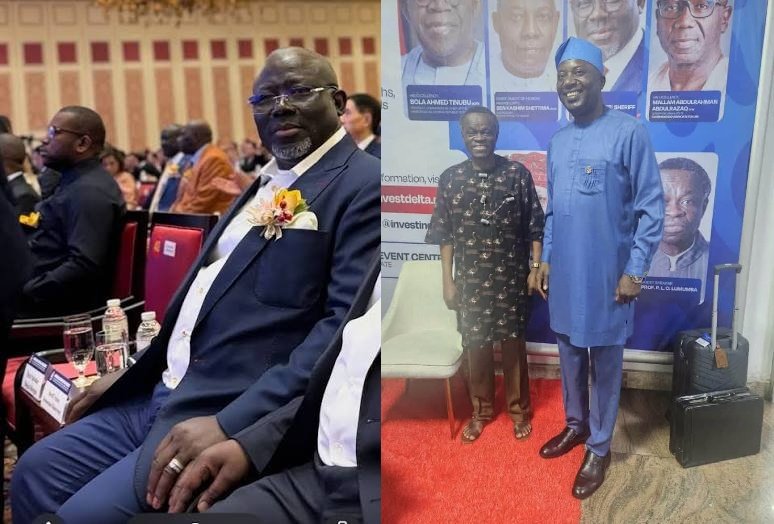
Renowned Pan-African scholar, Prof. Patrick Lumumba, has challenged Africans to stop looking outside the continent for development and investment, urging governments and businesses to begin believing in Africa’s capacity to finance and drive its own prosperity.
Key Highlights:
- Lumumba urged Africans to invest in Africa.
- Delta launched a $100m investment fund.
- Top leaders backed Oborevwori’s vision.
- Focus is on diversifying the economy.
- Investors were urged to seize opportunities.
Speaking at the Delta State Economic and Investment Summit 2026 in Asaba on Monday, Prof. Lumumba said Africa’s development would remain elusive if the continent continued to see foreign investors as the only source of capital while ignoring the enormous financial and intellectual resources within Africa.

“We still don’t think that fellow Africans are investors. We think our investors must be Malaysians, Brazilians or Chinese. That is not the case,” he said.
The Kenyan scholar urged Delta State to champion a new investment philosophy by deliberately attracting investors from across Africaz alongside partners from Europe, Asia and the Americas.
“I want to see Kenyans here. I want to see Namibians here. I want to see Sudanese, Ethiopians, Moroccans and Egyptians here because Africans must begin to believe that they have the intellectual and financial wherewithal to participate in the development of their continent,” he challenged.
According to him, once Africans begin investing in Africa, partnerships with countries outside the continent would become mutually beneficial rather than dependent.
“What we sometimes call development is not development; it is parasitism,” he declared.
Prof. Lumumba commended Delta State Governor, Sheriff Oborevwori, for recognising that Nigeria’s development would be driven from the states upward and for identifying strategic sectors capable of transforming the state’s economy.
“What gladdens my heart is that, in your own small way here in Delta, recognising that Nigeria must be built state by state, you are beginning to recognise the areas that ought to receive attention,” the academic stated.
While congratulating the governor, Prof. Lumumba urged the administration to leverage Delta State’s oil wealth, blue economy, agriculture, solid minerals and youthful population to build a globally competitive economy driven by innovation, research, skills development and reliable energy.
“You are doing a good job, but that job can be better. That job can be an African job. It can give meaning to the African Continental Free Trade Area and Africa’s Agenda 2063,” he said.
He also challenged the federal government to deepen African integration by removing barriers to the movement of people and investments across the continent, saying Nigeria, as Africa’s largest economy, should lead that process.
Prof. Lumumba’s remarks set the tone for the summit, where Governor Oborevwori unveiled a US$100 million (about ₦137.8 billion) Viability Gap Fund to de-risk private investments and accelerate industrialisation in Delta State.
Vice President Kashim Shettima also applauded Governor Oborevwori’s economic vision, saying the administration had demonstrated a clear commitment to building an economy beyond crude oil.
“The advantage is larger than its oil wealth. It resides in the conviction behind this government that the future of a people cannot be deposited in a single commodity,” he said.
Shettima described diversification as “an instinct of economic self-preservation” and praised the governor for recognising that sustainable development would be driven by ideas, institutions and enterprise.
He noted that Delta State’s coastline, ports, gas reserves, refining assets, agricultural potential, solid minerals and educated workforce positioned it among Nigeria’s leading investment destinations.
“There is no doubt that Governor Sheriff Oborevwori is devoted to leading Delta into a new era of productive expansion. The design of this summit reflects the seriousness of that purpose,” he added.
Earlier, Governor Oborevwori, said the summit represents the culmination of investment engagements his administration began in 2025 with economic missions to China and Brazil to attract strategic partnerships for Delta State’s development.
Describing the gathering as a practical step towards repositioning Delta State’s economy, Governor Oborevwori stressed that the summit was designed to connect ideas with capital, forge strategic partnerships and maximise the state’s comparative advantages.
“This summit is not another talk shop. It showcases our vision and strong will to reposition the state economy and enhance its competitiveness in business,” he said.
Read Also:
- Delta Orders Manhunt for Attackers of Governor Oborevwori’s Aide After Brutal Assault
- Delta Security Operatives Begs Governor Oborevwori Over None Payment of Five-Year Arrears, Inclusion in State Police
- If Endorsements Won Elections, Tinubu, Oborevwori Would Already Be Sworn In
He said Delta State with an economy estimated at about ₦17 trillion (approximately US$12.34 billion), abundant oil and gas reserves, vast agricultural land, rich solid minerals, a 163-kilometre coastline and a strategic location linking major markets, remained one of Nigeria’s most attractive investment destinations.
According to him, his administration’s MORE Agenda is anchored on private sector-led, data-driven development aimed at diversifying the economy, creating jobs and reducing dependence on oil.
The governor highlighted reforms including the establishment of the Delta State Ease of Doing Business Council, investment incentives, tax and levy waivers for qualifying investors and the earmarking of more than 12,000 hectares of farmland for commercial agriculture.
Governor Oborevwori also emphasised his administration’s fiscal discipline, disclosing that despite extensive investments in infrastructure, his government had not borrowed from any bank.
He noted that Delta State has also strengthened its security architecture, earning recognition as Nigeria’s safest state for oil and gas investments in 2024.
Announcing the Viability Gap Fund, the governor said the initiative demonstrated his administration’s resolve to ensure that agreements reached during the summit translate into real investments.
“I am pleased to announce that the government has set aside US$100 million, approximately ₦137.8 billion, as Viability Gap Funding to de-risk new investments in the state.
“This is a practical demonstration of our total commitment to ensuring that the agreements reached at this summit are executed without delay.
“This summit is not a talk shop; we are matching words with action,” he said.
The announcement drew immediate commendation from keynote speaker and Director-General of the World Trade Organization (WTO), Ngozi Okonjo-Iweala, who described Governor Oborevwori as an action-oriented leader committed to translating ideas into measurable outcomes.
“I want to congratulate Your Excellency on the development strides that you have been taking here,” she said.
“The reason I came is because you take action. The fund you just announced—over 100 million dollars—to de-risk investment is exactly the kind of thing we need.”
Okonjo-Iweala said Delta State possesses all the ingredients required to become Nigeria’s next major industrial hub alongside Lagos, citing its gas reserves, coastline, seaports, fertile agricultural land, youthful population and prudent fiscal management.
She urged the state to focus on Special Economic Zones, agro-processing, the blue economy, oil and gas, marine logistics, digital infrastructure and artificial intelligence while concentrating investments on strategic value chains capable of delivering the greatest economic returns.
“The true wealth of Delta State has never just been our oil and gas. It’s our people,” she said, expressing confidence that Delta could transform into “a diversified, inclusive and resilient sub-national economy.”
Anambra State Governor, Charles Soludo, also commended the improving macroeconomic environment created by the federal government’s reforms, saying Nigeria was now better positioned to attract investments.
Recalling why Anambra withdrew from a World Bank loan due to exchange rate distortions before the reforms, Governor Soludo said the situation has changed considerably.
He proposed closer institutional collaboration between Delta State and Anambra State following the completion of the Second Niger Bridge.
“I suggest that Delta and Anambra are now like twin cities because of the completion of the Second Niger Bridge. It’s similar to the relationship between New York and New Jersey,” the governor said.
Governor Soludo also praised the summit’s emphasis on networking and business deal-making, insisting that investment promotion should become “a habit and not an event.”
He further advocated increased patronage of Made-in-Nigeria products, arguing that doing so would create millions of jobs while strengthening local industries.
Also speaking, the Minister of Finance and Coordinating Minister of the Economy, Prof. Taiwo Oyedele, said Delta State is not searching for opportunities because its strengths had always been evident in its natural resources and enterprising people.
“The theme does not say ‘discovering strengths’ because Delta State’s strengths have never been hidden,” he said.
“The opportunities already exist. What is needed is the courage, leadership and determination to unlock them and turn them into real economic growth.”
Oyedele said the economic reforms introduced by President Bola Tinubu has strengthened public finances and created a more stable macroeconomic environment for investments.
He stressed, however, that macroeconomic stability alone would not guarantee prosperity.
“The responsibility of the federal government is to ensure macroeconomic stability. The responsibility of state governments is to transform that stability into prosperity by attracting investments, creating jobs and improving the quality of life of their people,” the minister added.
Describing Delta State as one of Nigeria’s most naturally endowed states, Oyedele said execution, rather than natural resources, would determine its economic success.
He urged investors to take advantage of the conducive business environment being created by both the federal government and Delta State.
The summit attracted senior government officials, diplomats, development partners, investors and business leaders from Nigeria, Brazil, China and other countries, with deliberations focusing on unlocking Delta State’s vast opportunities in agriculture, manufacturing, energy, solid minerals, marine services, technology and industrial development.