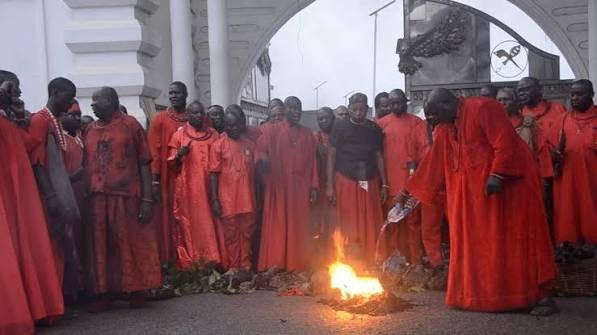
Traditional rulers of four communities in Uburu, Ohaozara Local Government Area of Ebonyi State, have invoked ancestral curses on individuals involved in kidnapping, ritual killings, theft, vandalism and other criminal activities, declaring that offenders will no longer have any hiding place.
Key Highlights
- Traditional rulers in four Uburu communities in Ebonyi State have invoked ancestral sanctions against criminals involved in kidnapping, ritual killings, theft, vandalism and other offences.
- The decision was reached after consultations involving residents of Uburu, Etiti Uburu, Enu-Uburu and Nweze Uburu.
- The monarchs said the move aims to restore moral values, strengthen community security and deter criminal activities.
- Eze Godwin Okoro Akpandu (De Ibom Eze II) said the communities reactivated ancestral institutions established by their forefathers to address rising insecurity.
- The traditional rites involved chief priests, community elders and contributions from residents.
The decision, announced after consultations with residents of Uburu, Etiti Uburu, Enu-Uburu and Nweze Uburu, is aimed at tackling the growing wave of insecurity and restoring the communities’ long-standing moral values.

Speaking with journalists at his palace, the traditional ruler of Enu-Uburu Autonomous Community, Eze Godwin Okoro Akpandu (De Ibom Eze II), said the four communities unanimously resolved to reactivate ancient cultural institutions handed down by their forefathers to confront rising criminality.
“We have invoked the ancient customs and ancestral sanctions handed down by our forefathers against anyone who engages in theft, vandalism, ritual killings, kidnapping and other criminal activities.
“The people unanimously agreed that this was necessary to restore sanity and protect our communities,” Eze Akpandu said.
The monarch explained that the traditional rites involved the participation of chief priests, community elders and financial contributions from members of the affected communities.
According to him, the ancestral curses cover crimes including ritual killings, housebreaking, vandalism of public infrastructure, conspiracy to kidnap and other acts capable of threatening peace and security.
He lamented the increasing incidence of ritual killings, theft of public facilities and the use of harmful charms, warning that such practices have undermined the values for which Uburu was once respected.
Eze Akpandu stressed that the exercise was not targeted at any individual or group, but was introduced solely to deter criminality and preserve communal peace.
“Our forefathers left us these traditional institutions to preserve morality, justice and peaceful coexistence. We have only activated what has existed from time immemorial to confront the disturbing rise in criminality,” he stated.
Responding to concerns about possible conflict with religious beliefs, the royal father maintained that the initiative does not contradict Christianity or any other faith.
“Christianity condemns stealing, murder and other forms of evil. What we have done is not against any religion. It is aimed at discouraging crime and ensuring that anyone who violates our communal values faces the consequences according to our tradition,” he said.
He also dismissed fears that the traditional process could be manipulated for personal vendettas, insisting that the invocation followed a transparent process involving the collective approval of elders and chief priests.
Read also:
- Foundation Awards Scholarships To 200 Indigent Ebonyi Students
- Governor Nwifuru Effects Major Cabinet Reshuffle, Reassigns Commissioners, Swears- In 2 New Appointees
- Ban On Raw Cocoa Export: Tinubu Unveils Plan To Process Product Locally, End Chocolate Imports
- Abia Crowned Champions At Maiden South-East Amateur Boxing Championship
“Anyone who attempts to abuse it will bear the consequences according to our customs,” he added.
The monarch further clarified that the decision was unrelated to the recent death of Miss Mary Habila, explaining that it formed part of a broader community initiative to combat insecurity and strengthen peaceful coexistence.
He called on other communities across Ebonyi State and the South-East to embrace positive cultural values as complementary tools for community policing and crime prevention.
Some residents who spoke to journalists, including Mr. Akpa Nnamdi, applauded the traditional rulers for the move, expressing optimism that the ancestral sanctions would help restore Uburu’s reputation as a peaceful and morally upright community.
The residents also urged the federal government to promote and preserve Nigeria’s cultural values, arguing that doing so would help sanitize society and significantly reduce crime across the country.