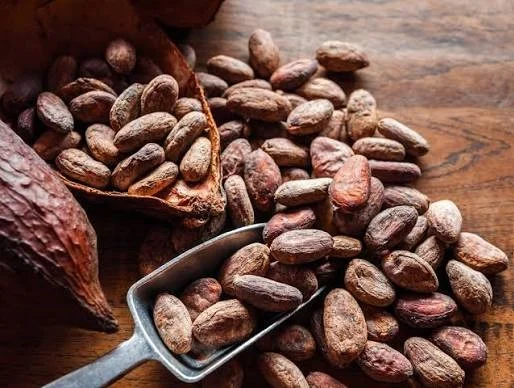
President Bola Tinubu has declared an end to Nigeria’s long-standing practice of exporting raw cocoa beans while importing finished chocolate products, unveiling a bold industrialisation agenda aimed at boosting local processing, creating jobs, increasing foreign exchange earnings, and strengthening Nigeria’s position in the global cocoa value chain.
Key Highlights

- Ban on raw cocoa export forms part of Tinubu’s value-addition strategy.
- Nigeria will prioritise local processing of cocoa into butter, chocolate and other finished products.
- Federal Government targets higher export earnings through value-added cocoa products.
- Bank of Industry commits fresh funding for cocoa processing and manufacturing.
- Nigeria seeks stronger alliance with Ghana, Côte d’Ivoire and Cameroon to reshape the global cocoa market.
- Proposed Abuja Declaration to promote regional processing, investment and coordinated pricing.
Represented by the Minister of Agriculture and Food Security, Senator Abubakar Kyari, at the Cocoa Value Addition Summit 2026 in Abuja on Tuesday, the President said Nigeria must stop exporting raw agricultural commodities without capturing their full economic value.
Speaking at the summit themed “From Bean to Brand: The Bean in My Hand, The Brand in Our Future,” Tinubu said the country was determined to reposition its cocoa industry through industrialisation, local manufacturing and export of finished products rather than raw materials.
## Ban on Raw Cocoa Export to Drive Local Manufacturing
Tinubu lamented that although Africa produces nearly 70 percent of the world’s cocoa, the continent earns only a fraction of the global chocolate industry’s estimated value of over 130 billion dollars, because processing, branding and manufacturing largely take place outside Africa.
He declared that the era of exporting raw cocoa beans without value addition must come to an end.
According to him, Nigeria will process its cocoa locally by producing cocoa butter, chocolate and other finished products before exporting them to international markets.
“Nigeria will no longer export raw beans while importing finished value. We will grind our beans at home, press our butter at home, make our chocolate at home, brand it at home and sell it to the world on our own terms,” the President stated.
Sagamu Processing Plant Signals New Direction
Tinubu revealed that Nigerian investors are already constructing what will become the country’s largest cocoa processing facility in Sagamu with a capacity of 70,000 tonnes, while Nigeria’s overall cocoa grinding capacity has exceeded 120,000 tonnes annually.
He added that the Bank of Industry (BOI) is prepared to finance viable cocoa value chain projects across the country.
Cocoa Industry Supports Over 300,000 Farming Families
The President disclosed that more than 300,000 Nigerian farming households cultivate cocoa across approximately 1.4 million hectares, making Nigeria responsible for between six and seven per cent of global cocoa production.
He noted that cocoa generated more than ₦3 trillion in export earnings when international prices exceeded 10,000 dollars per tonne, contributing almost one-quarter of Nigeria’s non-oil exports.
However, he stressed that future growth depends on processing cocoa domestically rather than exporting raw beans.
Federal Government Targets $1 Trillion Economy
Minister of State for Industry, Senator John Owan Enoh, described the summit as a major milestone in implementing President Tinubu’s industrial policy, saying Nigeria’s ambition is to export finished products instead of raw commodities.
According to him, the country’s focus has shifted from exporting anonymous cocoa sacks to exporting globally recognised Nigerian brands.
“If Nigeria truly wants to build a one-trillion-dollar economy, it cannot continue exporting raw materials while other countries earn the real wealth from processing and branding them,” Enoh said.
He also revealed that the Federal Government is working with Ghana, Côte d’Ivoire and Cameroon to establish a stronger African cocoa alliance capable of controlling about 75 per cent of global cocoa production.
BOI Commits Fresh Funding for Cocoa Value Chain
Managing Director of the Bank of Industry, Dr. Olasupo Olusi, announced that the bank is prepared to provide long-term financing across the cocoa value chain.
He disclosed that BOI disbursed over ₦164 billion in 2025 to more than 3,500 agro-processing businesses, while supporting nearly 48,000 smallholder farmers.
Olusi also announced a €60 million credit facility secured from the European Investment Bank to finance cocoa processing, packaging, ingredient manufacturing and chocolate production.
Read also:
- Tinubu Unveils Plan To Deliver 154,800 Affordable Homes Across Nigeria
- Tinubu Orders NIMC To Enrol All Nigerians Before End of 2026
- Calabar-Ebonyi- Benue- Kogi- Nasarawa-Abuja Superhighway Is Tinubu’s Flagship lnfrastructure- Umahi
“We are not approaching cocoa as a lending programme. We are building an industrial ecosystem,” he said.
Africa Pushes for Greater Control of Cocoa Industry
Chief Executive of the Ghana Cocoa Board, Ransford Abbey, called for stronger regional collaboration, noting that Africa currently produces between 75 and 77 per cent of global cocoa but receives less than 10 per cent of the value generated by the global chocolate industry.
He urged Nigeria and Cameroon to join the existing Ghana-Côte d’Ivoire cocoa partnership to strengthen Africa’s negotiating power in international markets.
“We do not need charity. We deserve equity. The time has come for Africa to process its own wealth, protect its farmers and negotiate with one voice in the global cocoa market,” Abbey said.
The summit concluded with the adoption of the Cocoa Value Addition Accord and the proposed Abuja Declaration, both aimed at accelerating domestic processing, attracting investments, improving farmers’ incomes and deepening cooperation among Africa’s major cocoa-producing countries.