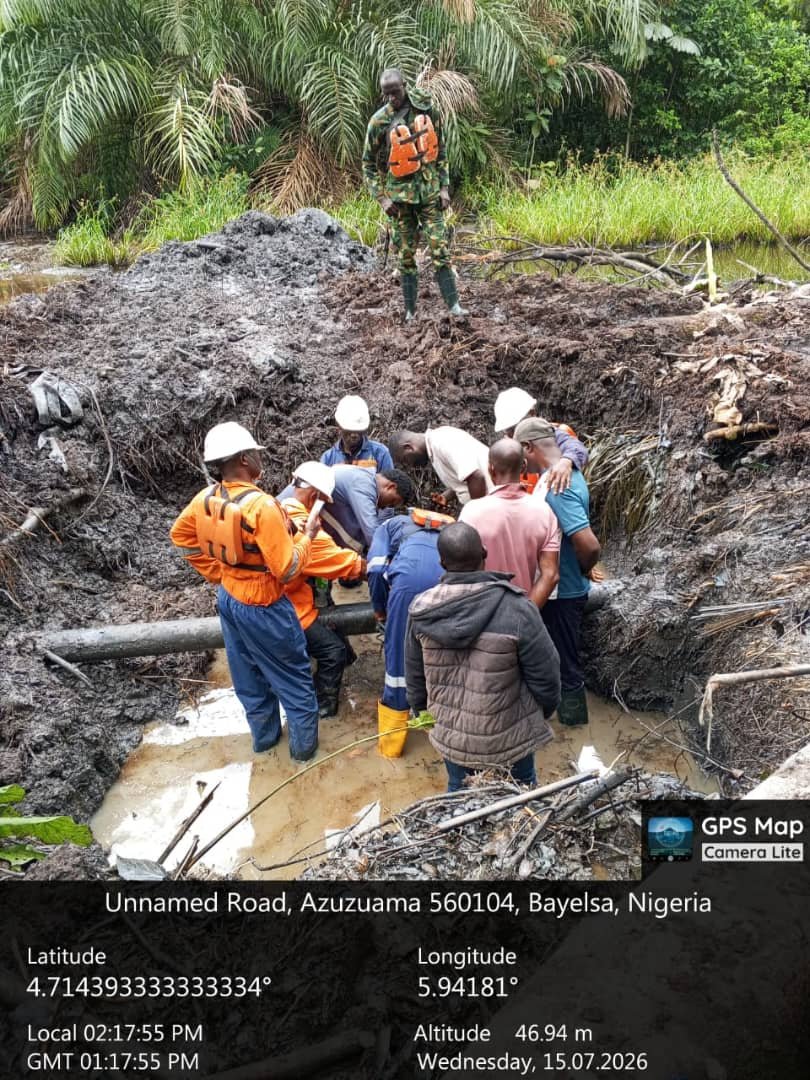
The Bayelsa Oil Spill Investigation has taken a fresh twist as the Azuzuama community in Southern Ijaw Local Government Area rejected the outcome of the Joint Investigation Visit (JIV) into the June 2026 oil spill on Oando’s six-inch Azuzuama-Tebidaba flowline, insisting the findings do not reflect the true cause of the incident.
Key Highlights
- Azuzuama community rejects Oando’s Joint Investigation Visit (JIV) findings.
- Regulators attribute the spill to “induced corrosion,” while residents blame equipment failure and natural corrosion.
- Disagreement among stakeholders leaves the JIV inconclusive.
- Community raises concerns over an alleged second underwater leak.
- ECARD calls for immediate cleanup, pipeline repairs and an independent investigation.
A Joint Investigation Visit (JIV) is the statutory process used to determine the cause, estimated volume and environmental impact of an oil spill, forming the basis for remediation and compensation. The exercise involves representatives of the operating oil company, regulators, host communities and the state Ministry of Environment.

The oil spill occurred on June 25, 2026, along Oando’s six-inch Azuzuama-Tebidaba flowline.
According to a field report by the Environmental Conservation Agriculture and Rural Development (ECARD), the host community rejected the investigation’s conclusion that the spill resulted from induced corrosion, arguing that the evidence points instead to equipment failure and long-term pipeline corrosion.
The disagreement among Oando, government regulators and community representatives prevented the Joint Investigation Visit from reaching a consensus, leaving the official cause of the spill unresolved.
Director of Petroleum and Pollution at the Bayelsa State Ministry of Environment, Engr. Reuben Enai, who participated in the investigation, maintained that the rupture resulted from induced corrosion.
He explained that visual examination of the pipeline revealed burn marks on its protective coating, suggesting that corrosive substances had been deliberately applied to the upper section of the pipe.
According to Enai, natural corrosion could not have caused damage at the 12 o’clock (top) position of the pipeline.
However, community leaders rejected the assessment, insisting that visible rust on the exposed pipeline indicates ageing infrastructure and equipment failure rather than sabotage.
The dispute persisted despite several Joint Investigation Visits involving Oando, the National Oil Spill Detection and Response Agency (NOSDRA), the Bayelsa State Ministry of Environment and representatives of the host community.
ECARD disclosed that the latest inspection conducted on July 15 also failed to produce an agreed conclusion, leaving the investigation unresolved.
Chairman of the Azuzuama Community Development Committee, Angasei Perediseghebofa, said visible corrosion on the pipeline supports the community’s position.
He further alleged that testing devices introduced during the investigation malfunctioned, making it impossible to establish the spill’s cause with certainty.
Read also:
- Cause Of Oil Spill: Anxiety Mounts In Bayelsa As Oando Delays Investigation Report
- Apex Isoko Youth Body Issues 72-Hour Ultimatum to Heritage Energy Over Oil Spillage in Uzere
- Oil Spillage: Mulade Demands Environmental Emergency Declaration Over Alleged Delta Oil Spill
Vice Chairman of the committee, Uyabara Boneghen, also questioned the reliability of the testing equipment, claiming it produced identical readings at different locations.
He further raised concerns over a suspected second leak beneath a river platform, alleging that bubbling gas indicates another environmental hazard that remains uninvestigated.
Meanwhile, ECARD has called on Oando to immediately contain the spill, clean up all contaminated areas and repair the suspected underwater leak to prevent further environmental degradation.
The organisation also urged regulators to conduct a separate investigation into the alleged underwater leak, warning that prolonged hydrocarbon discharge could worsen pollution, destroy aquatic ecosystems and threaten the livelihoods of affected communities.