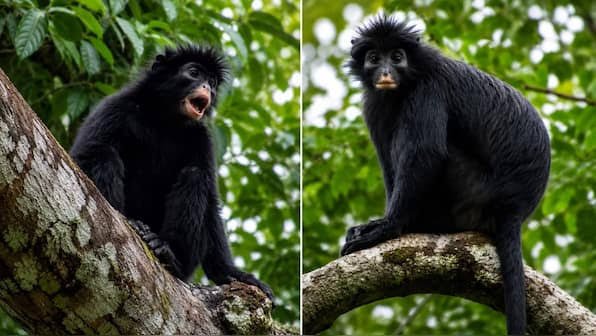
A team of international researchers has confirmed the discovery of a new monkey species with striking pinkish-orange lips in the forests of the Democratic Republic of Congo (DRC), marking only the fifth African monkey species to be formally identified in the past 75 years.

Key Highlights:
- Scientists confirm discovery of a new monkey species in the Democratic Republic of Congo.
- Newly identified primate has distinctive pinkish-orange lips and black fur.
- Species has been officially named Colobus congoensis.
- Discovery followed years of field research, photography, genetic analysis and audio recordings.
- Researchers say the species has a limited habitat and faces threats from bushmeat hunting.
- Scientists hope the discovery will strengthen conservation and legal protection efforts.
The elusive black-furred primate, locally known as Likweli, was discovered living high in the tree canopy of Lomami National Park in central-eastern DRC. Although conservationists first spotted the monkey in 2008, they were only able to capture a blurry photograph at the time.
A second encounter nearly a decade later prompted extensive scientific investigations involving field observations, photography, audio recordings and genetic testing to determine whether the animal represented a previously unknown species.
Read Also:
- DR Congo orders players into isolation ahead of World Cup over Ebola outbreak
- 6 Americans exposed to Ebola during DR Congo outbreak
- WHO declares Ebola outbreak in DR Congo a global health emergency after 80 people die
- Governor Eno Approves ₦1.3bn Bursary Fund, Raises Students’ Bursary to ₦50,000
- Governor Bago Commissions State-Of-The-Art Pharma‑Grade Central Medical Store
- CAC to Delist 100,000 Companies Over Annual Returns Default, Gives 90-Day Compliance Deadline
- Imo Assembly Directs Urgent Rehabilitation Of State School For Deaf Students
- All Farmers Association Of Nigeria Laments Exclusion Of Rivers Farmers From FG Input Distribution
The findings, published in the scientific journal PLOS One, confirmed the animal as a distinct species, officially named Colobus congoensis in recognition of the Democratic Republic of Congo’s rich biodiversity.
Lead researcher Junior Amboko, a PhD student at Florida Atlantic University, described the discovery as a remarkable scientific achievement, noting that the new monkey species is exceptionally elusive and rarely seen, even by communities living close to its forest habitat.
As part of the research, scientists interviewed residents in 52 villages surrounding the national park. However, only people from eight communities reported ever seeing the rare primate, highlighting its limited distribution and secretive nature.
The newly discovered species belongs to the colobus monkey family, a group of leaf-eating, thumb-less primates that play a vital ecological role by dispersing seeds and supporting forest regeneration.
Researchers believe the monkey’s distinctive orange facial markings may help individuals recognise one another or attract potential mates. The species is also known for producing a loud, roaring vocalisation that often reveals its presence before it can be seen.
Despite the excitement surrounding the discovery, scientists warned that the new monkey species appears to occupy a restricted habitat and faces growing threats from bushmeat hunting and habitat pressures.
They expressed hope that the formal scientific recognition of Colobus congoensis would strengthen conservation initiatives, attract greater international attention and provide stronger legal protection for the species.
Further scientific studies are expected to focus on estimating the monkey’s population size, mapping its distribution and understanding its behaviour to support long-term conservation efforts.