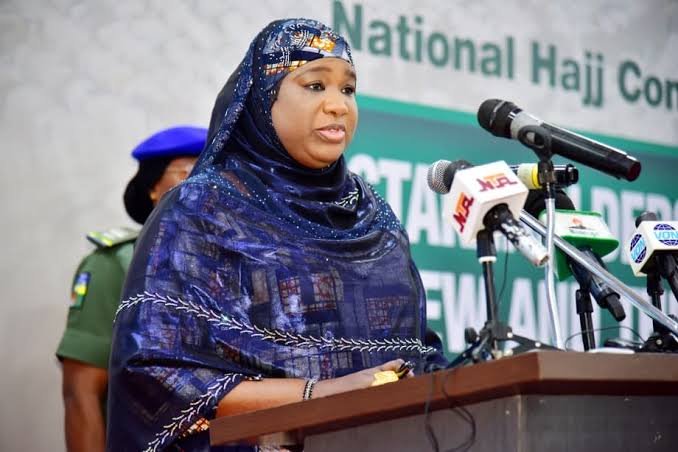
The Minister of State for the Federal Capital Territory (FCT), Dr. Mariya Mahmoud, has called for comprehensive reforms in Nigeria’s Hajj administration to build a transparent, efficient, accountable and pilgrim-centred system capable of delivering world-class services.
The call was contained in a statement issued by her Special Assistant on Media, Austine Elemue, following the stakeholders’ summit on post-2026 Hajj review and NAHCON reform held at the NAF Conference Centre, Abuja.

Speaking at the summit, Mahmoud described the theme: “Repositioning Nigeria’s Hajj Industry as a Model of Service Excellence,” as timely and significant, noting that it reflects the collective resolve to improve service delivery for Nigerian pilgrims.
She stressed that Hajj is not only a sacred religious obligation but also an exercise that requires meticulous planning, effective coordination and exceptional service delivery.
“Every pilgrim deserves an experience that reflects dignity, safety, comfort and professionalism. Achieving this requires unwavering commitment, transparency and accountability from all stakeholders,” she said.
Read Also:
- FCT minister links Tinubu’s ‘Renewed Hope Agenda’ to health sector reforms
- FCT minister sympathises with Singer Market fire victims in Kano
- FCT minister provides free dental outreach to 1,500 Kano residents
The minister commended the National Hajj Commission of Nigeria (NAHCON) for convening the summit to review the 2026 Hajj operations, noting that an honest assessment of achievements and challenges is essential to strengthening public confidence and driving institutional reforms.
Mahmoud reaffirmed the commitment of the Federal Capital Territory Administration to initiatives aimed at improving public service delivery, emphasising that collaboration among government agencies, service providers, state pilgrims’ welfare boards and religious leaders remains critical to building a more efficient and sustainable Hajj management system.
She urged participants to contribute practical ideas and global best practices that would enhance efficiency, accountability, innovation and pilgrim satisfaction.
Mahmoud also applauded President Bola Tinubu for his commitment to institutional reforms under the Renewed Hope Agenda, saying the administration’s emphasis on transparency, efficiency and people-centred governance continues to strengthen key national institutions, including those responsible for Hajj administration.
She further acknowledged the leadership of the Minister of the FCT, Nyesom Wike, for fostering an environment that supports reforms and excellence in public service delivery.
Chairman and Chief Executive Officer of NAHCON, Ambassador Ismail Yusuf, said the summit was convened not only to review the 2026 Hajj exercise but also to reposition Nigeria’s Hajj management system for improved performance.
He noted that Saudi Arabia’s Vision 2030 reforms are transforming pilgrimage administration and urged stakeholders to view the summit as a platform for accountability and institutional improvement.
“Every shortcoming must be identified and matched with a remedy. There are things we achieved, and there are things we must fix,” Yusuf said, adding that the gains recorded during the 2026 Hajj operation should be consolidated and institutionalised.