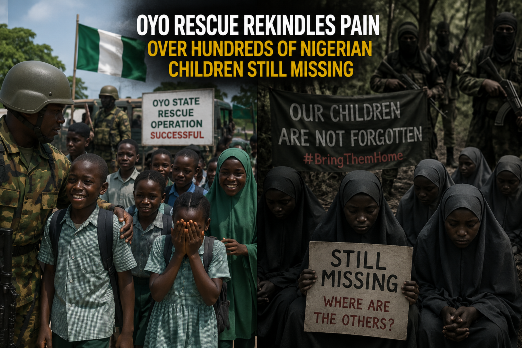
The successful rescue of abducted pupils, teachers and caregivers in Oyo State has brought relief and celebration across Nigeria.
Key Highlights:
- Oyo’s successful rescue operation has renewed hope but also highlighted children still missing after past abductions.
- Many families continue to wait for answers years after kidnappings across Nigeria.
- The Chibok and Dapchi cases remain powerful symbols of the country’s kidnapping crisis.
- Several other school abductions have left some victims still unaccounted for.
- Experts are calling for stronger intelligence, better school security, and a national missing persons database.
However, it has also refreshed a painful national question: what about the hundreds of Nigerian children abducted in previous attacks who are still missing and have never returned home?

While the Oyo operation demonstrated that security agencies can achieve results when intelligence, coordination and political will align, it also reminded Nigerians that many families have waited months and in some cases years for similar good news that has never come.
The celebration over the Oyo rescue has quickly given way to renewed calls for authorities to intensify efforts to locate children still held by terrorists and criminal gangs across the country.
Families of long-missing victims say every successful rescue elsewhere revives both hope and heartbreak.
The most enduring symbol of Nigeria’s kidnapping crisis remains the 2014 abduction of the Chibok schoolgirls in Borno State. Although dozens have been rescued or released over the years, many are still unaccounted for more than a decade later.
The tragedy did not end in Chibok. In 2018, terrorists abducted more than 100 schoolgirls from Dapchi in Yobe State. Most were later released, but Leah Sharibu remains in captivity after reportedly refusing to renounce her Christian faith.
Beyond these globally recognised cases, several other mass abductions continue to haunt affected communities.
In recent years, students were kidnapped from Government Science College, Kagara, in Niger State; Greenfield University in Kaduna State; Federal Government College, Birnin Yauri, in Kebbi State; Bethel Baptist High School in Kaduna State; and schools in Kuriga, Kaduna State.
While many victims eventually regained their freedom through rescue operations, negotiations or other interventions, others remain missing or their whereabouts are still unknown.
Read also:
- Nigeria’s Endless Security Battle: The Dark History of Boko Haram, Banditry, Insurgency, Kidnapping, Army Response
- Suspected Boko Haram kills 15, scores injured in Adamawa community
- Reactions trail graduation of 744 repentant Boko Haram terrorists
Fresh concerns have also emerged over recent attacks in the North-East, where reports indicate that dozens of children abducted during coordinated assaults in Borno State are yet to be accounted for despite ongoing security operations.
The pattern raises uncomfortable questions about Nigeria’s response to mass kidnappings.
Why do some cases receive swift and sustained security attention while others gradually disappear from public discourse? What support exists for families whose children remain in captivity long after media headlines fade?
Security analysts argue that Nigeria needs a comprehensive national missing persons database, stronger intelligence-led rescue operations, improved protection for schools and sustained public accountability on unresolved kidnapping cases.
The Oyo rescue deserves commendation because it demonstrates that successful rescue missions are possible.
But the real measure of Nigeria’s commitment will not be the celebration of a single operation; it will be the determination to ensure that every missing child receives the same urgency, regardless of where they were abducted or how long they have been missing.
Until then, every successful rescue will continue to remind Nigerians of the children who are still waiting to come home.