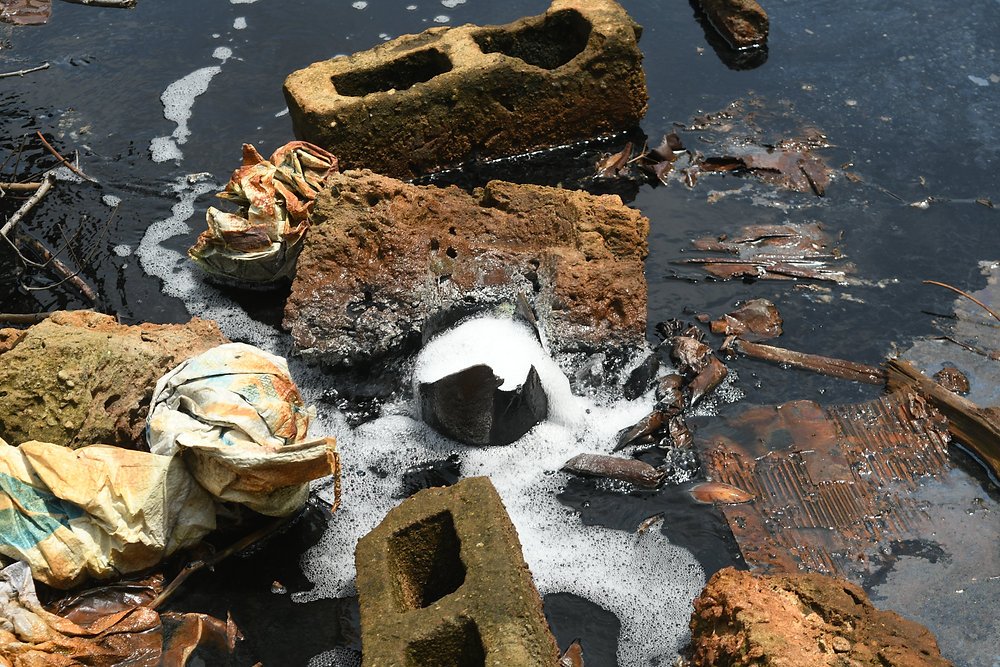
A social media video of a community with boiling waters is the immediate trigger of this intervention in the form of an essay. At first, I thought it was an AI generated image like the video in which it was falsely claimed that fish was raining from heaven like water! But I took the extra step to research into the video and what I found further was scary, familiar (in the sense of how the federal authorities treat the minorities), and baffling thereby eliciting my curiosity. The community in question is Bille located in my part of the country, the much-oppressed Niger Delta the golden goose which lays the nation’s eggs! The story of oil discovery in the Niger Delta is one of criminal neglect, state fraud, and insulting tokensim.
Bille Kingdom/Community is located in Degema Local Government Area of Rivers State. It is a coastal town in the oil-producing Niger Delta region. One of the islands and coastal communities in Rivers State, it is accessible mostly by boat/water. Bille is located close to mangrove swamps and rivers, with extensive oil and gas infrastructure like oil wells and pipelines nearby. It is instructive that it is within the OML 18 corridor.

Since October 2025, Bille Kingdom has been gripped by an environmental emergency: water in rivers, swamps, mangroves, and even household wells began “boiling” with gas and a sulphurous smell. Residents report methane bubbling to the surface, flames erupting from water, and contamination of the community’s main sources of drinking water. What began as a strange natural phenomenon has become a threat to health, education, livelihoods, and human rights. This essay examines the crisis and offers concrete suggestions to stop it.
Read Also:
- 2027: The Weight of Choice for Nigeria’s Future
- Angwan Rukuba: Why Mutfwang got It right
- President Trump shocking praise of Remi Tinubu – Is Tinubu’s $9 Million lobby contract at work?
The Nigerian Upstream Petroleum Regulatory Commission NUPRC, NOSDRA, and oil operators have carried out investigations and point to methane gas seepage from underground into surface water and soil. Preliminary assessments have not linked it directly to pipeline leaks or oil spills, but have described it as a “subsurface phenomenon”. By the way, Bille sits close to extensive oil and gas infrastructure, and residents suspect industrial activity, though the exact trigger remains under investigation.
The impact, we are told, has been severe and multi-layered. Wells which are used for drinking have been polluted. Children in a local school fell ill with vomiting and were forced to relocate. Exposure occurs through drinking, skin contact, and inhalation.
As it is with polluted communities, fishing and farming, the community’s main occupations, have been disrupted. Their protest placards read: “No farming, no fishing, no livelihood anymore in Bille”. Pupils were moved out of Bille for safety, breaking learning continuity with serious implications for the future of those kids.
To be sure, the sight of “bubbling water with flames erupting” has created fear and anxiety across the community. FG agencies have conducted Joint Investigation Visits and collected samples, but final laboratory results are still pending. NUPRC has promised potable water and fire trucks, and Minister Ekperikpe Ekpo reaffirmed FG’s commitment to a permanent solution. Civil society groups, however, argue that action has been slow and transparency lacking.
Research shows that Bille is not the only location where methane surfaces in water. In arctic and sub-arctic lakes. Example is in Alaska USA where researchers ‘documented lakes that look like they are “violently boiling’ with methane. In Siberia, similar ‘thaw lakes emit methane mostly through ebullition/bubbling – 95% 0f their methane release’. It is also found in Lake Baikal Russia, Lake Edward, Lake Nyamusingire, and Lake George in East Africa. Lake Sonachi in Kenya produces ‘high dissolved methane with strong ebullition potential if disturbed’. It is also found in coastal areas in Puget Sound Washington, USA, and Three Gorges reservoir in China.
The key difference between Bille and these other ones is that they are natural. These are ‘permafrost thaw, organic sediments, or geological seeps. Bille is abnormal because it is a populated community where people live.
This therefore is a call on NUPRC and NOSDRA to publish all JIV findings and lab data without delay. Independent geologists and environmental scientists should be included to rule out bias and identify whether the seepage is natural, induced by hydrocarbon activity, or both. It is an emergency.
As a stop gap, the government should deploy water tankers, boreholes with sealed casing, and filtration systems to every ward while wells remain contaminated. Mobile clinics to test residents, especially children, for exposure to methane and hydrogen sulphide is imperative. Also, government should install gas detectors and fire suppression equipment in vulnerable areas, as NUPRC has proposed.
If investigations trace the seepage to abandoned wells, fractured formations, or leaking infrastructure, FG should mandate operators to cap, seal, or depressurize the source. Where it is a natural geological vent, engineering solutions such as venting wells or impermeable barriers may be required.
In terms of Long-Term Environmental and Livelihood Restoration, government should remediate water bodies and soil to restore fishing and farming, establish a Bille Environmental Monitoring Committee with community, government, and industry representatives for continuous monitoring. Also, there should be compensation and Alternative Livelihoods for the people of Bille. It is only fair and just for government through its agencies provide support to families who lost income during the crisis.
It is noteworthy that CSOs like Social Action and Amnesty are calling for a state of emergency, safe water, and transparent findings in the Bille environmental crisis and health hazard. It is on record too that Minister Ekperikpe Ekpo said that “the investigation is still ongoing” and FG returned to engage Bille because community cooperation is critical. Final results are still being awaited for “definitive scientific clarification”. How long shall we wait before real action takes place?
The Bille “boiling water” is not a spectacle; it is a warning. Methane seepage has contaminated water, displaced children, and broken livelihoods in a community that already bears the weight of oil-producing environments. Stopping it will require urgent science, transparent governance, immediate relief, and long-term remediation. The primary duty of government, as Minister Ekpo stated, is to protect the welfare and security of the people. Bille deserves that protection now, not later.
Hope Eghagha
heghagha@yahoo.com