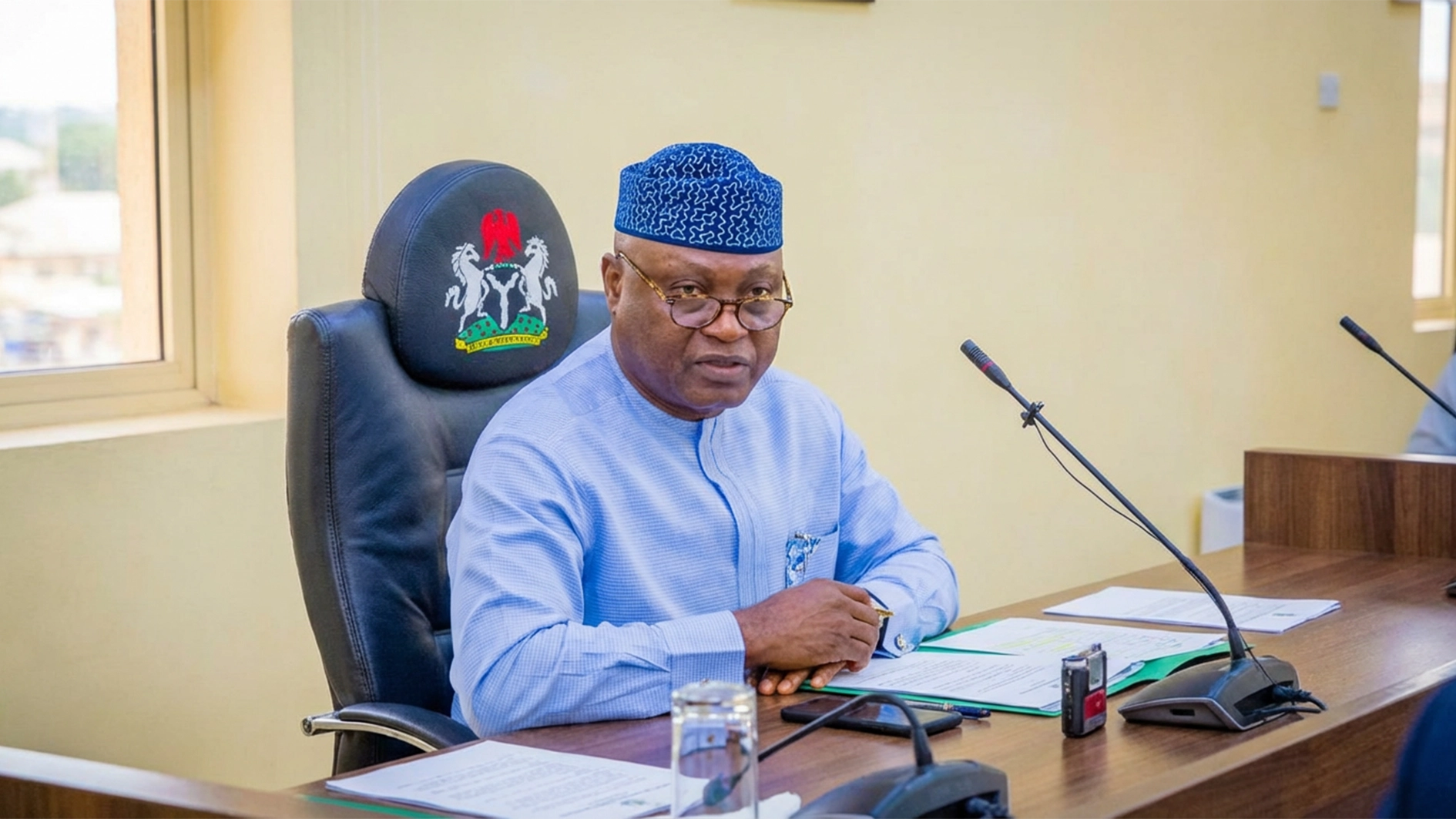
Governor Biodun Oyebanji’s landslide re-election victory in Saturday’s Ekiti State governorship election has not only secured him another four years in office, but has also fundamentally altered the state’s political landscape, raising questions about the future of opposition politics in a state long known for its fiercely competitive electoral contests.
Key Highlights:
The outcome of the election, in which Oyebanji of the All Progressives Congress (APC) secured 319,224 votes against the 40,543 votes recorded by the Peoples Democratic Party (PDP) candidate, Wole Oluyede, and the 12,872 votes polled by the African Democratic Congress (ADC) candidate, Dare Bejide, represented one of the most decisive victories in the political history of Ekiti State.

For many observers, however, the significance of the election goes beyond the numbers announced by the Independent National Electoral Commission (INEC). The result has become a case study in political coalition-building, elite consensus and the strategic neutralisation of opposition forces.
Read Also:
- Ekiti Decides 2026: How Oyebanji’s Political Masterstroke Crushed Opposition, Reshaped Ekiti Politics, Boosted APC’s 2027 Calculations
- Factional fire in Ekiti APC: How consensus politics and Abuja interference could cost Tinubu 2027
- Ekiti Election 2026: INEC Records Over 1.05 Million Registered Voters as PVC Collection Reaches 97.1%
- Ekiti Driver Claims He Borrowed ₦3.5m to Campaign for Tinubu, Bamidele, Fatoba
Unlike previous governorship elections in the state, where incumbents faced formidable opposition coalitions, Mr Oyebanji entered the race with the support of influential political actors cutting across party lines, effectively transforming what should have been a competitive election into a near coronation.
A State Known for Electoral Battles:
Since the return of democratic rule in 1999, Ekiti has built a reputation as one of Nigeria’s most politically vibrant states. Governorship elections in the state have often been fiercely contested, producing dramatic shifts in power between the APC and the PDP.
Former Governors Ayodele Fayose and Kayode Fayemi, epitomised the intense rivalry that defined Ekiti politics for more than a decade. Fayose defeated Fayemi in 2014, only for Fayemi to return and reclaim power in 2018. Neither man enjoyed the luxury of serving two consecutive terms. Instead, each had to fight political battles, lose power and later return to complete a cumulative eight years in office.
Against this backdrop, Oyebanji’s victory stands out. Not only did he secure a second consecutive term, he did so with margins rarely seen in the state’s electoral history. His triumph was made possible by an unusual convergence of political interests that transcended traditional party boundaries.
The Coalition That Changed Everything:
Months before the election, political analysts had begun noticing a remarkable trend. Former political rivals who had spent years battling one another appeared united behind the incumbent governor.
Perhaps the most significant endorsement came from former Governor Ayodele Fayose, one of the PDP’s most influential figures and a politician whose political machinery once dominated Ekiti politics.
Although Fayose repeatedly insisted he remained a member of the PDP, his public comments left little doubt about his preference for Oyebanji. Weeks before the election, he openly predicted a landslide victory for the governor and repeatedly criticised the opposition for lacking cohesion.
His influence in Ekiti Central Senatorial District proved crucial. Political observers noted that campaign materials supporting Oyebanji dominated communities where Fayose’s political network remains strongest.
The governor also benefited from the support of former Senate Minority Leader and former Deputy Governor, Abiodun Olujimi. Once a prominent PDP figure and long-time rival of Fayose, Mrs. Olujimi mobilised political structures across Ekiti South Senatorial District in support of the APC candidate. Her involvement effectively neutralised what had traditionally been a strong opposition base.
In the North, former House of Representatives member Bimbo Daramola emerged as one of the governor’s most active campaigners. Through his “BAO Walk” initiative, Mr Daramola spent months traversing communities, engaging voters and building support for the governor.
Former Governor Kayode Fayemi, though less visible than other political figures, also refrained from opposing the governor. His appearances alongside Oyebanji at official functions and his refusal to back any rival candidate were widely interpreted as tacit endorsement.The combined effect of these alliances was unprecedented. For perhaps the first time in recent memory, Ekiti’s major political power centres were aligned behind a single candidate.
Opposition Without Structure:
While the APC consolidated support, opposition parties struggled to establish momentum. The PDP entered the election weakened by internal divisions and the inability of its leaders to unite behind a coherent strategy. The emergence of ADC candidate Dare Bejide provided an alternative platform for dissatisfied politicians, but it also fragmented opposition votes. By election day, many communities reported little visible opposition presence.
Residents interviewed across several local government areas consistently described the race as one-sided. The absence of strong opposition structures became particularly evident in the results. Oyebanji not only won statewide but swept all 16 local government areas. Even in areas traditionally regarded as opposition strongholds, the APC recorded commanding victories.
Perhaps the most symbolic outcome occurred in Efon Local Government Area, where the PDP candidate Wole Oluyede suffered defeat in his home base. The result reinforced perceptions that the opposition lacked the organisational strength necessary to challenge the incumbent.
The Insecurity Question:
Yet, the election was not without controversy. In the days leading up to the poll, insecurity emerged as one of the dominant issues. Particular attention focused on the abduction of schoolchildren who remained in captivity on the eve of the election. The incident generated widespread concern and criticism among residents. Many voters questioned the government’s handling of the crisis and contrasted the response with efforts undertaken by neighbouring states facing similar security challenges.
Ordinarily, such an issue could have significantly damaged an incumbent seeking re-election. However, analysts argue that Oyebanji’s political coalition insulated him from the electoral consequences that might otherwise have followed. According to several observers, the governor’s broad support among influential political actors overshadowed public dissatisfaction in some quarters.
The election thus highlighted an enduring reality of Nigerian politics: while governance performance matters, elite consensus can sometimes prove equally decisive.
Election Day and the Results:
The governorship election recorded substantial participation. INEC reported that 384,940 voters were accredited out of the state’s 988,251 registered voters. A total of 382,109 votes were cast, while 375,777 were declared valid. When results began arriving from polling units and collation centres, the scale of Mr Oyebanji’s lead quickly became apparent.
The APC dominated both urban and rural communities. Its strongest showing came in Ado-Ekiti, the state capital, where the governor secured more than 38,000 votes. Other significant victories were recorded in Irepodun/Ifelodun, Ekiti West, Ikole and Ekiti East. The closest contest occurred in Ikere Local Government Area, home of the PDP candidate.
Even there, however, the APC maintained a clear advantage. By the time final results were announced, the outcome was beyond dispute. Returning Officer Adenike Oladiji, Vice Chancellor of the Federal University of Technology, Akure, formally declared Mr Oyebanji re-elected after satisfying the constitutional requirements.
Allegations of Vote-Buying:
Despite the margin of victory, opposition parties rejected the outcome. ADC candidate Dare Bejide described the election as lacking credibility and alleged widespread vote-buying and intimidation. He argued that the scale of financial inducement witnessed during the election undermined the integrity of the process. Mr Bejide also claimed that preliminary reviews of polling unit results revealed cases of over-voting and alterations.
The candidate vowed to analyse the election further before determining his next course of action. His concerns echoed those raised by election observers. The Nigerian Bar Association’s Election Working Group, led by former INEC National Commissioner Festus Okoye, cited reports of vote-buying, voter inducement and isolated technical challenges involving the Bimodal Voter Accreditation System (BVAS).
The association called for investigations into reported electoral malpractices and urged authorities to strengthen enforcement mechanisms. While these concerns did not alter the outcome, they reinforced longstanding debates about the quality of elections in Nigeria.
What the Victory Means for Tinubu:
Beyond Ekiti, the election carries broader political implications. The result is already being interpreted within the context of preparations for the 2027 general elections. President Bola Tinubu was among the first national leaders to congratulate Oyebanji, describing the outcome as a vote of confidence in continuity and people-centred governance. The APC leadership has similarly framed the result as evidence that voters remain receptive to the party despite economic difficulties associated with ongoing reforms.
Governor Hope Uzodimma, chairman of the Progressive Governors Forum, argued that the election demonstrated the strength of the APC ahead of 2027. Ogun State Governor Dapo Abiodun made a similar assessment, suggesting that the scale of the victory could offer insight into future electoral trends. Whether that interpretation proves accurate remains uncertain. Governorship elections are often influenced by local dynamics that differ significantly from national contests. Nevertheless, the APC is likely to use the Ekiti result as a psychological boost and organisational template for future elections.
The End of Competitive Politics?
Perhaps the most intriguing question arising from the election is what it means for democracy in Ekiti State. On one hand, the governor’s victory reflects impressive political organisation and coalition-building. On the other, the near absence of a viable opposition raises concerns about the health of democratic competition.
Strong democracies depend not only on effective governments but also on credible opposition parties capable of holding those governments accountable. The collapse of opposition structures in Ekiti may provide short-term stability, but it could also reduce political accountability over time.
Several analysts argue that the election exposed deeper weaknesses within opposition parties. Without internal cohesion, strong grassroots mobilisation and persuasive alternatives to incumbent administrations, opposition parties risk becoming increasingly irrelevant.
For the PDP, the election result represents another painful setback in the South-West. The party must now confront difficult questions about leadership, organisation and electoral strategy. The ADC, despite attracting some dissatisfied politicians, also faces the challenge of transforming protest support into a sustainable political movement.
The Road Ahead:
For Governor Oyebanji, the election victory brings both opportunity and responsibility. The overwhelming mandate provides him with political capital unmatched by many governors across the country. However, it also raises expectations. Issues such as insecurity, youth unemployment, infrastructure deficits and economic development will continue to shape public perceptions of his administration.
Having secured support from virtually every major political bloc in the state, the governor can no longer attribute governance challenges to political opposition. The responsibility for delivering results now rests squarely with his administration. The election may have settled the immediate political contest, but the larger test lies ahead.
How Oyebanji utilises his second term will determine whether his landslide victory is remembered merely as an extraordinary electoral achievement or as the beginning of a transformative chapter in Ekiti’s development.
For now, one conclusion appears inescapable: the 2026 governorship election has redrawn Ekiti’s political map, strengthened the APC’s position in the South-West and offered a glimpse into the alliances and calculations that may shape Nigeria’s political future heading into 2027.