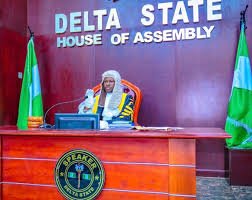
The Delta State House of Assembly has disclosed that it passed five key bills and is currently considering several others aimed at strengthening security, public health, revenue administration, tenancy relations and cybercrime regulation as part of its legislative interventions over the past year.
Key Highlights
- The Delta State House of Assembly passed five major bills over the past year, covering security, revenue administration, budgeting, and anti-cultism reforms.
- Speaker Guwor Emomotimi Dennis disclosed that 11 bills were received during the Assembly’s third session, with four already signed into law and one awaiting assent.
- Lawmakers are currently considering strategic legislation on cybercrime prevention, public health, tenancy regulation, anti-discrimination protections, and gaming oversight.
- The Assembly established a Post-Legislative Scrutiny Department with support from Westminster Foundation for Democracy to monitor the effectiveness and implementation of state laws.
- Delta became the second state in Nigeria after Oyo State to create a dedicated post-legislative scrutiny unit, aimed at ensuring laws deliver tangible benefits to citizens.
Speaker of the House, Rt. Hon. Guwor Emomotimi Dennis, made the disclosure on Thursday during a press briefing marking the third anniversary of the 8th Assembly, where he outlined the legislature’s achievements and ongoing reforms.

According to the Speaker, the House received a total of 11 bills during its third session, comprising five executive bills and six private members’ bills, with four already signed into law by Governor Sheriff Oborevwori and one awaiting assent.
Among the bills passed by the Assembly were the Delta State Anti-Terrorism and Anti-Cultism (Amendment) Bill, 2025, the Delta State Revenue Service Bill, 2026, the Supplementary Appropriation Bill, 2025, the Appropriation (Amendment) Bill, 2024, and the Delta State Appropriation Bill, 2026.
Guwor said several other strategic bills remain under active consideration, including the Delta State Cybercrime Prohibition and Prevention Bill, the Violence Against Persons (Amendment) Bill, the HIV/AIDS and Hepatitis B/C Anti-Discrimination, Prevention and Protection Bill, the Delta State Public Health and Hygiene Bill, the Landlord and Tenant Bill, and the Delta State Gaming Board Bill.
The Speaker described the legislative agenda as evidence of the Assembly’s commitment to addressing contemporary social, economic and security challenges confronting the state.
Highlighting one of the landmark bills passed during the period, Guwor said the Delta State Revenue Service Bill was designed to modernise revenue administration and eliminate multiple taxation.
“The overarching objective of the Bill is to harmonise and improve revenue generation in the State, eliminate multiple taxation, and create a more business-friendly environment that will enhance ease of doing business and attract investment,” he stated.
Beyond lawmaking, the Speaker revealed that the Assembly had intensified its oversight responsibilities by scrutinising public finances and approving audit reports covering the Delta State Government, the Delta State Oil Producing Areas Development Commission (DESOPADEC), and the state’s 25 local government councils for the year ended December 31, 2024.
In a move aimed at improving the quality and impact of legislation, Guwor announced the establishment of a Post-Legislative Scrutiny Department in the House with support from the Westminster Foundation for Democracy (WFD).
“The Department is designed to systematically monitor and evaluate the implementation and effectiveness of laws passed by the House, assess their impact on the daily realities of our people, and recommend legislative interventions where necessary,” he said.
He noted that Delta State had become only the second state in Nigeria, after Oyo, to establish a dedicated post-legislative scrutiny unit.
The Speaker said the initiative would ensure that laws passed by the Assembly do not merely exist on paper but are periodically reviewed to determine their effectiveness and relevance to citizens.
Read also:
- Police arrest alleged fraud syndicate, recover 1,600 fake dollar bills in Delta
- Ethnic differences shouldn’t threaten Delta’s stability, pro-Tinubu group coordinator warns
- Two Women arrested as community rescues abducted 6-month-old baby in Rivers State
- INEC restores 6 Delta Assembly Constituencies, fixes June for primaries ahead of 2027 polls
- Delta Tenancy Bill 2026: What Tenants, Landlords Need to Know About Rent, Agency Fees, Eviction
Guwor also highlighted what he described as growing national recognition for the Delta State legislature, noting that he was elected Chairman of the Conference of Speakers of State Legislatures of Nigeria, while the Deputy Speaker and Majority Leader secured leadership positions in national forums of deputy speakers and majority leaders respectively.
“This unprecedented achievement has elevated the profile and visibility of the Delta State House of Assembly at the national level and reinforces the confidence reposed in our leadership by our colleagues across the federation,” he said.
Reaffirming the Assembly’s commitment to its constitutional mandate, the Speaker said lawmakers would continue to focus on enacting people-oriented legislation, strengthening oversight mechanisms and supporting policies that promote peace, security and economic growth in Delta State.