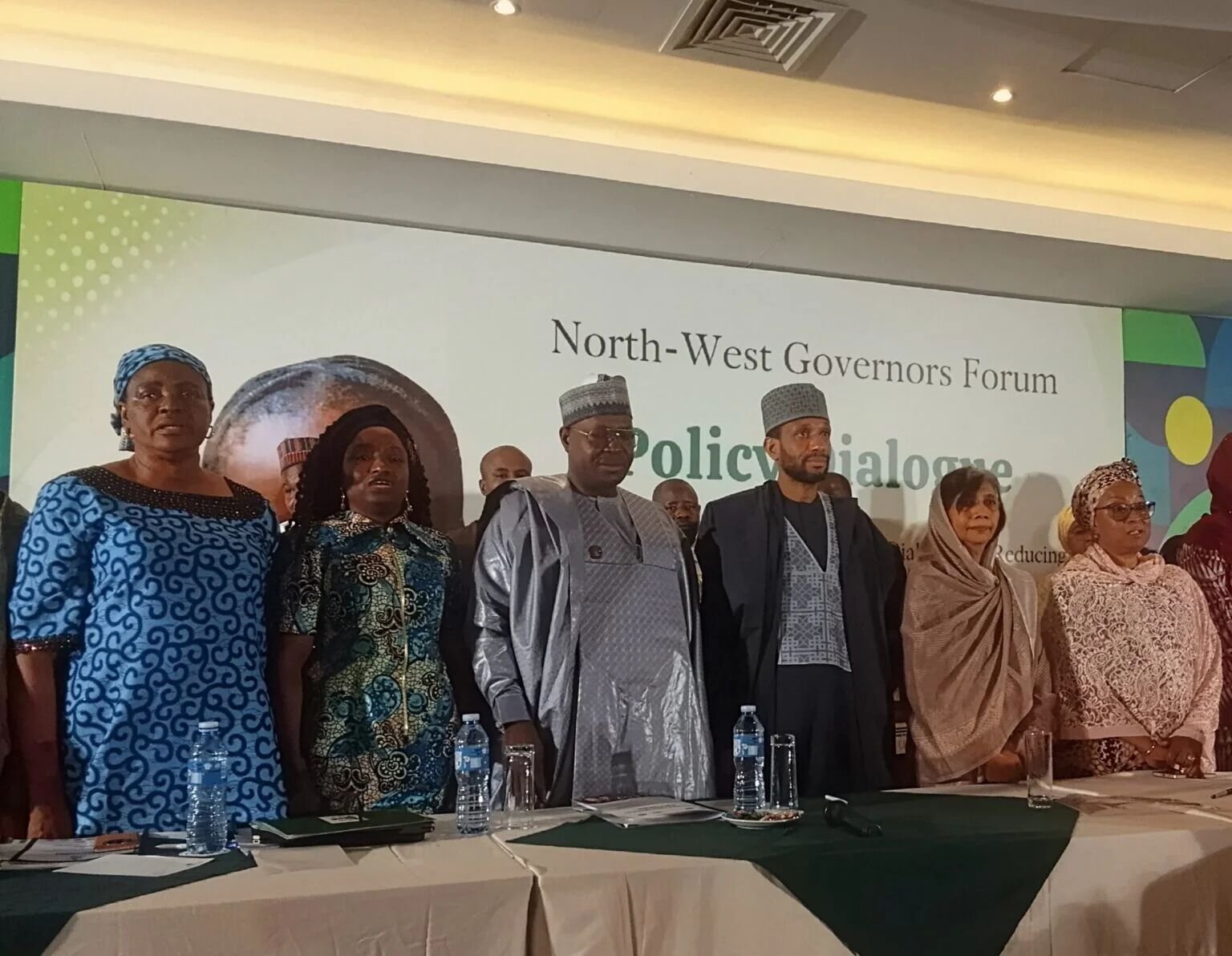
Governors of the seven North-West states have adopted an ambitious six-month action plan aimed at reducing multidimensional poverty in the region, with a target of re-enrolling no fewer than 781,200 out-of-school children into formal education between July and December 2026.
Key Highlights:
- North-West Governors’ Forum plans to enroll 781,200 out-of-school children within six months.
- The plan covers Kaduna, Kano, Katsina, Jigawa, Kebbi, Sokoto, and Zamfara states.
- It targets education, healthcare, nutrition, and social protection improvements.
- The governors also aim to boost school retention and child immunisation programs.
- A coordination system will track progress and ensure accountability.
The resolution was contained in a communiqué issued at the end of a two-day North-West High-Level Policy Dialogue on Reducing Multidimensional Poverty through Scaled Social Protection Systems and Innovative Financing, held at the Government House, Kano.

The communiqué, signed by the Director-General of the North-West Governors’ Forum (NWGF) Secretariat on behalf of the forum, said the governors also committed to retaining at least 1.3 million school-age children in schools through attendance and retention interventions, while another 781,200 children would be enrolled in Early Childhood Care Development and Education (ECCDE) programmes.
The forum, comprising governors of Kaduna, Kano, Katsina, Jigawa, Kebbi, Sokoto and Zamfara states, unanimously adopted the Renewed Hope Child Support Programme as a regional framework for accelerating the reduction of multidimensional child poverty and improving human capital development across the zone.
The governors expressed concern over the high incidence of poverty in the North-West, noting that the region’s multidimensional poverty rate stands at 75.8 per cent, compared to the national average of 63 per cent.
According to the communiqué, about 45.9 million people in the region are living in multiple deprivations, with children disproportionately affected through poor access to education, healthcare, nutrition and social protection services.
To improve health outcomes, the governors resolved to enrol at least 1,171,800 vulnerable children into non-contributory health insurance schemes and ensure the full immunisation of 781,200 children under the age of five.
They also pledged to strengthen access to antenatal, postnatal and child healthcare services, as well as improve primary healthcare delivery in underserved communities across the region.
On nutrition, the forum committed to providing nutrition support services to at least 781,200 malnourished children and reaching a similar number of mothers and caregivers with Infant and Young Child Feeding (IYCF) awareness and behavioural change programmes.
Read also:
- FG disburses N2.25bn grant to boost student-led innovations
- Police launch 2026 National Police Day with sanitation drive, free medical outreach in FCT
- Isoko Monitoring Group hails Prof. Aghalino’s appointment as vice chancellor of DDU, Asaba
The communiqué further stated that the governors would strengthen girls’ education and transition programmes while supporting the integration of western education into the Almajiri education system as part of efforts to improve educational outcomes.
In the area of social protection, the governors resolved to harmonise and strengthen social registers across the seven states, validate and enrol vulnerable households into the Renewed Hope Child Support Programme and integrate beneficiary databases with education, health and nutrition information systems.
The forum also pledged to prioritise vulnerable groups, including internally displaced persons, persons with disabilities and communities affected by insecurity.
To guarantee sustainable implementation of the programme, the governors agreed to establish dedicated Child Support and Social Protection budget lines in their respective states and progressively allocate not less than two per cent of annual state budgets to child-focused social protection interventions.
They also resolved to leverage federal government financing windows, development partner support, private sector partnerships and philanthropic contributions, while exploring Islamic social finance instruments such as Zakat and Waqf to fund child development initiatives.
As part of measures to ensure accountability and effective coordination, the forum approved the establishment of a North-West Child Development and Social Protection Coordination Mechanism under the NWGF Secretariat.
The mechanism is expected to coordinate implementation across the states, monitor progress against agreed targets, facilitate peer learning and publish periodic governors’ scorecards on child development indicators.
The governors adopted a six-month implementation framework covering July to December 2026, with priority actions focused on expanding and validating social registers, enrolling beneficiaries into the Renewed Hope Child Support Programme, re-enrolling out-of-school children, scaling up immunisation and nutrition interventions, and strengthening financing and accountability systems.
They called on the Federal Government, development partners, development finance institutions, the private sector, civil society organisations, traditional and religious institutions, as well as humanitarian organisations, to support the implementation of the programme.
The governors reaffirmed their commitment to reducing multidimensional child poverty and improving human capital outcomes across the North-West, pledging to translate the resolutions of the dialogue into measurable actions capable of improving the lives of millions of vulnerable children and households in the region.