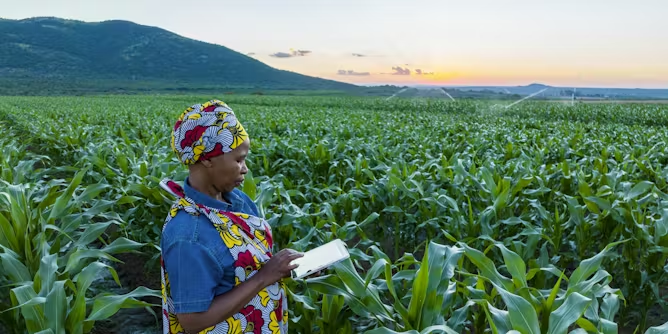
Kenya has recorded a major development in agricultural finance with the first private-sector local currency securitisation in the smallholder farming sector reaching a first close of KES 276 million. The transaction is designed to expand access to credit for rural farmers and deepen institutional investment in agricultural lending.
Key Highlights:
- First private-sector agri-focused securitisation in Kenya
- KES 370 million farmer input credit portfolio structured
- KES 276 million raised in initial financing close
- Covers 23,839 smallholder farmers across Kenya
- 51% women and 22% first-time borrowers included
- Investment-grade BBB- rating by Agusto
- Supports expansion of local currency agricultural lending
- Expected to scale up to KES 2.37 billion over time
The deal was led by fintech platform Kaleidofin in partnership with Apollo Agriculture and supported by the IDH Farmfit Fund, marking a significant step in building structured credit markets for rural economies.

The securitisation converts agricultural input loans issued to smallholder farmers into investable assets for institutional investors. The underlying portfolio, originated by Apollo Agriculture, is valued at KES 370 million and includes nearly 24,000 farmers, many of whom had limited or no prior access to formal credit.
Read Also:
- Mixed reactions follow Apostle Lazarus’ move to Kenya, igniting online debate
- Tinubu to visit France, Kenya, Rwanda to boost strategic partnerships
- Kenya’s President Ruto under fire for ‘Translator’ remark about Nigerians’ English
The structure was built using Kaleidofin’s ki platform, which enables customised debt structuring and risk segmentation. It uses an AI-driven scoring model known as ki score to assess borrower risk based on loan performance data, bureau records and alternative datasets.
By packaging these receivables into a structured financial product, the arrangement allows Apollo Agriculture to recycle capital more efficiently, extending new loans to farmers without increasing its balance sheet pressure. The model is designed to align financing with seasonal agricultural cycles while improving transparency for investors.
According to Apollo Agriculture, the system is expected to expand access to seeds, fertilisers and farm inputs for smallholder farmers while strengthening repayment capacity through improved productivity.
Roel Messie, Chief Executive Officer of IDH Investment Management, said the transaction shows how structured finance can unlock capital for agriculture at scale, noting that blended finance remains key to reducing risk in underserved markets.
Sucharita Mukherjee, Co-founder and Chief Executive Officer of Kaleidofin, said the platform was designed to support inclusive financial systems across emerging markets by enabling institutional capital to flow into underserved sectors through data-driven infrastructure.
Eli Pollak, Chief Executive Officer of Apollo Agriculture, described the transaction as a step forward in scaling affordable local currency financing for farmers, adding that it reduces foreign exchange exposure and lowers funding costs for agricultural lending.
The IDH Farmfit Fund acted as anchor investor in the deal, which is part of a broader programme expected to mobilise KES 2.37 billion and reach more than 130,000 farmers across future phases.
Development finance and market institutions including FSD Africa, MOBILIST and British International Investment supported the transaction through regulatory guidance, structuring assistance and technical capacity building. These partners said the deal could serve as a model for scaling structured agricultural finance across emerging markets.
FSD Africa noted that improved financial infrastructure and investor confidence are essential to expanding capital flows into high-risk but high-impact sectors such as smallholder agriculture.
The transaction is being positioned as a blueprint for future securitisation deals in Africa’s agricultural sector, combining technology, blended finance and institutional investment to address long-standing financing gaps.