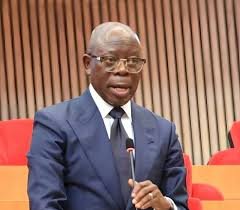
The senator representing Edo North, Adams Oshiomhole, has urged the federal government to revoke the operating licences of South African companies in Nigeria, including MTN and MultiChoice’s DStv, following renewed xenophobic attacks on Nigerians in South Africa.
Sen. Oshiomhole made the call during plenary, insisting that Nigeria must adopt a tougher stance to protect its citizens abroad.

“I don’t want this Senate to be shedding tears, to sympathise with those who have died. We didn’t come here to share tears,” he said.
“If you hit me, I’ll hit you. I think it is appropriate in diplomacy. It’s an economic struggle.”
His remarks came as the House of Representatives condemned the latest wave of attacks, urging the federal government to take immediate diplomatic and protective measures.
The former Edo State governor, argued that Nigeria should consider nationalising MTN and withdrawing its licence, alleging that the telecom giant repatriates substantial revenue, while Nigerians face hostility in South Africa.
“This Senate should adopt a position that MTN, a South African company that is cutting away millions of dollars from Nigeria every day — that Nigeria nationalise it and withdraw its licence,” he said.
Read Also:
- Fear, frustration, and fault lines: The unending roots of xenophobic attacks in South Africa
- UN condemns xenophobic attacks in South Africa as country marks Freedom Day
- Nigerians in South Africa cry out over renewed Xenophobic attacks, demand urgent federal government intervention
He added that such action would not only serve as a deterrent but also open up economic space for indigenous companies.
Sen. Oshiomhole also called for the revocation of DStv’s licence, accusing the company of exploitative practices and urging Nigerians to take over sectors dominated by foreign firms.
“I call on the federal government to revoke DStv, which is also a South African company that is cutting away millions of dollars,” he said.
The senator linked the recurring xenophobic violence to domestic political dynamics in South Africa, noting that anti-immigrant rhetoric has increasingly influenced public attitudes toward foreign nationals, including Nigerians.
According to him, Nigerians in South Africa are economically active and contribute meaningfully to the host country’s economy.
“These Nigerians who are in South Africa, they are not there on holiday. They are there to work and to earn,” he said.
“When we hit back, the president of South Africa will go on his knees to recognise that Nigerians cannot be intimidated.”
Also speaking, Senator Victor Umeh (Anambra Central) described the situation as alarming, saying many Nigerians in South Africa are living in fear.
“It is worrisome they are hiding for their lives, they can’t move freely. This is a situation where people are paying good with evil,” he said, referencing Nigeria’s role in the anti-apartheid struggle.
Umeh called on the African Union to intervene and impose sanctions on South Africa, warning that continued attacks on Nigerians must not be tolerated.
“The AU, of which South Africa is a member, should rise now and impose necessary sanctions,” he said. “We cannot allow this to continue.”