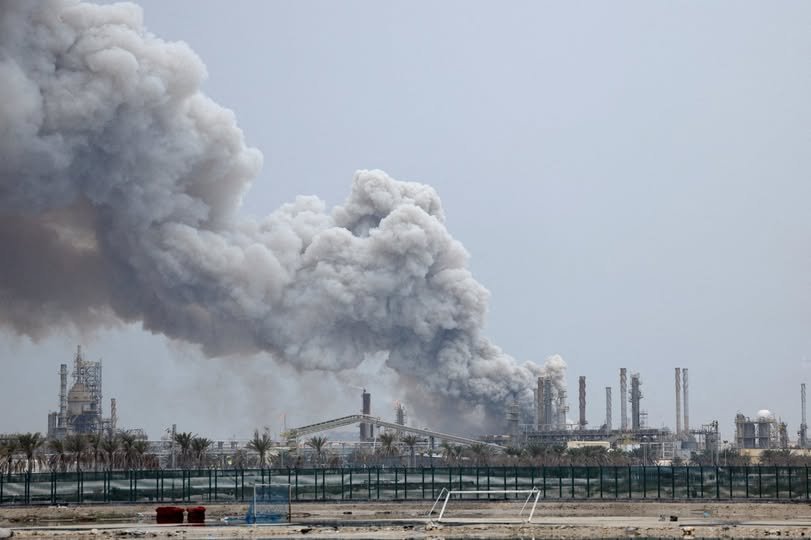
Firefighters battled a major blaze at Kuwait’s Mina Al-Ahmadi refinery on Friday following a fresh drone attack, as Iran intensified strikes across the Gulf and maintained its stance on continued missile production.
The latest incident comes amid a widening regional conflict that has seen repeated attacks on critical energy infrastructure, including a recent strike on Qatar’s Ras Laffan gas facility. The escalation has heightened fears over global oil and gas supply disruptions.

Iran had vowed retaliation after the strike damaged its South Pars gas field, one of the world’s largest reserves and a key source of domestic energy. The growing cycle of attacks has continued to push oil and gas prices upward, raising concerns about inflation and long-term economic impact.
Israeli Prime Minister Benjamin Netanyahu said the conflict could end sooner than expected, despite ongoing hostilities.
“We are winning and Iran is being decimated,” Netanyahu said, adding that the war “is ending a lot faster than people think,” though he gave no timeline.
Read Also:
- Israel intensifies Tehran strikes as Iran retaliates, raising global energy fears
- Israel says it has killed Iran’s intelligence minister in an overnight strike
- Pains, Gains of US–Israel–Iran War: Global Energy Crisis Looms as Crude Surges Past $100 per Barrel, Nigeria’s Government Earnings Rise
Iranian officials, however, insisted their military capabilities remain intact. A spokesman for the Islamic Revolutionary Guard Corps said the country’s missile programme was continuing without disruption, even under sustained attacks.
Shortly after the statement, Iranian media reported that the spokesman had been killed in joint US-Israeli strikes, highlighting the intensity of the ongoing conflict.
The situation has drawn attention to the strategic importance of the Strait of Hormuz, through which roughly one-fifth of the world’s oil and liquefied natural gas passes. Any disruption to the route could have severe consequences for global energy markets.
Missile exchanges continued overnight, with explosions reported over Jerusalem. The United Arab Emirates confirmed further attacks, while Saudi Arabia said it intercepted more than a dozen drones as Gulf countries marked Eid al-Fitr.
Energy analysts warn that sustained damage to infrastructure could trigger a prolonged global supply crisis. The attack on Ras Laffan alone is estimated to cause billions in losses and may take years to fully repair.
Oil prices remain volatile, with Brent crude trading around $108 per barrel and West Texas Intermediate near $94, reflecting market uncertainty over the duration and scale of the conflict.
Beyond the Gulf, the war has expanded into Lebanon, where Israeli airstrikes targeting Hezbollah positions have resulted in significant casualties. Lebanese authorities report that more than 1,000 people have been killed in strikes affecting multiple regions, including Beirut.
Lebanese President Joseph Aoun has renewed calls for a ceasefire, urging diplomatic efforts to halt the violence.
Civilians across the region are facing worsening conditions, with many marking Ramadan under the strain of displacement, rising costs, and insecurity.
As global concern mounts, French President Emmanuel Macron said discussions would be held with United Nations Security Council members on securing safe navigation through the Strait of Hormuz once hostilities subside.
The conflict continues to pose significant risks to global energy stability, with analysts warning that prolonged disruption could have lasting economic consequences worldwide.