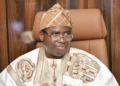
Chairman of the Senate Committee on Local Content, Senator Joel-Onowakpo Thomas, has declared that Nigerians will no longer remain passive observers in the nation’s economic activities, especially within the oil and gas sector.
He stated this on Monday while addressing stakeholders at the 14th Annual Practical Nigerian Content (PNC) Forum in Yenagoa, Bayelsa State.
Senator Joel-Onowakpo said the era of “paper compliance” with the Nigerian Oil and Gas Industry Content Development (NOGICD) Act, the Nigeria First Policy, and Presidential Executive Order No. 5 was over, stressing that the National Assembly is now fully committed to strict enforcement and measurable results.

He was joined at the forum by the committee’s Vice Chairman, Senator Ede Dafinone, and members Senator Abdul Ningi, Senator Sharafadeen Abiodun Ali, and Senator Victor Umeh. The event also drew top government officials, industry leaders, and international partners.
In his remarks, the senator highlighted what he described as “systemic failures” in adhering to local content laws, even after more than six decades of oil exploration in Nigeria and 14 years after the implementation of the NOGICD Act.
“We are still lagging behind in fully realizing our local content aspirations,” he said. “But let me assure you: the days of non-compliance are gone. Nigerians will no longer be bystanders but key players and beneficiaries in their own economy.”
Joel-Onowakpo reaffirmed the committee’s commitment to supporting President Bola Ahmed Tinubu’s economic reform agenda, particularly the Nigeria First Policy, which prioritizes Nigerian professionals, goods, and services in public procurement and major industry operations.
He emphasised that the renewed commitment to local content is anchored on three major pillars: The NOGICD Act of 2010; Presidential Executive Order No. 5 (2018) and The Nigeria First Policy.
Quoting Section 28 of the NOGICD Act, which requires operators to submit succession plans for expatriate-held positions, he noted that some companies were still violating the law.
He cited an instance involving Chevron, alleging that the company planned to replace a retiring Nigerian procurement director with an expatriate.
“That is not the intent of the law,” he said. “Positions occupied by expatriates must be Nigerianised after a four-year period. We will invoke our oversight powers to ensure full compliance.”
Senator Joel-Onowakpo also referenced Executive Order No. 5, signed by former President Muhammadu Buhari, which mandates all procuring entities to prioritize Nigerian companies and ensure foreign firms present verifiable capacity development plans before securing public contracts.
“This bold nationalistic policy will reduce capital flight, create jobs, and stimulate local industries,” he said. “For Nigerian workers, it means more opportunities, better skills transfer, and improved economic participation.”
Read also:
- NCDMB, BOI sign MoU on $100m equity fund scheme
- Shun partisan politics, stomach infrastructure, vote Joel-Onowakpo, Eta insists
- Joel-Onowakpo Thomas felicitates with Olu on coronation anniversary
The senator added that the committee’s focus goes beyond employment numbers, stressing that workforce welfare, safety, and professional development were equally critical. Sections 35 to 39 of the NOGICD Act, he noted, mandate compulsory investments in research, training, and human capital development.
“These provisions are not ornamental,” he stated. “They are actionable legal standards that must be fully implemented. Granting unnecessary waivers hurts our long-term national interest.”
He urged International Oil Companies (IOCs), National Oil Companies (NOCs), and service providers to align with the government’s renewed push for transparency, accountability, and sustainable local capacity development.
“This address is both an affirmation of our purpose and an invitation to our partners IOCs and NOCs to join us in deepening local content enforcement and creating meaningful jobs for millions of Nigerians,” he concluded.
The 14th PNC Forum, themed “Securing Investment, Strengthening Local Content, and Scaling Energy Production,” continues to serve as a major platform for assessing Nigeria’s progress in local content development and shaping future policy directions.