
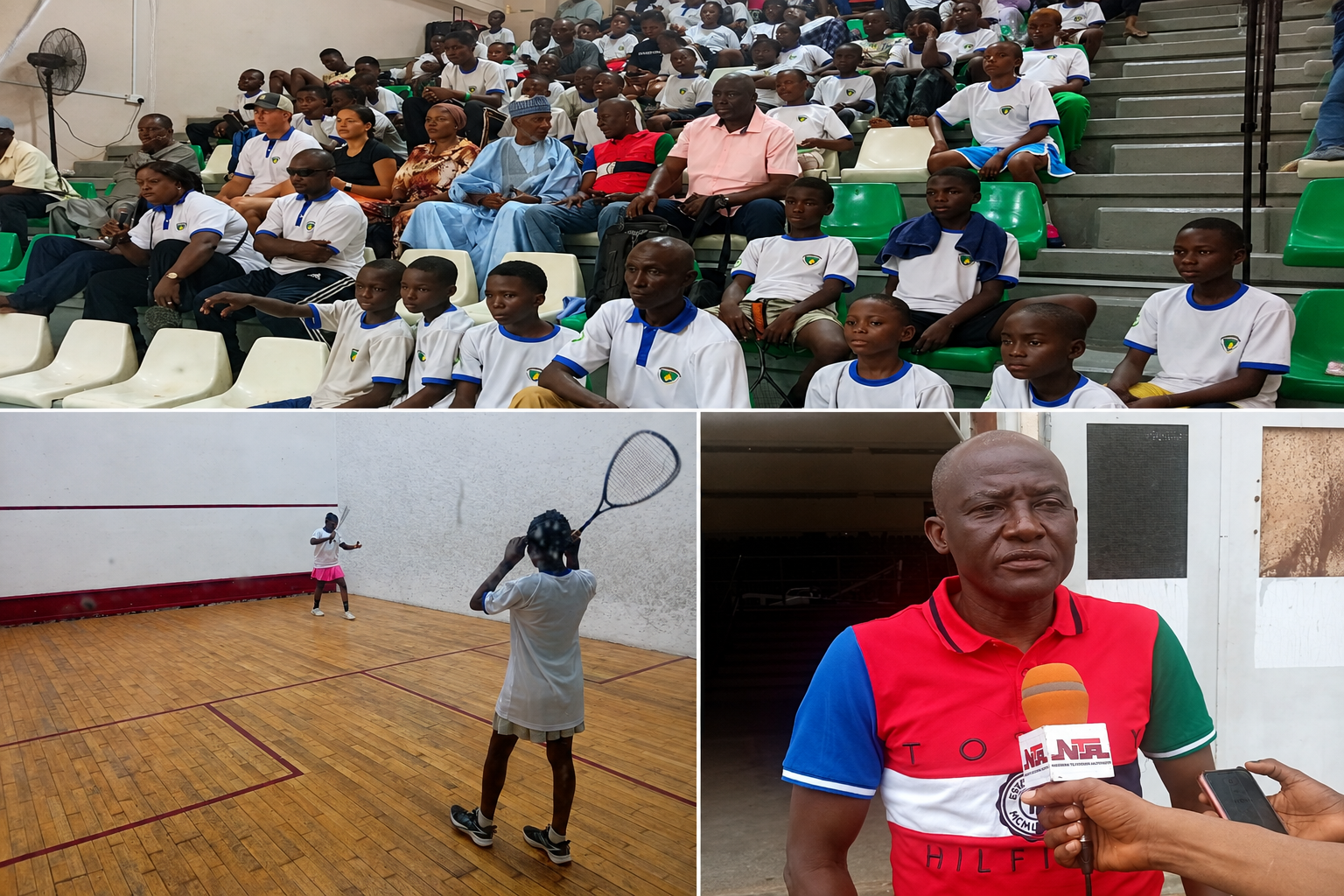
The seventh Squash in Diaspora Under-11, Under-13 and Under-17 Boys and Girls Championship has ended in Abuja with stakeholders calling for wider regional coverage and stronger grassroots investment, as the Northeast emerges as a potential destination for a future edition.
The championship, held outside Lagos for the first time after six consecutive editions in the commercial capital, attracted more than 85 junior players from across northern Nigeria.
The participation included 33 players from the Federal Capital Territory, 13 from Plateau State and 11 from Kaduna State.

The turnout has strengthened calls for the competition to be taken to more parts of the country, particularly regions where young talents have limited access to high-level competitive squash.
Adekunle Adebiyi, Secretary of the Ex-Pros in the Diaspora, tournament organiser and sponsor, said the organisers were considering taking future editions to other regions.
He identified the Northeast, Southeast and Kano among possible destinations, saying the priority was to use the tournament to discover more young players.
“Our aim is to develop. Our aim is to go where we will be able to pull new players in,” Adebiyi said.
The possible move to the Northeast would further extend the championship’s reach beyond its traditional Lagos base and the Abuja edition.
Adebiyi disclosed that the championship cost more than ₦10 million, excluding miscellaneous expenses, but said the organisers remained committed despite economic challenges.
He said the welfare of the children remained the priority, with every participant catered for and presented with something at the end of the competition.
Comptroller Haniel Haddison, Vice President of the Nigeria Squash Federation (NSF), tournament sponsor, former national champion and two-time NUGA champion, described the Abuja edition as an important step towards decentralising squash development.
Haddison, who also represented Team Nigeria internationally as captain, said the government could not develop sports alone and urged former athletes, private organisations and Nigerians in the diaspora to complement government efforts.
He described the return of former professionals to invest in young players as an important way of giving back to the sport that helped shape their careers.
“You can see not just squash, even the Federal Government has a very unique platform for its citizens in the diaspora. So, the Squash Federation is not ignoring that,” he said.
Haddison, who started playing squash at 16, said his experience demonstrated the opportunities the sport could create for young Nigerians.
“Stakeholders should come and complement the effort of the government so that we can collectively move the nation forward,” he said.
He described the decision to take the championship to Abuja as “a very worthy initiative” and called for similar competitions in other regions.
According to him, the NSF’s “catch them young” strategy would be critical to producing a new generation of Nigerian squash players.
Squash veteran Dr. Shehu Sule also stressed the importance of identifying and developing players from an early age, saying the process should begin even before the Under-11 category.
Sule, who said he has been involved in squash for about three decades and is now over 75, said he recently watched children as young as eight compete and was impressed by their performances.
“I think it’s very important to catch everybody young, even lower than the age of 11,” he said.
According to him, squash should adopt the same early-development approach seen in sports such as swimming and golf, where children can begin training from very young ages.
Sule also noted significant improvements in Nigerian squash over the years, including better courts, protective equipment, professional coaching and increased sponsorship.
He recalled that players in earlier years faced more injuries because of inadequate protective equipment, while modern players now benefit from better safety standards.
He said the growth of professional coaching and improved facilities had made him optimistic about the future of squash in Nigeria.
“I am very encouraged that squash is gaining ground in Nigeria,” Sule said.
Sule also commended Nigerian squash professionals in the diaspora for maintaining their commitment to grassroots development.
He recalled receiving support from Nigerian squash players abroad during his visit to the United States in 1995, including rackets, balls, shoes and other equipment.
He said the gesture demonstrated how former Nigerian players abroad had continued to give back to the sport that helped them build their careers.
“I am very happy that the people in diaspora are giving back to what they got from Nigeria. And I appreciate their efforts. We continue to encourage them to continue to do this,” he said.
Former North American champion and former Nigerian champion Segun Maku said sustained investment in junior development could position Nigeria for major breakthroughs internationally.
Maku said the championship provided former professionals with an opportunity to reconnect with the sport and contribute to the next generation.
“This tournament means a lot to me because it reminds me of my days coming up. I am glad that we, the ex-professionals, are giving back, trying to grow the sport and focusing more on grassroots development,” he said.
He predicted that Nigeria could begin making significant international breakthroughs within five to 10 years if grassroots programmes were sustained.
“Hopefully, in the next five, 10 years, we’ll start getting on the main draw and probably start winning most of the international tournaments,” Maku said.
He offered a ₦2 million reward to any young player who eventually breaks his squash record.
Maku also disclosed plans to promote a sports university that would enable athletes to combine education with competitive sports.
“Education is key to life, so you can’t give that away,” he said.
Engineer Iniobong Jacob, a squash development advocate, highlighted the impact of grassroots programmes in developing young players.
Jacob said about 47 children are currently involved in a programme that evolved from what initially started as a private squash court at his home.
He explained that children from the neighbourhood became interested in the sport, prompting him to transform the facility into a grassroots development platform.
According to him, one of the girls developed through the programme had represented Nigeria in Canada.
Jacob said the programme also focuses on discipline, character and behaviour.
“These children don’t loiter in the streets anymore. We use that platform to discipline them, to mentor them for character, for behaviour. So, it is not just squash,” he said.
He called for increased exposure, modern equipment, quality coaching and strategic partnerships to help Nigerian juniors close the technical gap with leading squash-playing countries.
Jonah Attah, Technical Director of the Nigeria Squash Federation, board member, Vice Chairperson of the African Squash Federation and member of the organising committee, said the Abuja edition exceeded expectations.
Attah, who has spent 41 years in squash, said the championship demonstrated what could be achieved when former players returned to support grassroots development.
He said more than 85 players attended from across the northern region.
“FCT alone brought 33 junior players. Plateau came with about 13, Kaduna came with about 11. Everyone just came with their players,” Attah said.
He linked the strong participation to the NSF’s development roadmap covering 15 pilot states, designed to produce 11 Under-11 players from each state.
The Under-11 category recorded a full draw of 32 players, compared with about 12 to 14 participants in previous editions.
“That shows you that what the federation is doing is working, and I’m happy to be part of that work,” Attah said.
He added that the technical standard displayed by the juniors had also improved significantly.
Attah, who recently formed part of the coaching team that took Nigerian players to the World Junior Team Championship in Canada, said the Abuja performances indicated that the country’s young players were gradually approaching international standards.
T’Connor Tuodolo, founder of the Squash Premier League and one of the pioneers of the championship, said stronger collaboration among stakeholders would accelerate squash development.
Tuodolo described the Ex-Pros in the Diaspora as a major pillar of grassroots development, saying former Nigerian players had returned their experience and resources to the country.
“This Ex-Pros Diaspora has been a family. They have been some of the ex-squash players who are now representing us in the diaspora, and they have brought it back home,” he said.
He called for other former players and stakeholders to support similar initiatives.
Tuodolo also proposed joint programmes between the Ex-Pros in the Diaspora and the Squash Premier League, saying such collaboration could have a major impact on the sport.
“As a co-founder of a Squash Premier League, I think if we can liaise and do one or two programmes together, it will be of enormous benefit to the development of squash in Nigeria,” he said.
Read also:
- Adekunle Adebiyi: Abuja Move ‘One of Our Best Decisions’ As Squash In Diaspora Tournament Hits Semifinals
- Haniel Commends FG as Abuja Hosts 7th Squash In Diaspora Tournament, Targets Grassroots Growth
- Why We Established The Squash Premier League- Founder
Parents Urged to Encourage Children
Sule also urged parents to support their children’s participation in squash and other sports, stressing the role of sports in discipline, social development and keeping young people away from harmful activities.
He said sports could help children develop discipline, build relationships and avoid negative influences.
“Every game, not only squash, brings a lot of discipline, a lot of encouragement and a lot of camaraderie with other people,” he said.
He added that children should continue to be encouraged to participate in sports.
Sule also emphasised the importance of physical fitness in squash, noting that players need to be fit to perform effectively.
With the seventh edition concluded, stakeholders are now looking beyond Abuja, with the Northeast potentially next in line for the championship.
The proposed regional expansion, alongside continued grassroots academies, early-age development, better coaching, improved facilities, international exposure and educational opportunities, could provide a broader pathway for discovering and nurturing Nigeria’s next generation of national, continental and world-class squash champions.