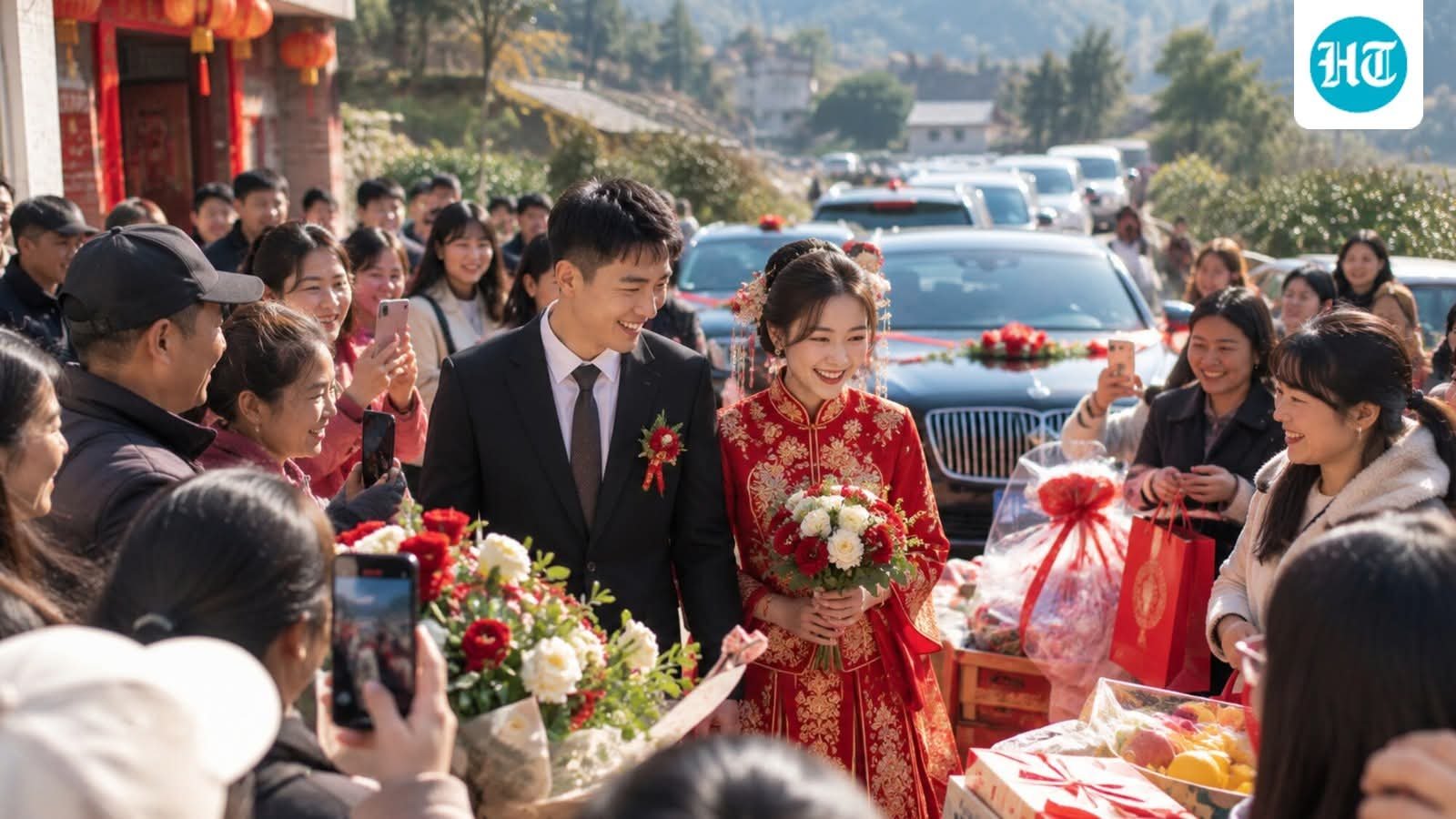
A 24-year-old orphan in China’s southwestern Yunnan Province has turned his wedding into a nationwide gathering after inviting strangers on social media to attend his special day, drawing thousands of people to his remote village on October 31, 2026.
Xu Chenghong, popularly known online as Xiao Xiao Xu or Xiaoxiaoxu, had feared that only a handful of relatives would attend his wedding in Yunfeng Village, Luowang Miao Ethnic Township, Yiliang County. His simple invitation on Douyin, asking people to come and make the celebration lively without bringing money or expensive gifts, prompted an extraordinary response from across China.

Key Highlights
- A 24-year-old orphan’s wedding invitation attracted thousands of strangers to a remote village in Yunnan, China.
- Xu Chenghong had expected only 10 to 20 people to respond to his invitation.
- Guests travelled from different parts of China, with reports putting attendance at more than 10,000.
- Volunteers and donors provided food, flowers, household appliances, furniture and other wedding supplies.
- Local authorities helped manage traffic, crowd control, food safety and the large gathering.
- The wedding became a widely discussed example of online solidarity and community support.
From a Difficult Childhood to a Wedding Celebration
Xu grew up in Yunfeng Village after losing his father to illness when he was three years old. His mother remarried and left when he was five, while his grandmother, who had been raising him and his older brother, died when he was about seven.
The brothers largely raised themselves. Xu left school around junior high school and took several jobs to support himself, including sofa-making, textile work, working at a food stall and sorting parcels.
Over the years, he saved approximately 160,000 to 167,500 yuan, much of which he intended to use for his wedding and bride price.
He met his bride, Luo Chui, also known as Luo Chuichui, online. She is from the Bouyei ethnic group in the Qianxinan region of Guizhou Province. The couple dated for three years before deciding to marry.
Their first physical meeting took place in 2023. After Luo was involved in a car accident, Xu reportedly travelled from Shandong to Liaoning to care for her.
Her father later returned the 128,000 yuan bride price Xu had prepared, advising him to keep the money for building a house.
With only two or three tables of relatives expected at the wedding, Xu became concerned that the celebration would be too quiet. On October 25, he posted a video on Douyin inviting strangers to attend.
He explained that he did not need cash gifts or expensive presents. He simply wanted people to fill the seats and make the occasion memorable.
He initially expected between 10 and 20 people to show up.
Thousands Respond to the Invitation
The response quickly exceeded his expectations. WeChat groups were established to coordinate guests, while people from different parts of China began making arrangements to attend.
By October 27, about 200 people had reportedly arrived or confirmed their attendance. By midday on October 28, reports indicated that between 2,000 and 3,000 people were expected.
Visitors travelled from Guangdong, Sichuan, Chongqing, Hong Kong, northeastern China, Xinjiang and other regions. Some drove long distances along narrow mountain roads to reach the village.
Hotels in the township became fully occupied, while some residents opened their homes to accommodate visitors.
The growing crowd also prompted local authorities to intervene. Village officials, tourism authorities, police, fire services and market regulators helped organise the event.
The celebration was moved from the family’s small courtyard to the larger cultural square at the Hengdianzi resettlement site. Officials also coordinated traffic, crowd management and food safety.
China Mobile reportedly provided additional 5G equipment to support connectivity during the gathering.
The original traditional flowing-table banquet was eventually changed to a buffet because of the number of guests.
Media reports gave different attendance figures. While several accounts described the gathering as involving thousands of people, Global Times and other reports said attendance exceeded 10,000. Some earlier accounts mentioned figures as high as 20,000, although that number was not consistently confirmed.
Donors Provide Food, Gifts and Wedding Services
The response extended beyond attendance, with individuals, businesses and volunteers contributing food, household items and services to make the celebration possible.
Donations reportedly included refrigerators, heaters, furniture, stools, livestock, vegetables, fish and drinks.
Among the contributions were large quantities of apples, including a reported donation of about 1.2 tonnes. Another account put one donation at 1,500 jin, equivalent to approximately 750 kilogrammes.
A donor who contributed apples reportedly explained that he had also grown up in a single-parent family and wanted to support Xu.
The wedding also featured 30,000 roses, which young volunteers reportedly cleaned of thorns before decorating the celebration venue.
A 6.6-metre-long wedding cake was prepared by a pastry chef and students. Designed to serve approximately 600 people, the cake reportedly required more than 10,000 yuan for equipment and cream alone.
The kitchen prepared about two tonnes of chicken, while volunteer chefs worked for hours to feed the growing number of guests. Reports put the number of volunteer cooks at between 40 and 150.
Other contributions included free makeup services, drone photography, lighting arrangements and the services of a wedding planner who travelled from Hunan Province.
A Chengdu-based blogger also reportedly arrived with luxury vehicles, including a Maybach and a Rolls-Royce, alongside thousands of roses.
Xu’s own savings covered the main wedding expenses, while many of the additional contributions came from donors and volunteers.
His wedding vow, which circulated widely online, was: “Marrying her is the blessing of three lifetimes.”
Douyin later confirmed that Xu’s account was authentic and reportedly removed more than 100 impersonator accounts created around the story.
Read also:
- Zlatan Ibile, Davita Celebrate Wedding In Traditional Benin Attire
- N1.5bn Kano Mass Wedding Expenditure Triggers Debate On Tackling Poverty, Unemployment
- China Nominates Song Li for WHO Director-General as Leadership Race Intensifies
Bonfire Gathering Brings Different Communities Together
The celebration extended beyond the wedding ceremony itself.
On the night of October 29, guests and residents gathered for a bonfire celebration featuring traditional dances. Participants reportedly included people from Han, Yi, Lahu, Dai and other ethnic communities.
The gathering featured circle dances, including performances associated with the Munao Zongge tradition.
On the evening of October 30, Xu travelled to Guizhou to bring his bride back to Yunnan. The couple returned on the morning of October 31 for the wedding ceremony, which reportedly took place at about 11:30 a.m., followed by a day-long celebration and feast.
Social Media Reactions Celebrate Community Spirit
The wedding attracted widespread attention on Chinese social media platforms and international online communities.
Many users praised the generosity of the guests and volunteers, describing the gathering as an example of grassroots solidarity and the ability of strangers to come together for someone they had never met.
Some online observers described it as possibly China’s biggest wedding, while others highlighted the community spirit demonstrated by people who travelled long distances simply to support the young couple.
On X, Chinese Ambassador to the United States Xie Feng shared a video of the gathering and described how Xu’s simple request had grown into a nationwide celebration.
He wrote:
“It all started with a simple wish: An orphan from Yunnan Province invited strangers online to attend his upcoming wedding, hoping to feel the love and support of the family he never had. But what happened next was beyond anything he could have imagined: Thousands of people from across the country showed up, bringing gifts and warm wishes, turning the wedding into a nationwide celebration of kindness and connection.”
The ambassador later shared footage of the evening bonfire gathering and thanked people who had sent messages of goodwill.
Other users also expressed their admiration. One described being moved to tears by the willingness of individuals and companies to support the young man.
Another post summarised the event by saying that Xu had no family to invite, but thousands of strangers travelled to his village, shared food with him and made him feel part of a larger family.
Some users, however, questioned whether the scale of the gathering could have involved a marketing strategy. Others reflected on the wider social issues raised by the contrast between the public’s response to Xu’s personal invitation and its reactions to organised campaigns.
Global Times also reported that a section of online users questioned whether the event was a publicity exercise, although positive reactions remained prominent.
Wedding Brings Attention to Rural Yunnan
By November 1, videos of the wedding continued circulating online, while local hotels and restaurants reportedly benefited from increased business.
The event also drew attention to the capacity of social media to mobilise people around personal causes and to the enduring role of traditional village celebrations in Chinese rural communities.
For Xu, what began as a simple request for company became a gathering of thousands of people who travelled from different parts of the country to share his wedding day.
The celebration gave the young couple a memorable start to married life and demonstrated how an invitation from one person could bring together strangers from across a country.
For more global human-interest stories, follow us on X.