The Universal Basic Education Commission (UBEC) has intensified efforts to strengthen basic education in Kano State, with the construction of nearly 4,000 classrooms and support for the recruitment of thousands of teachers aimed at improving learning conditions across the state.
The intervention forms part of ongoing efforts to tackle classroom shortages, address the deficit of qualified teachers and expand access to quality education for children, particularly in underserved communities.
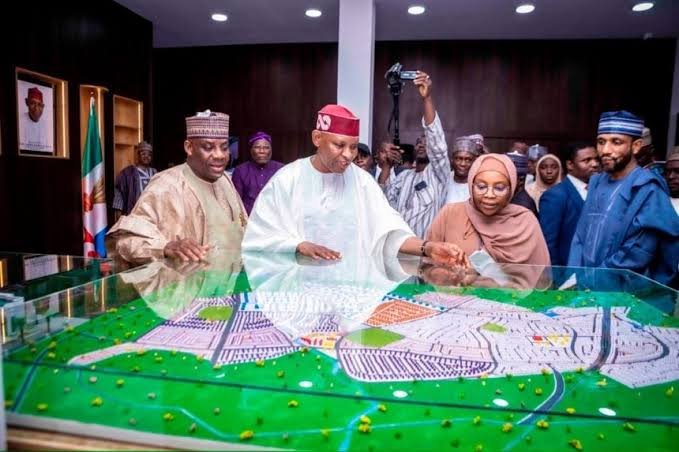
UBEC Executive Secretary, Aisha Garba, disclosed this during an education assessment visit to Kano, where she joined the Minister of Education, Tunji Alausa, the Minister of State for Education, Prof. Suwaiba Ahmad, and Governor Abba Yusuf to inspect UBEC-funded projects and witness the presentation of appointment letters to newly recruited teachers.

Speaking in a statement issued on Wednesday, Garba said the commission has completed close to 4,000 classrooms across Kano to provide pupils with safer, more conducive environments for learning.
She noted that improving education requires a balanced investment in both school infrastructure and qualified teaching personnel, stressing that classrooms alone cannot deliver quality learning without competent educators.
According to Garba, the Tinubu administration remains committed to ensuring that every Nigerian child has access to quality basic education regardless of location.
She said no child should be denied educational opportunities because of inadequate facilities or the absence of teachers, describing investment in the teaching profession as an investment in Nigeria’s future.
Garba also commended the Kano State government for what she described as one of the country’s most ambitious teacher recruitment programmes, noting that more than 16,000 teachers have been employed by the state, including the latest batch that recently received appointment letters.
She explained that the large-scale recruitment would significantly reduce the shortage of teachers, particularly in rural and underserved schools, while improving teaching standards and pupils’ academic performance.
According to her, every newly recruited teacher represents renewed hope for thousands of children who depend on quality instruction to realise their educational aspirations.
While acknowledging persistent teacher shortages across many parts of the country, especially in remote communities, Garba called for sustained investment in teacher recruitment, training and welfare to strengthen Nigeria’s basic education system.
She further praised Governor Yusuf for placing education at the centre of his administration’s development agenda, adding that closer collaboration between the federal government, UBEC and state governments remains essential to achieving inclusive and equitable education nationwide.
Garba also applauded the leadership of the Minister of Education and the Minister of State for Education, describing ongoing reforms in the sector as evidence of the Federal Government’s commitment to improving learning outcomes.
Read also:
- Senate Expands Safe Schools Probe To TETFund, NELFUND, UBEC, Extends Investigation By 3 Weeks
- UBEC Deploys Over ₦100bn To Improve School Infrastructure, Teacher Training, Digital Learning
- UBEC’s intervention impact 8.7m learners, disburses over N100bn unutilized funds
Earlier, Chairman of the Kano State Universal Basic Education Board (SUBEB), Yusuf Kabir, said the recruitment exercise followed a transparent and merit-driven process to ensure only qualified candidates were employed.
Kabir, however, stressed that employing teachers alone would not guarantee improved educational outcomes unless they were properly deployed, supervised, mentored and regularly evaluated.
He assured that the newly recruited teachers would be posted to schools experiencing the greatest shortages while monitoring and evaluation mechanisms would be strengthened to enhance classroom performance and improve pupils’ learning achievements.
Kabir also appealed to development partners, traditional institutions, private organisations and local communities to support government initiatives, emphasising that lasting improvements in basic education require collective participation from all stakeholders.
UBEC reaffirmed its commitment to partnering with state governments to improve access to quality basic education through sustained investments in classroom infrastructure, teacher development and learner-focused programmes across the country.