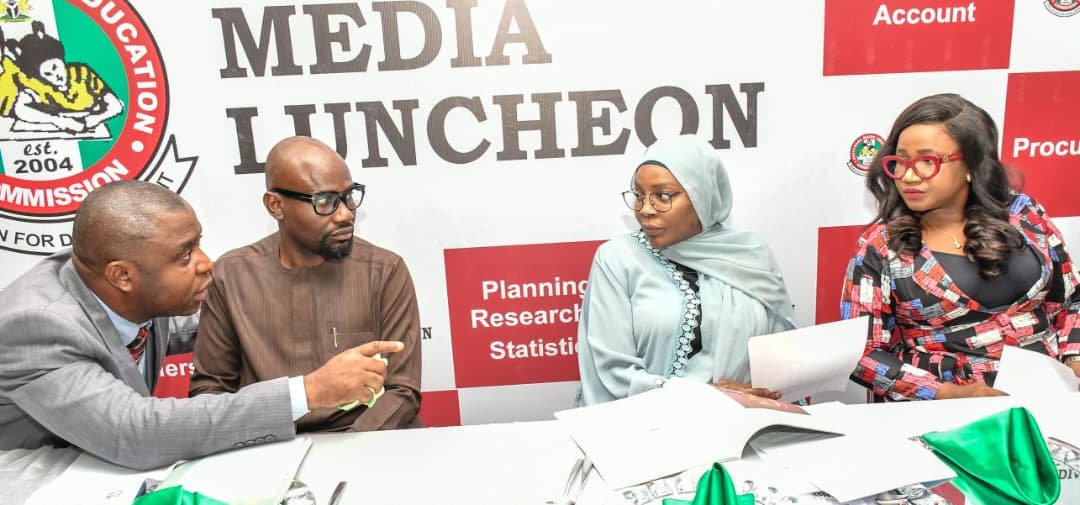
The Universal Basic Education Commission (UBEC) says it has deployed more than ₦100 billion in previously unaccessed matching grants to improve basic education across Nigeria, resulting in significant investments in school infrastructure, teacher development, and digital learning.
UBEC Executive Secretary, Aisha Garba, disclosed this during a media luncheon with education correspondents in Abuja.
She said the commission’s activities are being driven by its 2025–2031 strategic blueprint, which aligns with the federal government’s Renewed Hope Agenda and focuses on delivering measurable improvements in the basic education sector.

“We are moving beyond reforms to delivering measurable results,” Garba said, while highlighting the commission’s achievements in infrastructure development, teacher capacity building, and technology-driven education.
According to her, the funds mobilised in collaboration with state governments and the Federal Capital Territory Administration have already produced tangible outcomes nationwide.
She said UBEC has constructed more than 4,600 classrooms, renovated over 6,100 classrooms, provided 2,780 toilet facilities, drilled 678 boreholes, and supplied more than 334,000 pieces of classroom furniture to schools across the country.
Garba added that the commission has also supported the establishment of more than 2,300 early childhood care development and education centres to improve access to quality early learning.
She described teacher development as a key pillar of the commission’s reform agenda, revealing that over ₦20.4 billion has been invested in professional training programmes aimed at improving classroom instruction and school management.
According to her, initiatives such as the effective schools programme and strengthened school-based management committees are helping to improve teaching quality, leadership, accountability, and learning outcomes.
The executive secretary also highlighted UBEC’s efforts to modernise basic education through technology.
She said the commission is expanding digital literacy centres, strengthening smart schools, and introducing training in artificial intelligence, coding, and robotics to equip learners with skills needed for the future.
In addition, Garba disclosed that more than 7.8 million instructional materials have been distributed nationwide to support literacy, numeracy, and foundational learning.
Beyond physical infrastructure, she explained that UBEC is implementing programmes designed to improve access to education through open schooling, the integration of Qur’anic and Tsangaya education, as well as girl-child and inclusive education initiatives.
She added that institutional reforms are also being implemented to strengthen transparency, project monitoring, and data-driven decision-making to ensure better value for public investment.
Speaking at the event, the Chairman of the Nigeria Union of Journalists (NUJ), FCT Council, Grace Ike, described journalists as critical partners in promoting transparency and accountability within the education sector.
She encouraged regular engagement between UBEC and education correspondents through periodic media briefings, project inspection visits, and collaborative storytelling that highlights both achievements and existing challenges.
Ike also advocated improved access to education data, greater transparency in project implementation, and capacity-building programmes for journalists covering the sector.
“UBEC can strengthen this partnership by organising quarterly or biannual media briefings, providing press kits, conducting training on interpreting education data and child-friendly reporting, facilitating field visits to projects, supporting collaborative awareness campaigns, and creating effective feedback channels for journalists,” she said.
She called on governments, development partners, teachers, communities, and the media to work together to ensure every Nigerian child has access to safe, inclusive, and quality basic education.
“Together, we can ensure that every Nigerian child’s right to quality education is reported with accuracy, context, and urgency,” she added.
Read also:
- Alleged N5.78bn UBEC Fraud: Court Adjourns Ex-Kwara Governor’s Trial To July 27
- UBEC-SUBEB to flag off community sensitization campaign on school enrollment June 2
- UBEC’s intervention impact 8.7m learners, disburses over N100bn unutilized funds
Also speaking, Chairman of the Education Correspondents Association of Nigeria (ECAN), Chuks Ukwuatu, urged UBEC to deepen its collaboration with education journalists by including selected correspondents in field inspections and project monitoring visits outside Abuja.
He said firsthand access to projects would enable journalists to produce more balanced and comprehensive reports that reflect both the successes and the challenges of basic education interventions.
According to him, stronger cooperation between the commission and the media would enhance public awareness, improve accountability, and ultimately strengthen education programmes across the country.
The meeting marked UBEC’s first major engagement with education correspondents in almost a decade and signals a renewed commitment by the commission to greater openness and collaboration with the media.
Garba reaffirmed her determination to reposition the commission and address longstanding challenges in Nigeria’s basic education system to improve access to quality education nationwide.