
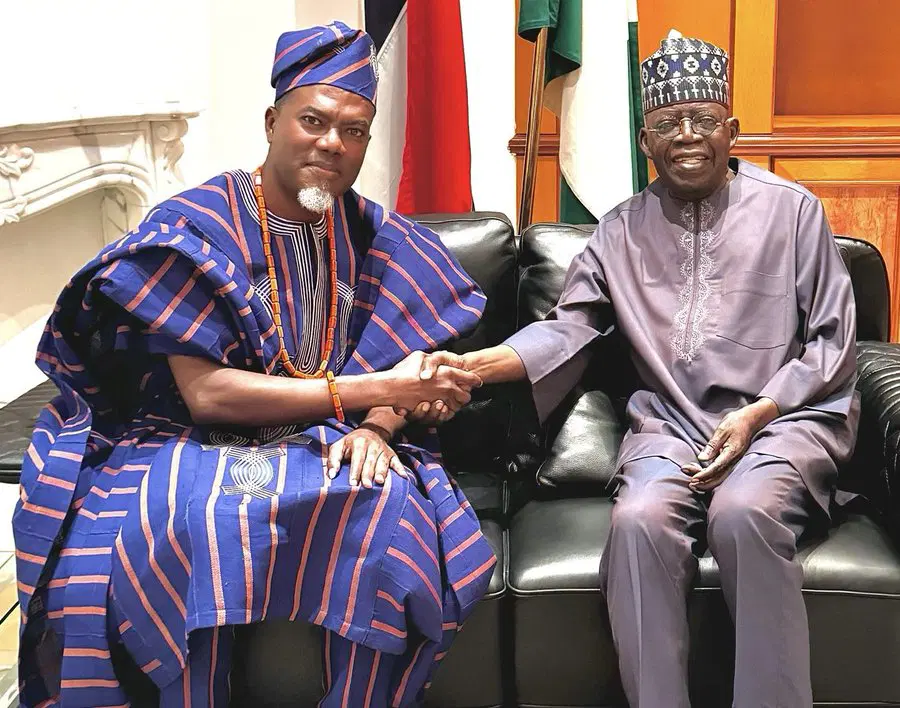
Former presidential aide, Reno Omokri, has dismissed claims that the United States Federal Bureau of Investigation (FBI) files relating to President Bola Tinubu amount to evidence of a criminal record.
Omokri, in a post on X on Monday, said the existence of FBI records on an individual should not automatically be interpreted as proof of criminal conduct, as government databases contain information generated through various official processes.

His comments is coming amid renewed controversy over documents concerning Tinubu that are currently before a US federal court.
According to Omokri, FBI records may include information obtained through background checks, visa screening and other government procedures, meaning that the presence of a person’s name in the agency’s database does not necessarily establish a criminal history.
“President Bola Tinubu has no criminal record in the United States, Nigeria, or anywhere else, and the FBI has not provided any criminal record on the President to anyone because none exists,” Omokri said.
He cited a February 2003 correspondence between the US Embassy in Nigeria and the office of then Inspector-General of Police, Tafa Balogun, as support for his position.
Omokri said Balogun had written to the US Embassy on February 3, 2003, seeking information on whether the FBI had any criminal records concerning Tinubu, who was then governor of Lagos State.
He said the US Embassy responded the following day after conducting a records check, stating that there were no criminal arrest records, wants or warrants for Tinubu.
The correspondence, dated February 4, 2003, reportedly stated that a search of the FBI’s National Crime Information Center produced no criminal arrest records, wants or warrants concerning Tinubu.
Omokri argued that the 2003 correspondence should be distinguished from the current controversy over FBI and Drug Enforcement Administration (DEA) records being sought in the United States.
He also recalled his visit to Chicago in September 2022, saying he travelled there while Tinubu was a presidential candidate to examine questions surrounding the President’s academic and other records.
Read also:
- FBI Hands Tinubu’s Drug Case Records To US Court
- Obi Stuns Nigerians With Fresh Take On Tinubu’s Presidency, Says “God Wanted Him There”
- Tinubu Asks US Federal Court To Block Release Of Drug Investigation Records
- Dolly Parton Laid To Rest Beside Late Husband As Family, Music Stars Pay Tribute
- Edo, State Of African Diaspora Sign Strategic Partnership On Seaport, Agriculture, Others
- Over 40 EFCC Officers Were Sacked For Corruption, Financial Malpractice — Olukoyede
- Group Supports Governor Mutfwang Stopping Activities Of Hisbah Board In Jos North LG
- Sheikh Nura Khalid’s Son Converts To Christianity After Studying Quran, Bible
The latest controversy stems from a Freedom of Information Act case filed by Aaron Greenspan, who sought records concerning Tinubu and another individual from US government agencies.
In April 2025, US District Judge Beryl Howell ruled that the FBI and DEA could no longer rely on a “Glomar” response to refuse to confirm or deny the existence of certain records relating to Tinubu.
The ruling followed previous disclosures by the US Department of Justice which, according to the court, had officially acknowledged that Tinubu was a subject of a criminal investigation involving the FBI and DEA.
The court said the investigation involved allegations relating to money laundering and proceeds connected to a heroin distribution organisation in the Chicago area.
It further noted that an affidavit incorporated into a Justice Department forfeiture complaint contained allegations concerning funds in accounts controlled by Tinubu and transactions investigators alleged were proceeds of drug trafficking.
However, the court’s ruling did not constitute a criminal conviction against Tinubu.
The present dispute centres on access to the underlying investigative records and whether the US government can continue withholding portions of them under exemptions contained in the Freedom of Information Act.
The FBI has recently submitted records to Judge Howell for private judicial review rather than releasing the documents publicly.
Omokri maintained that Nigerians should distinguish between the existence of government records, an investigation and proof of criminal wrongdoing, insisting that FBI files alone do not establish that Tinubu has a criminal record.
The underlying records submitted to the judge have not yet been made publicly available.