By 2027, Nigeria’s fuel subsidy debate may no longer be about petrol alone. It will be a referendum on whether the country can reform its economy without leaving millions of citizens behind.
Key Highlights
- President Tinubu removed Nigeria’s petrol subsidy in May 2023 and continues to defend the reform ahead of 2027.
- Atiku Abubakar, who backed removal during the 2023 campaign, now says he would restore subsidy if elected.
- Peter Obi agrees removal was necessary but says government mismanaged the savings it freed up.
- Reforms tied to subsidy removal and forex liberalisation generated N15.8 trillion for the federation between June 2023 and December 2025.
- Other contenders — Sowore, Makinde, Olawepo-Hashim and Duke — have proposed alternative approaches to the subsidy question.
- The real test for 2027 will be household welfare, not macroeconomic statistics alone.
Three years after President Bola Tinubu announced the end of Nigeria’s petrol subsidy, the policy has returned to the centre of the country’s political conversation.

What was presented in May 2023 as a decisive break from a costly and corruption-prone system is now shaping up as one of the defining economic issues of the 2027 presidential election.
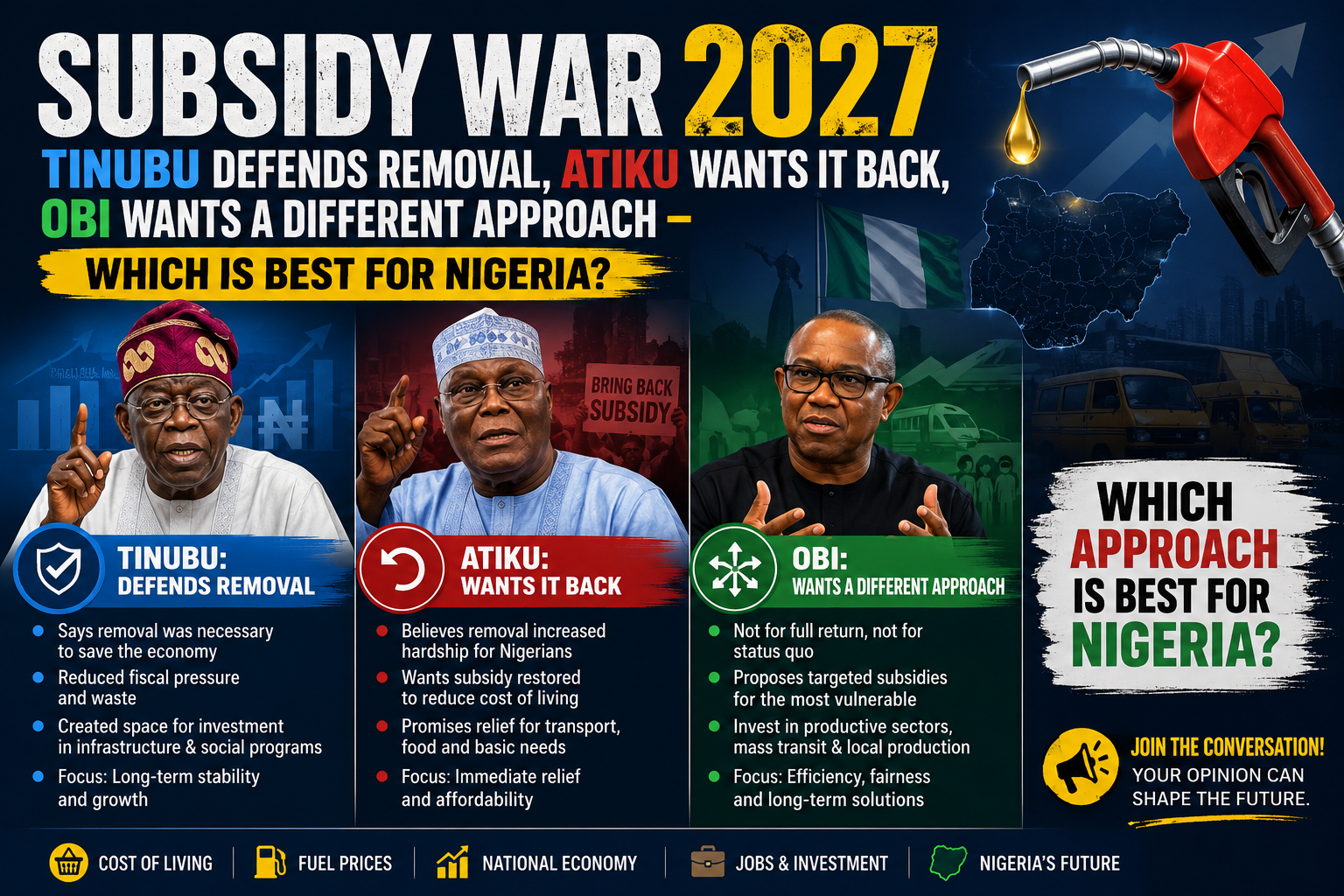
President Tinubu insists that reversing the reform would be economically reckless. Former Vice President Atiku Abubakar, who supported subsidy removal during the 2023 election, now says he would restore it if elected. Peter Obi, the presidential candidate of the Labour Party in 2023 and now associated with the National Democratic Congress, has taken a different position: subsidy removal was necessary, but the government failed to properly manage the resources freed by the policy.
Other presidential contenders have offered variations of these positions, ranging from targeted subsidies and domestic production support to stronger social protection and a fundamental questioning of the way Nigeria defines fuel subsidy.
The debate therefore goes beyond whether petrol should be cheap. It is about who should bear the cost of economic reform, how government should use public resources, and whether Nigerians have received enough in return for the sacrifices demanded of them.
Tinubu: The Subsidy Had To Go
For President Tinubu, the removal of the petrol subsidy remains one of the central pillars of his economic reform programme.
In his inaugural address on May 29, 2023, he announced that “fuel subsidy is gone”, triggering an immediate increase in petrol prices and setting off a chain of economic consequences.
The government argued that the old subsidy regime was fiscally unsustainable and vulnerable to fraud. For years, Nigeria had spent enormous sums subsidising petrol while remaining heavily dependent on imported refined products. Tinubu’s administration has maintained that the money previously spent on subsidy could be redirected towards infrastructure, social programmes and development.
The administration also links subsidy removal with its broader foreign-exchange reforms, arguing that both policies were necessary to correct longstanding distortions in the economy. According to figures cited by the Federal Ministry of Finance, reforms associated with subsidy removal and foreign-exchange liberalisation generated N15.8 trillion in additional resources for the federation between June 2023 and December 2025. Of that amount, N5.4 trillion accrued to the federal government while N10.4 trillion was distributed to states and local governments.
The government has also pointed to improved foreign reserves, increased crude oil production and stronger GDP growth as evidence that the reforms are beginning to produce results.
But these macroeconomic indicators have not erased the central political problem confronting the administration: many Nigerians do not feel that their living standards have improved.
For households, the consequences of subsidy removal were immediate. Transport fares rose. Food prices increased. Businesses faced higher operating costs. Electricity generation became more expensive for companies and households that rely on generators. Workers began spending a larger proportion of their incomes simply getting to work.
This creates a difficult political equation for the Tinubu administration. Macroeconomic stabilisation may be improving, but economic reform ultimately has to translate into improvements in household welfare. The government can point to stronger reserves and higher revenues.
A struggling family, however, is more likely to ask how much it costs to feed its children or travel to work. That gap between macroeconomic statistics and lived experience is at the heart of the 2027 subsidy debate.
Atiku: Restore Subsidy, Recover The Stolen Money
Atiku Abubakar has seized on that frustration. The former vice president has reversed his earlier position and now says he would restore petrol subsidy if elected president in 2027.
During the 2023 campaign, Atiku supported subsidy removal and argued that the existing system was unsustainable. His current position has therefore provided ammunition for critics who accuse him of changing his economic position for electoral reasons.
Gbenga Olawepo-Hashim, the Accord Party presidential candidate, recently described Atiku as the “father of subsidy removal” in Nigeria’s Fourth Republic and demanded that he explain his reversal to Nigerians.
Mr Hashim argued that politicians should be able to change their positions when circumstances or evidence change, but should also acknowledge their previous positions.
Atiku’s argument is nevertheless politically potent. He has questioned what happened to the savings from subsidy removal and why Nigerians have not seen corresponding improvements in healthcare, education, security and poverty reduction. “If elected, I will bring back the oil subsidy, and whoever stole the money must refund it,” he said.
His recent position has reportedly been presented not as a return to the old, open-ended import subsidy but as a more controlled intervention designed to support domestic refining. That distinction is important.
Nigeria’s old subsidy regime was widely criticised because of allegations of inflated fuel consumption figures, fraudulent claims and opaque payments to petroleum marketers. A new system would therefore have to demonstrate why it would avoid the failures of the past. The central question for Atiku is simple: how much would the proposed subsidy cost?
A second question follows: where would the money come from? And a third is perhaps even more important: what safeguards would prevent a new subsidy regime from becoming another channel for rent-seeking?
Atiku’s proposal may provide short-term relief to consumers, but relief without fiscal discipline could recreate the very problem the country spent years trying to solve.
Obi: The Problem Was Not Removal, But What Followed
Peter Obi’s position occupies a different space. He agrees with Tinubu on one fundamental point: Nigeria needed to remove petrol subsidy. But he strongly disagrees with how the policy was implemented.
Obi has argued that subsidy removal should have been accompanied by measures that protected Nigerians from the immediate consequences. He has also criticised the management of the savings generated by the policy. “I subscribe and I maintain that we need to remove subsidy. Mismanagement of the proceeds should not be the reason for not removing it,” he said.
That argument introduces an important distinction into the debate. A government can be right to remove an economically inefficient subsidy and still be wrong in how it manages the transition.
This is perhaps the strongest part of Obi’s argument. Economic reforms are rarely judged only by their theoretical correctness. They are judged by their consequences. If subsidy removal creates additional fiscal space but citizens experience worsening poverty, unemployment and declining purchasing power, government must demonstrate how the reform is improving the broader economy.
Obi has argued that the government should have clearly identified alternative uses for the money before or alongside subsidy removal. His proposed approach during the 2023 election included removing subsidy in an organised manner and investing the resulting resources productively.
This raises a critical issue for Nigeria’s future. The choice may not have to be between an expensive universal petrol subsidy and a complete withdrawal of government support. There is a third possibility: remove the subsidy while redirecting public resources towards targeted assistance for those most affected.
Subsidising Nigerians, Not Petrol
This may ultimately be the most useful way to frame the debate. A universal petrol subsidy does not distinguish between a poor worker using public transport and a wealthy Nigerian driving multiple vehicles.
Both benefit from cheaper petrol. The richer consumer, however, generally consumes more fuel and therefore receives a larger absolute benefit. A targeted social protection system could instead direct government resources towards vulnerable households, farmers, public transport operators, small businesses and other groups most exposed to fuel-price increases.
Such an approach could include cash transfers, subsidised public transport, agricultural support, investment in mass transit and targeted assistance to small businesses.
But this model has its own challenge: Nigeria’s record on social intervention programmes has also been criticised for weak targeting, inadequate transparency and poor accountability.
The issue, therefore, is not simply whether government spends money. It is whether government can spend it transparently and efficiently.
The Question Of Domestic Refining
Any serious subsidy debate must also confront Nigeria’s refining capacity. For decades, Africa’s largest oil producer remained heavily dependent on imported petroleum products despite possessing significant crude oil reserves. That contradiction helped make fuel subsidy particularly expensive.
If Nigeria can refine enough of its crude domestically, the economics of petrol supply could change significantly. Domestic refining could reduce exposure to international refined-product prices and foreign-exchange volatility while creating jobs and industrial opportunities. But domestic refining alone will not solve every problem.
Refineries require reliable crude supply, infrastructure, financing and effective management. The country also needs transparent pricing mechanisms and competition within the downstream petroleum sector.
The Dangote refinery has changed the structure of Nigeria’s petroleum market, while the government’s efforts to revive its state-owned refineries have continued. The question for the next president is therefore not simply whether to subsidise petrol.
It is whether government can create a petroleum market in which the cost of production, refining, transportation and distribution becomes low enough to reduce pressure on consumers without relying indefinitely on the treasury.
Read also:
- 2027: Tinubu Has Strongest Path To Re-Election, Says ADSC META Report
- Obi Stuns Nigerians With Fresh Take On Tinubu’s Presidency, Says “God Wanted Him There”
Other Voices Complicate The Debate
The emerging presidential contest has also produced positions that do not fit neatly into the Tinubu-Atiku-Obi divide. Omoyele Sowore, for example, has challenged the tendency to treat subsidy itself as the fundamental problem, focusing instead on corruption and inefficiency within the system.
Seyi Makinde, the Oyo State governor and a potential presidential contender, has criticised the simultaneous removal of subsidy and floating of the naira, arguing that the combination produced a severe economic shock for Nigerians.
Gbenga Olawepo-Hashim has advocated a targeted and transparent intervention designed to protect citizens and productive sectors while avoiding the abuses associated with the previous subsidy regime.
Donald Duke has gone further by questioning the premise of the debate itself and asking whether Nigeria ever operated a genuinely transparent subsidy system.
These arguments are important because they demonstrate that the policy choices are more complicated than “subsidy versus no subsidy”.
Nigeria can subsidise consumers, producers, transportation, strategic industries or vulnerable households. It can also invest the money that would otherwise have gone into subsidy. The question is which intervention produces the greatest economic and social benefit.
Which Approach Is Best?
On balance, a permanent return to the old-style universal petrol subsidy appears difficult to justify.
The historical record shows that the system consumed enormous public resources while creating opportunities for abuse. Restoring it without fundamental structural changes would risk repeating those failures.
That does not mean Tinubu’s approach should be accepted without qualification. The strongest argument against the administration is not necessarily that subsidy removal was wrong.
It is that the government has not sufficiently demonstrated the connection between the sacrifice demanded from citizens and the benefits being delivered to them. That is where Obi’s position becomes particularly relevant. Removing subsidy while establishing credible mechanisms to protect vulnerable citizens, invest the savings and publish measurable outcomes offers a potentially more sustainable framework.
Atiku’s proposal, meanwhile, deserves consideration only if its financing, duration, beneficiaries and accountability mechanisms are clearly established. A targeted and temporary intervention during severe economic shocks is fundamentally different from an unlimited petrol subsidy. The distinction must be made explicit.
The Real Test: Household Welfare
Nigeria’s economic debate has often become trapped between competing ideological positions. One side says markets should determine prices. Another says government must intervene to protect citizens.
The reality is more complicated. Markets can allocate resources efficiently, but sudden price shocks can destroy household welfare. Government intervention can cushion those shocks, but poorly designed intervention can become expensive, corrupt and politically difficult to terminate. The real policy challenge is therefore to combine economic efficiency with social protection.
Nigeria needs an energy policy that encourages domestic production, expands refining capacity, improves transportation and reduces dependence on imported petroleum products.
It also needs a social protection system capable of protecting Nigerians during periods of severe economic adjustment. Above all, it needs transparent public finances.
If subsidy is restored, Nigerians must know exactly how much it costs. If it remains removed, Nigerians must know how the resulting fiscal space is being used.
If government chooses targeted subsidies, the beneficiaries and costs should be publicly disclosed. And if domestic refining is expected to reduce prices, Nigerians should be able to measure progress against clear targets.
The 2027 Question
The subsidy debate will likely become increasingly intense as the 2027 election approaches.
But voters should be wary of simple promises. “Bring back subsidy” is not an economic programme. “Keep subsidy removed” is not an economic programme either.
The serious questions concern financing, implementation, accountability and outcomes. Atiku must explain how his proposed subsidy would be financed and protected from the corruption that plagued the old regime.
Tinubu must explain why Nigerians should continue to endure the present hardship and provide clearer evidence of how the gains from reform will translate into household prosperity.
Obi must demonstrate that better management of subsidy savings can realistically deliver the social and economic outcomes he promises. And every other presidential contender must answer the same basic question: what is the practical plan?
Three years after subsidy removal, Nigerians are still being asked to accept that sacrifice today will produce prosperity tomorrow.
That promise cannot remain indefinite. The ultimate measure of any subsidy policy is not whether government spends more or less money. It is whether the policy helps create an economy in which Nigerians can afford energy, transport, food, healthcare and education without depending permanently on government intervention.
Nigeria does not necessarily need cheap petrol forever. It needs an economy in which Nigerians can afford the petrol they buy. That is the standard by which the competing subsidy proposals of 2027 should be judged.