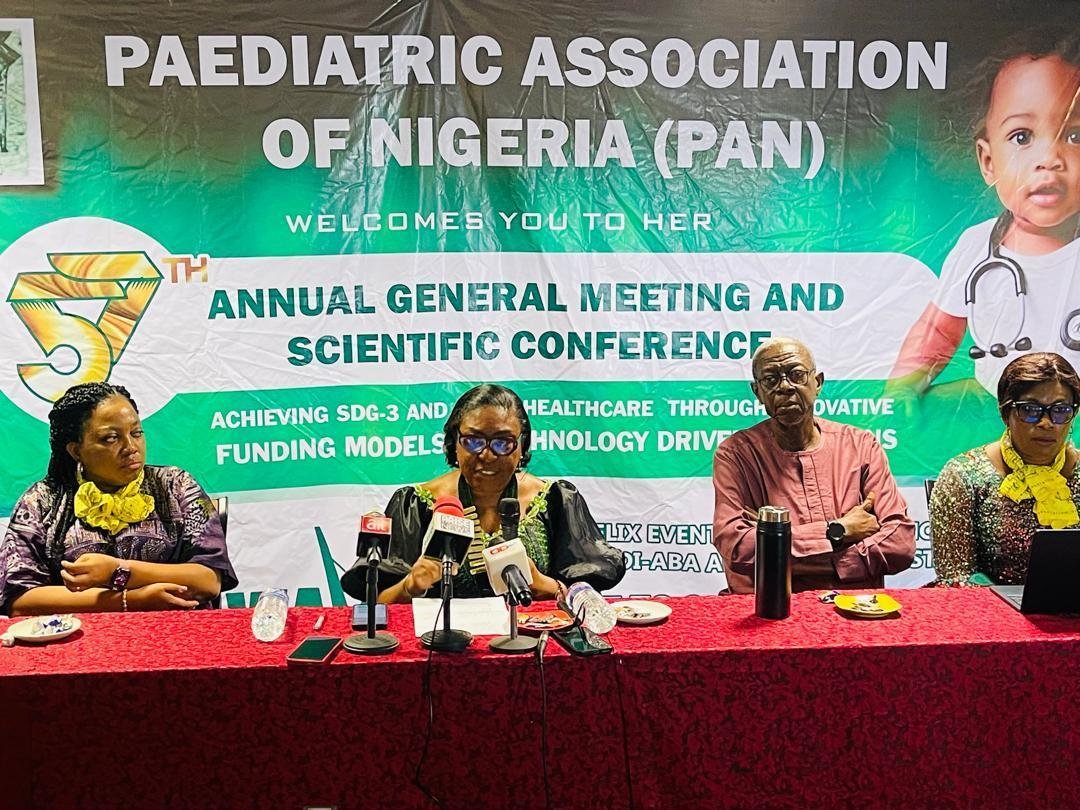
The President of the Paediatricians Association of Nigeria (PAN), Dr Ekanem Ekure, has criticised the 4.3 percent allocation to health in the 2026 national budget, warning that it reflects a disturbing lack of commitment to the welfare and future of Nigerian children.
Ekure also demanded comprehensive medical intervention and environmental remediation for victims of the Ogijo lead poisoning crisis in Ogun State, which has been linked to recycled battery factories and has largely affected children. She said the incident must trigger stricter regulatory enforcement and coordinated national action to protect vulnerable children and prevent a recurrence.
The PAN President spoke on Thursday in Abeokuta at the opening ceremony of the association’s 57th Annual General Meeting and Scientific Conference, themed “Achieving SDG-3 and Child Health Care through Innovative Funding Models and Technology-Driven Solutions.”

She said the conference theme reflected the urgency of Nigeria’s worsening child health indicators and the need for decisive action by government, health professionals, and development partners.
According to her, Nigeria continues to carry an unacceptable burden of preventable childhood illnesses and deaths despite ongoing interventions.
“Neonatal and under-five mortality rates remain high at 41 and 110 per 1,000 live births respectively. Malnutrition persists, immunisation coverage is still suboptimal, and access to quality child health services remains deeply unequal,” Ekure said.
She described the Ogijo lead poisoning incident as a stark reminder of the dangers facing children, noting that while the closure of the affected factories was welcome, it fell short of what was required.
“Comprehensive remediation, sustained medical care for affected children, firm regulatory enforcement, and coordinated national action remain our demand,” she said.
Ekure also raised concern over rising cases of child abuse, including abductions from schools and markets, particularly in northern Nigeria, describing them as grave violations of children’s fundamental rights.
She said poverty, conflict, insecurity, climate change, and emerging health threats had compounded these challenges, adding that paediatricians were morally obliged to speak out as frontline witnesses to these realities.
On global commitments, Ekure said Sustainable Development Goal 3 places emphasis on ensuring healthy lives and ending preventable deaths of newborns and children under five, but Nigeria remained off track despite having policies aligned with the goal.
She stressed that achieving SDG-3 by 2030 would require accelerated action, adequate financing, and approaches that go beyond existing practices.
Ekure said the 4.3 per cent allocation to health in the 2026 budget fell far below the 15 per cent benchmark set by the Abuja Declaration and showed weak prioritisation of child health at the national level.
She called for innovative funding models, including public-private partnerships, blended financing, and outcome-based funding tied to independently verified results. She also advocated greater use of technology to improve immunisation tracking, strengthen disease surveillance, enhance data use, and expand access to care through telemedicine and digital platforms.
Reaffirming PAN’s commitment to collaboration, Ekure said the association would continue to build partnerships that translate research into policy and policy into measurable improvements in child health outcomes.
She urged the Federal Government to demonstrate clear political will by treating child health as a national development priority rather than a narrow sectoral concern. She also called on state governments to significantly increase health sector spending with a clear focus on child health, noting that sustained investment in immunisation, nutrition, primary healthcare, and maternal and child health services was essential.
“Adequate investment in child health is one of the most cost-effective ways to improve health outcomes and drive long-term social and economic development,” she said.
Read also:
- College of Health Technology, Akure students protest alleged extortion, decaying facilities
- Group urges Health Minister to intensify Genotype education across Nigeria
- Obaseki seeks doctors’ support to rejig Edo health system, tackle brain drain
Meanwhile, the Minister of State for Health, Dr Isiaq Salako, represented by the Deputy Director of Child Health, Dr Omokore Oluseyi, said the Federal Government was committed to reducing child mortality to the lowest possible level.
Salako said the National Child Survival Action Plan had been finalized and would focus on evidence-based interventions such as newborn resuscitation, integrated nutrition services, and community-based management of childhood illnesses.
He said the ministry was leveraging technology by digitalising the integrated community management platform to improve real-time diagnosis, referrals, and data capture.
According to him, Nigeria accounts for over 17 per cent of global under-five deaths, largely due to preventable conditions such as prematurity, pneumonia, malaria, and malnutrition.
He called on stakeholders to support the effective implementation of government plans, particularly in addressing operational gaps in newborn care, child nutrition, and digital health.
In his keynote lecture, a Professor of Paediatrics at the University of Ilorin and Strategic Adviser to the Ministry of Health on Malaria Elimination, Prof Olugbenga Mokolu, said innovative financing and strategic use of technology were critical to achieving SDG targets, especially in reducing child mortality rates.