The global technology industry has been rocked by a fresh wave of job losses, with new data showing that nearly 245,000 tech workers were laid off worldwide in 2025 as companies rapidly restructured around artificial intelligence, automation and efficiency-driven models.
A comprehensive report compiled by RationalFX, drawing from verified sources including U.S. WARN notices, TechCrunch, TrueUp and the Layoffs.fyi tracker, revealed that a total of 244,851 tech jobs were cut globally between January 2025 and January 2026. Of this figure, about 69,840 roles, representing roughly 28.5 per cent, were directly linked to AI implementation and large-scale organisational restructuring.
The findings underline a deepening shift in the tech sector, where artificial intelligence is no longer just a growth tool but a central driver of workforce reduction. Analysts say the scale and nature of the cuts point to a structural transformation rather than a temporary downturn.

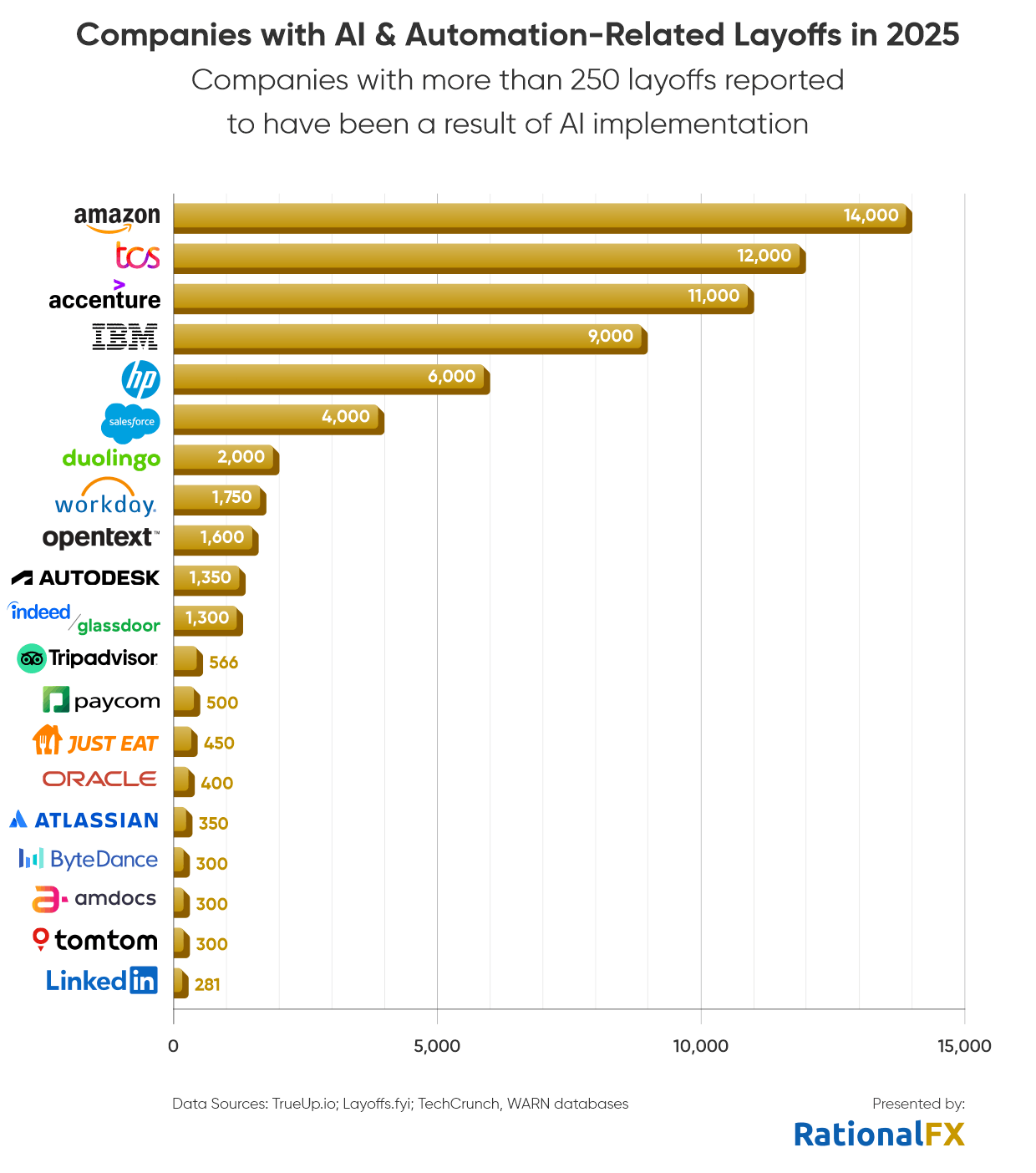
Amazon emerged as the company with the highest number of AI-related job losses in 2025, shedding around 14,000 roles as it accelerated the integration of artificial intelligence across its operations. Tata Consultancy Services followed closely with about 12,000 layoffs, while Accenture reduced its workforce by approximately 11,000 positions, all tied to AI adoption and internal restructuring.
Other major technology firms also recorded significant AI-driven layoffs during the year. IBM cut about 9,000 jobs, Hewlett-Packard eliminated roughly 6,000 roles, while Salesforce reduced its staff by around 4,000. Duolingo laid off close to 2,000 employees, Workday cut about 1,750 jobs, OpenText reduced headcount by roughly 1,600, and Autodesk eliminated an estimated 1,350 positions.
Although overall tech layoffs declined slightly from 2024, when about 281,000 jobs were lost, 2025 marked a turning point as artificial intelligence became a dominant force behind workforce reductions. Companies that remained financially strong still cut jobs, signalling a deliberate shift of investment away from labour and towards AI infrastructure, data systems and automation.
The United States remained the epicentre of the layoffs, accounting for approximately 170,630 job cuts, nearly 70 per cent of the global total. Analysts attribute this to the concentration of major tech firms in the US and their aggressive push to deploy AI across engineering, customer support and corporate functions.
The trend has continued into 2026. Meta recently announced plans to cut around 1,500 roles as it scales back long-term metaverse hardware projects, including virtual and augmented reality devices, in favour of AI-focused products and next-generation data infrastructure.
Experts warn that AI-driven workforce disruption is likely to intensify further this year. The International Monetary Fund has cautioned that most countries and businesses are not adequately prepared for the speed of AI adoption. Employee anxiety is also rising sharply, with concerns about AI-related job losses increasing from 28 per cent in 2024 to 40 per cent in 2026.
Commenting on the report, Alan Cohen, an analyst at RationalFX, said the pattern of layoffs reflects a fundamental redesign of how tech companies operate.
Read also:
- BoI explains delay in N75bn MSME loan disbursement, cites documentation, compliance gaps
- NANS postpones National Congress, announces new inauguration date for Zone ‘A’ Executives
- Stop fee hike, commercialisation of education in Nigeria, CAPPA tells FG
“The AI-driven layoffs seen in 2025 point to a structural shift in the tech industry rather than a temporary downturn. As artificial intelligence becomes more powerful, companies are redesigning operations around automation and eliminating roles in support, administration and middle management,” Cohen said.
He added that unlike previous downturns, the cuts are happening alongside strong corporate earnings, highlighting a strategic reallocation of resources from human labour to AI systems. While demand is expected to grow for specialised skills in AI engineering, data science and infrastructure, large sections of the traditional tech workforce face increasing uncertainty.
The report concluded that how companies manage AI upskilling and workforce transitions may soon become a decisive factor for investors, as pressure mounts on firms to balance innovation with social and economic responsibility.