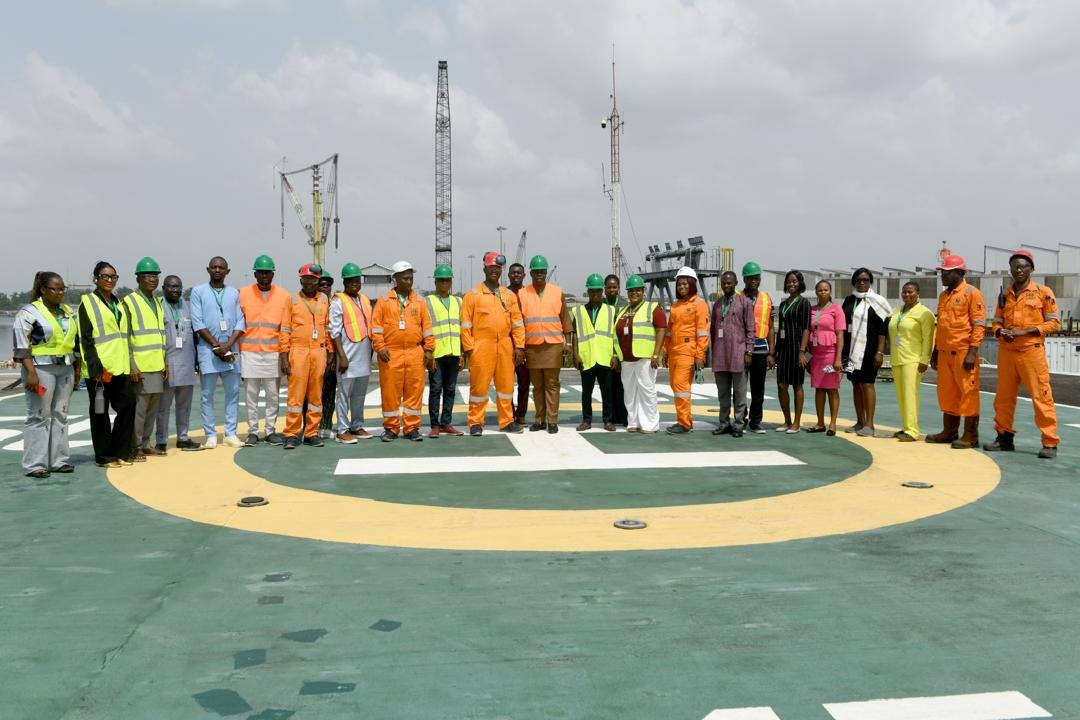
The Nigeria Content Development and Monitoring Board, (NCDMB) has concluded a media tour of some oil and gas facilities in Port Harcourt.
The tour with select journalists was aimed at exposing the journalists to witness firsthand how some of the processes in the oil and gas value chain take place and it was part of the annual capacity building of journalists fashioned by the management of the NCDMB.
The tour concluded with a visit to Marconi.NG EPC Limited (Marconi), where the firm said it is positioning itself as one of the leading oil and gas service companies in West Africa, with focus on cost competitive and speedy delivery of projects and opportunities.
Marconi, which is a wholly Nigerian entity, acquired the assets of Saipem Contracting Nigeria’s Rumuolumeni Yard in May 2025.
Read also:
- Firm seeks legislation to ensure availability of raw materials
- Nigerian Teacher Kayode Adewale named among World’s top 50 educators
- Tamunokuro declares for Port Harcourt City Mayor, pledges purposeful leadership
Conducting the journalists round the facility, Nigerian Content Manager of Marconi, Dr. David Editang, explained that the new owners retained the services of local experts who operated the facility for decades prior to the acquisition of the facility.
He noted that the facility has the capacity to fabricate, store and load out completed project structures through three of its jetties.
According to him, Marconi recently marked the First Steel Cutting Ceremony for some subsea structures for one of the major offshore projects currently being executed in Nigeria.
The facility also played a significant role in the execution and construction of several notable projects in the past including Egina, Usan, Akpo, Train 7, among many others.
The General Manager, Corporate Communications Division (CCD) of the NCDMB, Dr. Obinna Ezeobi, led other NCDMB personnel and a host of journalists on the facility tour.
He noted that Marconi is now well positioned to operate across the oil and gas value chain, from land, swamp and shallow waters to deep sea offshore.
Giving reasons for the tour, Dr. Ezeobi said, “As we showcase the companies, we are achieving our mandate as set out in Sections 67 and 70 (n) of the Nigerian Oil and Gas Industry Content Development (NOGICD) Act.” These Sections mandate the NCDMB to promote Nigerian Content through communication and stakeholder engagement and also outlines the Board’s functions which include capacity building.
He explained that media practitioners are critical stakeholders in the implementation of the NOGICD Act. According to him, “We want the media to better understand how the oil and gas industry works; we want to deepen our relationship, and to build the capacity of media stakeholders in reportage.”
He also noted that the NCDMB had established sustainable relationships with media stakeholders in different parts of the Country, and organized annual engagements in Port Harcourt, Lagos and Abuja.
Speaking during the tour, the Chief Executive Officer of Marconi, Mr. Gian Fabio Del Cioppo explained that the company’s yard covers more than 1,000,000 square meters, includes a 330-meter jetty, and has the capacity to fabricate over 25,000 tons of heavy structures per year. He added that the facility is one the leading yards in the country with assets and organizational capability to execute fabrication and other services for complex capital EPC projects, both onshore and offshore.
He emphasized that the company possesses the equipment, technical capacity, legacy and human capabilities to deliver the highest quality of work in the industry at competitive costs and schedule, aligned with the Presidential Directives on Local Content and the provisions of the Nigerian Oil and Gas Industry Content Development (NOGICD) Act, 2010.
He appealed to the Government and oil industry stakeholders to be steadfast with the implementation of the NOGICD Act, insisting that Marconi is well positioned to support national goals, while contributing significantly to job creation and economic growth. He underscored the benefits of local content to the economy and urged the Government to resist pressures to roll back the progress that had been achieved in local content implementation in the last 15 years.