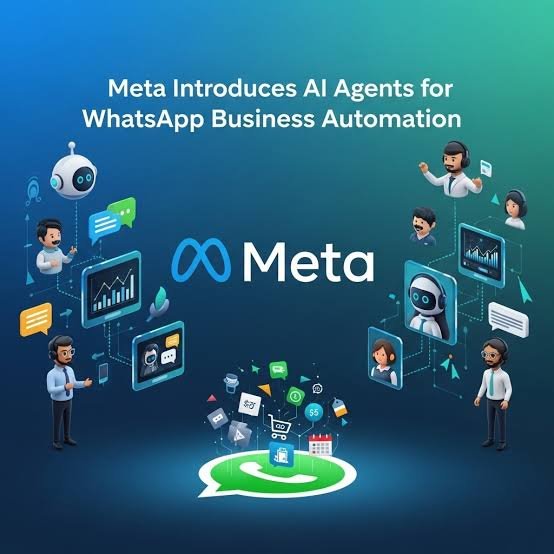
Meta Platforms has launched a new artificial intelligence service aimed at helping small businesses automate tasks across the digital platforms they already use.
Key Highlights
- Meta launches Muse for Small Business, an AI service designed to help small businesses automate routine tasks across workplace and business applications.
- Muse can connect with platforms including Asana, Zoom, Intuit, Box, Canva and Slack, as well as Meta advertising accounts and professional Facebook and Instagram profiles.
- Meta said the service is aimed at helping small businesses save time and manage routine operations across multiple platforms.
- The company said about 200 million small businesses are present on its platforms, providing a large potential market for Muse.
- Muse will be available for free within specified usage limits, with additional usage offered through a paid subscription.
The company announced the launch of Muse for Small Business, an expansion of its Muse AI agent that allows businesses to connect the technology with popular workplace and business applications.

According to Meta, Muse can work with platforms including Asana, Zoom, Intuit, Box, Canva and Salesforce’s Slack, while also connecting to businesses’ Meta advertising accounts and professional Facebook and Instagram profiles.
The company said the service was developed to help small businesses save time by allowing the AI agent to carry out routine tasks across multiple applications. “Small businesses have been growing on our apps for nearly two decades,” Meta said in a statement announcing the service.
The company said businesses had told it they were “short on hours, not ideas,” prompting the development of the new service.
Meta said about 200 million small businesses are present on its platforms, giving the company a large potential market for the AI product.
Under the existing pricing model for Muse, businesses will be able to use the service for free within specified usage limits, while additional usage will be available through a paid subscription.
The launch marks another major step in Meta’s efforts to expand its artificial intelligence business beyond its traditional social media and digital advertising operations.
Meta has historically generated most of its revenue from advertising on Facebook and Instagram. However, Chief Executive Officer Mark Zuckerberg has increasingly identified AI as a major area of investment and future growth for the company.
The company has committed billions of dollars to expanding its AI infrastructure and recruiting leading researchers and executives as it competes with companies such as OpenAI and Anthropic.
Among its prominent AI hires is Scale AI founder Alexandr Wang, who is leading Meta’s AI efforts and whose team has been developing models under the Muse Spark family.
At Meta Connect last week, Zuckerberg described Muse as the “centerpiece” of the company’s AI strategy, highlighting the growing importance of the technology to Meta’s broader business plans.
The latest initiative follows Meta’s unveiling of Muse earlier this month. The AI application rapidly climbed Apple’s App Store rankings following its September 8 launch and at one point moved ahead of OpenAI’s ChatGPT.
Evercore analyst Mark Mahaney has projected that Muse could reach 100 million users within six to 12 months, reflecting growing demand for AI-powered assistants.
Meta is now attempting to extend that momentum into the business sector by allowing Muse to perform tasks across several workplace and commercial platforms. “Give Muse a goal, like running your business or finding new customers, and it gets it done,” Meta said.
Read also:
- Alphabet Increases AI Spending To $205bn As Global Artificial Intelligence Race Intensifies
- Artificial Intelligence and Academic Integrity: Where Should We Draw the Line?
- AI Revolution: How Artificial Intelligence rendered Stack Overflow obsolete for developers
The move comes shortly after Meta announced plans for a new enterprise platform as it intensifies its competition with major AI companies.
As part of the enterprise push, Meta has recruited MongoDB Chief Executive Officer CJ Desai to lead the new platform.
The planned offering is expected to include a Muse AI agent, a business-focused agent and a coding tool.
The development reflects a broader shift in the AI industry towards AI agents capable of performing tasks autonomously, rather than systems limited to generating text, answering questions or producing images.
Meta’s latest move also comes as OpenAI hosts its developer-focused event, highlighting the increasingly fierce competition among major technology companies for dominance in the emerging enterprise AI market.
Related: Apple TV Nigeria Launches With iCloud+ Plans Starting at ₦1,300