
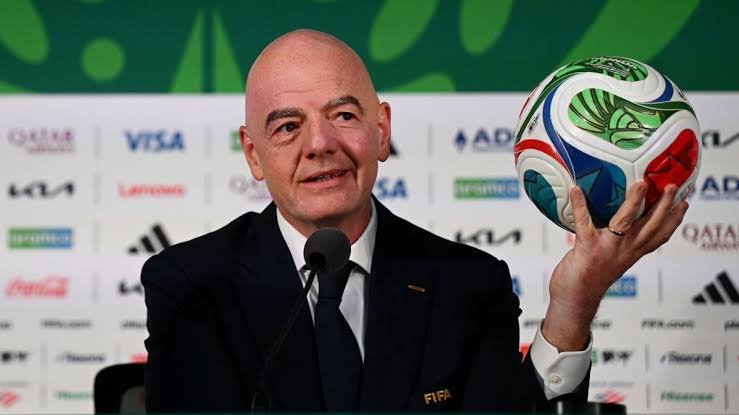
World football governing body FIFA has defended its controversial proposal to allow private investors to acquire minority stakes in a new commercial arm, insisting that “nobody is selling football” despite mounting resistance from major football confederations.

In a statement released on Friday, FIFA rejected claims that it intends to privatise the sport, stressing that its consultation process had been distorted by inaccurate media reports.
The organisation reaffirmed its commitment to allowing all 211 member associations to vote on the proposal based on factual information.
“We respect the feedback and concerns expressed publicly and remain committed to an open and democratic consultation. Nobody is selling football. This is not something FIFA would ever entertain,” the governing body said.
Read Also:
- UEFA Threatens World Cup Boycott Over FIFA Private Investment Plan
- FIFA Faces Backlash Over $40m Offer To Secure Support For World Cup Commercial Plan
- FA Raises Alarm Over FIFA Investment Plan As UEFA Calls Emergency Meeting
The proposal, championed by FIFA President , seeks to establish a new commercial subsidiary known as FIFA Forward Enterprise (FFE). Under the plan, external investors would be allowed to purchase minority, non-controlling stakes in the company, which would manage FIFA’s flagship competitions, including the FIFA World Cup.
FIFA argued that the new structure would enable member associations to benefit more directly from football’s commercial growth while preserving the organisation’s governance and the integrity of the game.
However, the initiative has triggered fierce opposition across world football.
The (UEFA) voted on Thursday to boycott future FIFA World Cups if the proposal is approved, warning that the tournament should never become an investment asset.
“The World Cup cannot be treated as an investment product,” UEFA said, describing the plan as a failure of leadership and insisting that football’s greatest competition must remain under the stewardship of the global football community rather than private investors.
The (Concacaf), representing 41 national associations, also rejected the proposal, citing concerns over inadequate consultation and the short deadline imposed on member federations.
Together, UEFA and Concacaf account for 96 of FIFA’s 211 voting members, meaning their combined opposition poses a significant obstacle to securing the 106 votes required for the proposal’s approval.
Reports indicate that member associations supporting the initiative would receive up to $40 million in funding, with an initial $20 million available to federations that endorse the plan before the September 19 deadline.
If approved, American venture capital firm Thrive Eternal is expected to lead the consortium of investors backing the new commercial entity.
Opposition has also spread beyond Europe and North America. The criticised FIFA for acting without proper consultation and questioned the absence of detailed financial, legal and governance information.
Meanwhile, South America’s has yet to publicly state its position, while the (CAF) and the (OFC) are expected to deliberate on the proposal during meetings in August.
The debate has also drawn reactions from within the football community. Chelsea manager argued that football should remain accessible to supporters rather than private investors.
“I think football has to be for the people, not in private hands,” Alonso said during Chelsea’s pre-season tour of Australia. “Hopefully it won’t happen, and we can keep the game attractive, authentic and for everyone.”
The coming weeks are expected to be decisive as FIFA continues consultations with its member associations ahead of the September vote that could reshape the commercial future of world football.