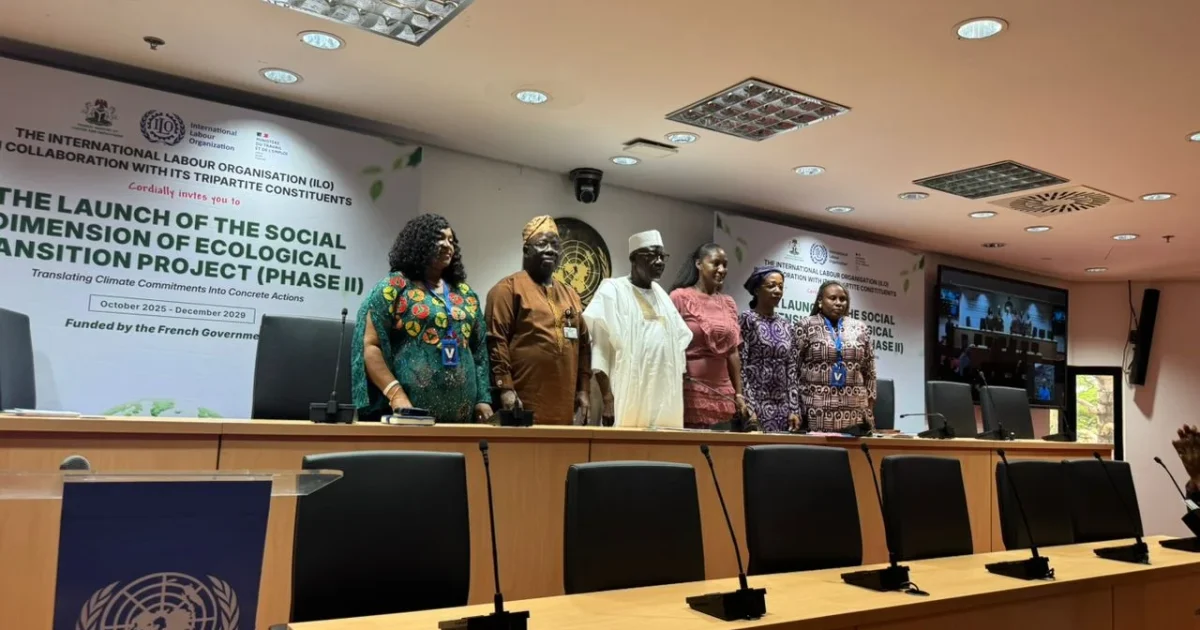
The Federal Government has launched Phase II of the International Labour Organisation (ILO) Social Dimension of Ecological Transition Project, reaffirming its commitment to ensuring that Nigeria’s transition to a low-carbon economy creates decent jobs, protects workers and promotes inclusive economic growth.

The project, funded by the French Government through the International Labour Organisation’s (ILO) technical cooperation programme, was officially launched on Thursday at the United Nations House in Abuja. It brings together government agencies, employers, workers’ organisations, development partners and climate experts to strengthen Nigeria’s just transition agenda from 2025 to 2029.
Key Highlights
- Federal Government launches Ecological Transition Phase II in Abuja.
- Initiative aims to create green jobs and support a just transition to a low-carbon economy.
- Project is funded by the French Government through the ILO.
- Nigeria to implement its Just Transition Guidelines and Action Plan between 2025 and 2029.
- Stakeholders call for stronger collaboration to drive climate action, job creation and sustainable development.
Speaking at the launch, the Minister of Labour and Employment, Dr. Muhammad Dingyadi, described the renewed partnership as an opportunity to move beyond policy formulation to practical implementation.
According to him, Nigeria’s ecological transition must deliver climate action that promotes decent work, social justice, sustainable enterprise development and inclusive economic growth.
“This gathering comes at an important moment as Nigeria deepens its commitment to climate action in a manner that advances decent work, social justice, sustainable enterprise development and inclusive growth,” Dingyadi said.
The minister explained that Phase II of the Ecological Transition Project would build on the achievements recorded during the first phase by supporting sustainable businesses, creating green employment opportunities and strengthening community resilience.
He noted that the renewed programme, which will run from 2025 to 2029, provides an opportunity to transform policy commitments into measurable outcomes for workers, employers and local communities.
Dingyadi disclosed that the first phase of the project strengthened Nigeria’s institutional capacity through policy engagement, social dialogue and evidence-based planning, leading to the development of the country’s Just Transition Guidelines and Action Plan.
He stressed that successful implementation would require coordinated action among government institutions, development partners, employers and labour organisations.
“The real test is implementation. Commitments must become investments, policies must become programmes and programmes must produce results that citizens can see and feel,” he said.
The minister urged all stakeholders to align their resources, expertise and institutional capacities to ensure the successful implementation of the second phase of the project.
Earlier, the ILO Country Director for Nigeria, Ghana, Liberia, Sierra Leone and the ECOWAS Liaison Office, Dr. Vanessa Phala, described the initiative as a major platform for promoting a just ecological transition in Nigeria.
She noted that the first phase focused extensively on capacity building, training government institutions and social partners on the principles of just transition.
According to her, one of the landmark achievements of the first phase was the successful integration of Just Transition into Nigeria’s Nationally Determined Contributions (NDC 3.0), making Nigeria one of the few countries to embed labour and social protection considerations into its climate commitments.
Read Also:
- FG To Distribute Free Gas Cylinders To 5m Households
- FG Credits Reforms For Improved Performance Of Nigerian Universities In 2026 Global Rankings
- FG Plans Competency-Based Digital Curriculum For Colleges Of Education, Says NCCE Boss
Dr. Phala explained that the second phase would prioritize durable clean energy solutions and support Nigeria’s gradual transition from conventional energy sources to more sustainable alternatives.
She reaffirmed the ILO’s commitment to supporting the Federal Government in implementing climate-friendly labour policies and achieving its renewable energy and sustainable development goals.
Also speaking, the Permanent Secretary of the Ministry of Labour and Employment, Dr. Kamil Shoretire, said lessons learned during the first phase would shape the implementation strategy for the new programme.
He emphasized the importance of reliable data and evidence-based planning in achieving a successful and inclusive ecological transition.
The Director-General of the National Council on Climate Change (NCCC), Mrs. Tenioye Majekodunmi, called for climate policies that place people at the centre of development.
She said the council would leverage the second phase of the project to align implementation of Nigeria’s Just Transition Guidelines and NDC 3.0 with practical interventions, including clean energy, clean cooking initiatives and other programmes capable of creating jobs, reducing poverty and improving livelihoods.
Majekodunmi urged all stakeholders to work collectively to ensure that Nigeria’s ecological transition remains equitable, sustainable and beneficial to both the economy and the environment.