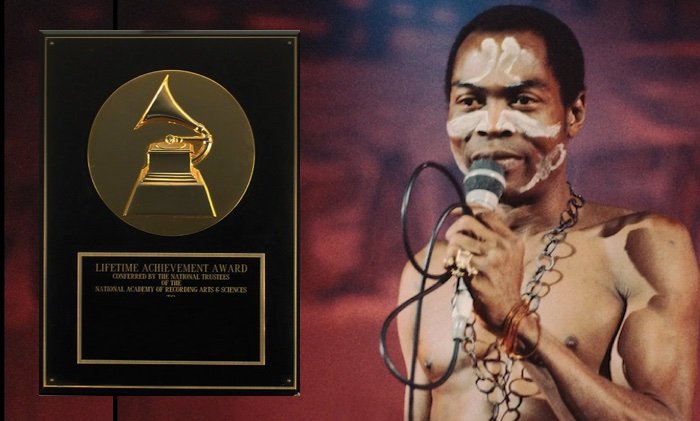
The late Nigerian icon Fela Anikulapo Kuti has made history as the first African to be honoured with the Grammy Lifetime Achievement Award, a landmark recognition that cements his towering influence on global music and culture.
Nearly three decades after his death in 1997 at the age of 58, the king of Afrobeat will receive the award posthumously, marking a long overdue acknowledgment by the world’s most prestigious music institution.

Rikki Stein, Fela’s longtime friend and manager, described the honour as “better late than never,” noting that African contributions to global music have often been ignored despite their far-reaching impact. According to him, the tide is finally turning as African sounds continue to dominate international stages.
The recognition comes at a time when Afrobeats, a genre deeply rooted in Fela’s work, has become one of the fastest-growing music movements worldwide. Reflecting this shift, the Recording Academy introduced the Best African Performance category in 2024. This year, Nigerian superstar Burna Boy is also nominated for Best Global Music Album, underscoring Africa’s growing presence at the Grammys.
Fela Kuti now joins an elite list of Grammy Lifetime Achievement Award recipients, an honour first bestowed in 1963 on American singer Bing Crosby. His inclusion not only breaks a continental barrier but also reaffirms his enduring relevance.
More than a musician, Fela was a fearless political activist, cultural philosopher, and the architect of Afrobeat, a genre that fused West African rhythms with jazz, funk, highlife, and sharp political commentary. Across a career that spanned over three decades, he released more than 50 albums, using music as a weapon against oppression and military rule in Nigeria.
Read also:
- Omije Ojumi’s children learn of biological father at funeral
- TikToker Jarvis confirms new boyfriend after split from Peller
- Met Gala 2025: Theme, dress code, co-chairs, hosts announced
His defiance reached a climax in 1977 with the release of the album Zombie, a scathing satire of Nigerian soldiers. The record provoked a brutal military raid on his Lagos commune, the Kalakuta Republic, during which his mother, Funmilayo Ransome-Kuti, sustained injuries that later led to her death. Fela transformed his grief into protest with the powerful song Coffin for Head of State, further cementing his legacy as music’s most uncompromising dissenter.
Drawing inspiration from Ghanaian highlife, jazz legends, and Yoruba musical traditions, Fela shaped Afrobeat into a pan-African force that carried West Africa’s sound and political consciousness to the world.
On stage, he was magnetic and unrestrained, performing with his saxophone in hand, backed by a large band, and delivering marathon shows that blended music, theatre, and resistance. Decades after his death, Fela Kuti’s voice still echoes across generations, and with this Grammy honour, the world has finally caught up.