The Delta State Government has allocated 0.5 percent of its ₦1.729 trillion 2026 budget to fund healthcare services for pregnant women, children under five and other vulnerable groups under the Equity Plan of the Delta State Contributory Health Scheme.
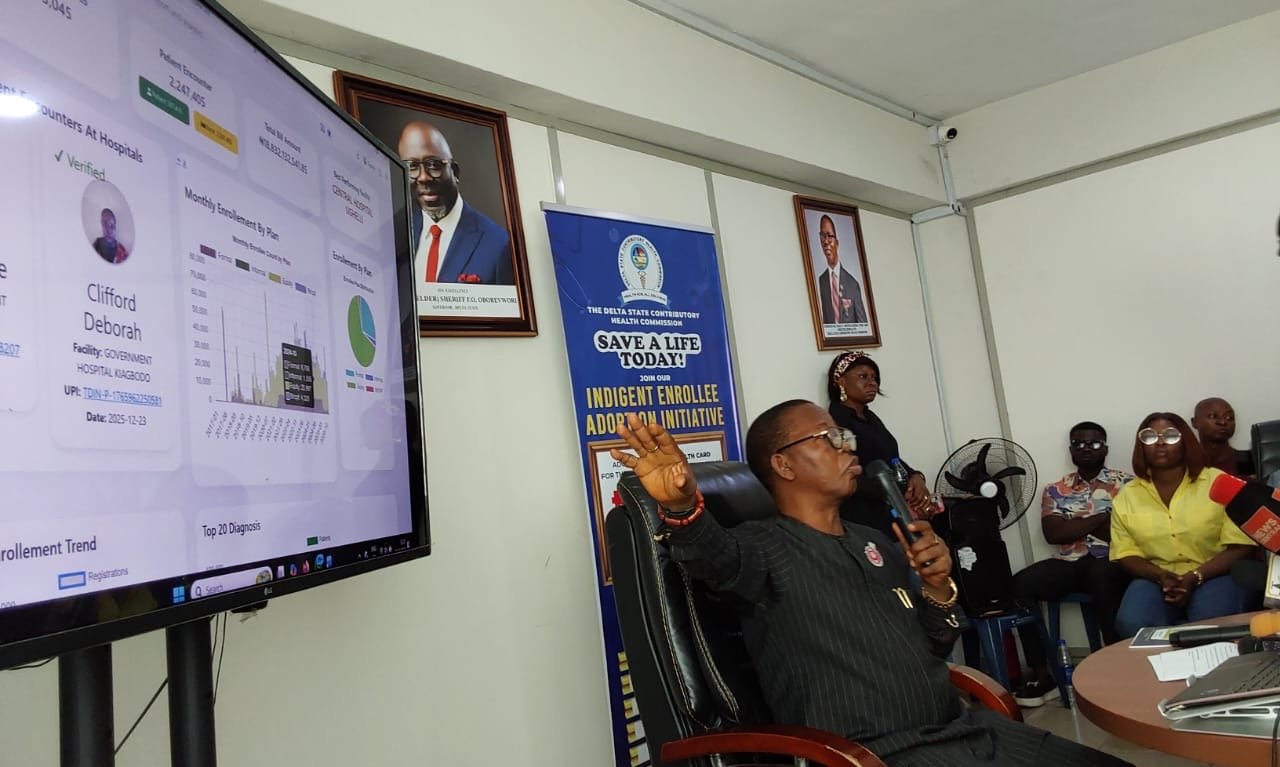
The Director General and Chief Executive Officer of the Delta State Contributory Health Commission (DSCHC), Olorogun Isaac Akpoveta, disclosed this to journalists in Asaba, Tuesday, while highlighting the financial commitment of the Governor Sheriff Oborevwori–led administration to strengthening universal health coverage in the state.

Akpoveta praised Governor Oborevwori for his consistent support for the scheme, noting that the dedicated budgetary allocation reflects the administration’s people-focused approach to healthcare delivery.
According to him, the 0.5 percent allocation from the ₦1.729 trillion 2026 budget is earmarked specifically for the Equity Plan, which caters for vulnerable members of society, including pregnant women, children under five, the elderly, and persons living with physical or mental disabilities.
He explained that under the Equity Plan, pregnant women are entitled to free healthcare from antenatal care through delivery, regardless of their place of origin. He added that all costs—whether from normal delivery or caesarean section—are borne by the state government through the health insurance scheme.
Akpoveta further stated that children delivered under the scheme receive free healthcare services from birth until the age of five, a policy he said has contributed significantly to the reduction in maternal and child mortality across Delta State.
The DG noted that the Equity Plan is one of three major components of the state’s health insurance programme, with the others being the Formal Sector Plan and the Informal Sector Plan.
Read also:
- Delta commissioner spreads Christmas cheer to APC Ughelli South with ₦2.5m food support
- Delta Role Model Awards holds Nov. 7
- Delta Council boss puts smile on worker’s faces, presents cars to top LG executives
He explained that while the Equity Plan is fully funded by government, the Formal Sector Plan covers civil servants, public servants and workers in the organised private sector, who contribute 3.5 percent and five percent of their monthly and gross salaries respectively to sustain the scheme.
According to Akpoveta, the health insurance system operates on a risk-pooling principle, where contributions from higher-income earners help support those who are unable to pay, ensuring equitable access to healthcare services.
He stressed that the Oborevwori administration has prioritised healthcare access for rural communities, where residents are more exposed to illness and delayed medical attention. He said the impact of the scheme is evident in improved health indices across the state.
Akpoveta also revealed that enrolment under the scheme has grown from 1.3 million to over 2.7 million beneficiaries since the inception of the present administration, attributing the growth to sustained funding, policy clarity and increased public confidence.
He called on the media to support awareness creation and disclosed that the Commission has deployed a QR code–enabled digital platform that allows Deltans in the diaspora to sponsor health insurance coverage for relatives at home and make donations directly to the scheme.
He added that initiatives such as the Indigent Early Adoption Initiative, Tertiary Students Social Health Insurance Scheme and the Artisan Early Inducement Initiative have further expanded coverage among low-income earners, students and artisans.
Akpoveta reaffirmed that with the continued backing of Governor Oborevwori, the Delta State Government remains committed to sustaining the Equity Plan and ensuring that no resident is denied access to quality healthcare due to financial constraints.