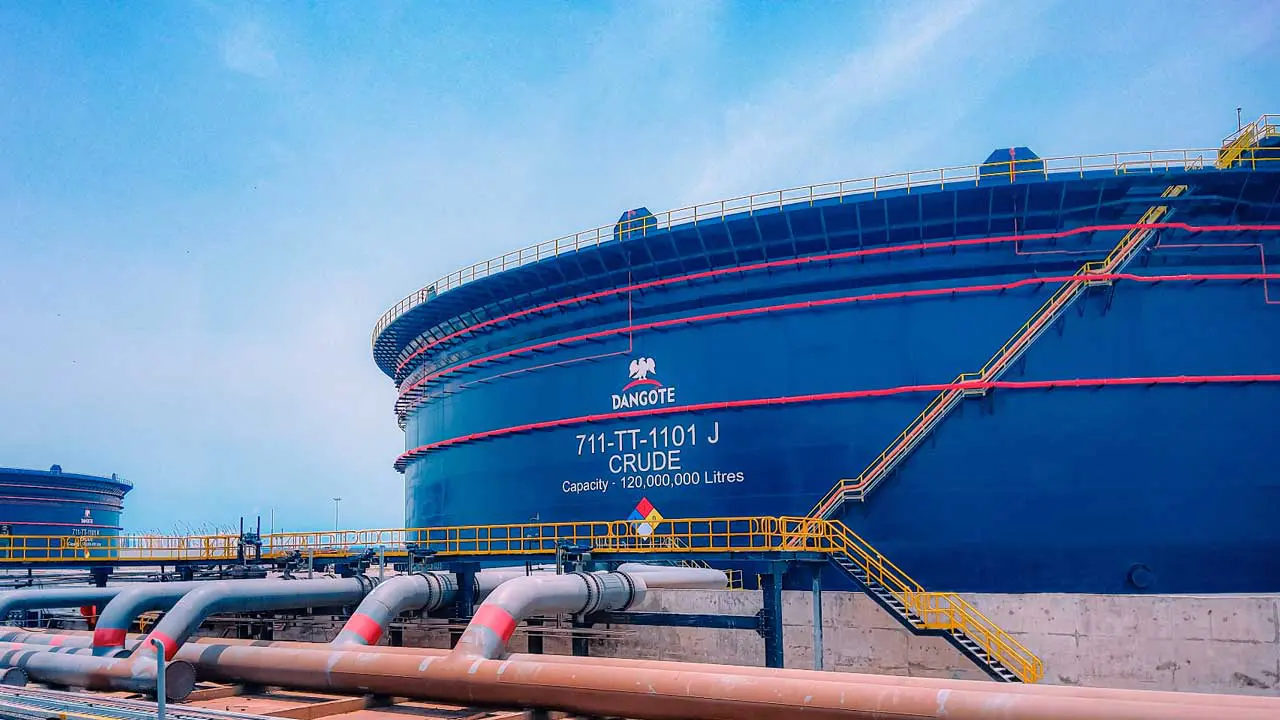
Dangote Petroleum Refinery has dismissed allegations that its petroleum products are exported to Lomé, Togo, and subsequently re-imported into Nigeria, describing the claims as false, unsubstantiated, and lacking any commercial basis.
Key Highlights
- Dangote Petroleum Refinery denies exporting fuel to Togo for re-import into Nigeria.
- Refinery describes allegations as baseless and contrary to business logic.
- Company says contracts expressly prohibit re-importation of its products into Nigeria.
- Refinery estimates such a trade route would add significant logistics costs.
- Dangote insists fuel imports undermine local refining and Nigeria’s energy security.
- Management says comprehensive sales records ensure product traceability.
- Refinery reaffirms commitment to reducing Nigeria’s dependence on imported petroleum products.
The refinery’s response comes amid heightened public debate over petrol pricing in Nigeria following recent developments in the global oil market and the easing of geopolitical tensions after a ceasefire agreement involving the United States and Iran.

The earlier conflict involving the United States, Israel, and Iran had triggered concerns over possible disruptions to global crude oil supply routes through the Strait of Hormuz, leading to a surge in international oil prices and corresponding increases in domestic fuel prices.
During the period, the Dangote Petroleum Refinery, one of Nigeria’s largest suppliers of refined petroleum products, adjusted its ex-depot petrol prices several times in response to market realities.
Petrol prices, which hovered around ₦870 per litre before the geopolitical crisis, climbed significantly, reaching nearly ₦1,500 per litre in some parts of the country. Current pump prices remain around ₦1,340 per litre in Abuja and several other major cities.
Read Also:
- Dangote Petroleum Refinery to revolutionize Nigeria’s fuel supply with nationwide distribution starting August 15
- 4 steps to become Dangote Petroleum Refinery Distributor in Nigeria
- Top oil marketers ask Court to block Dangote Refinery from monopolizing Nigeria’s petroleum sector
Following the ceasefire and the subsequent decline in global crude oil prices, many Nigerians expected a corresponding reduction in domestic petrol prices. Brent crude, which had surged above $100 per barrel during the conflict, has since fallen significantly and recently traded between $74.95 and $75.07 per barrel.
The situation has generated widespread discussions, with some commentators questioning why domestic fuel prices have not declined at the same pace as international crude prices.
Responding to recent allegations, the refinery issued a statement on Tuesday titled “Response to Unsubstantiated Claims and Tissue of Lies”, explaining that while it generally avoids engaging with unfounded accusations, it considered it necessary to clarify the matter.
According to the company, claims that its products are shipped to Lomé and later re-imported into Nigeria are not supported by available trade data and defy commercial reasoning.
The Dangote Petroleum Refinery stressed that facilitating imports that would directly compete with its products in Nigeria would undermine its own business interests and market position.
“Accordingly, Dangote Refinery’s sales contracts and tender terms expressly prohibit the resale or re-importation of products into Nigeria,” the statement noted.
The company further explained that the economics of such transactions make little sense. It estimated that transporting petroleum products from its refinery to Lomé and back into Nigeria would cost between $82 and $90 per metric tonne, significantly increasing operational expenses and reducing profitability.
The refinery stated that it does not provide export discounts large enough to offset additional logistics, financing, storage, and handling costs associated with such a route.
“Simply put, there is no evident commercial incentive for a producer to incur additional shipping, storage, financing and handling costs only for the product to return and compete in its largest and closest market,” the company stated.
The refinery also disclosed that it maintains detailed records of all product sales, including vessel nominations, loading terminals, counterparties, and destination declarations where required.
According to the management, allegations suggesting it knowingly supports the re-importation of its products into Nigeria are inconsistent with both its contractual obligations and compliance procedures.
The company further argued that increased fuel imports run contrary to its long-standing advocacy for local refining and energy independence.
It maintained that excessive dependence on imported petroleum products places pressure on Nigeria’s foreign exchange reserves, weakens domestic industrial growth, and undermines investments in local refining infrastructure.
“It would therefore be inconsistent with both the refinery’s commercial interests and its publicly stated position to support or encourage practices that increase imports into Nigeria,” the statement added.
The Dangote Petroleum Refinery concluded that there is neither a strategic nor commercial incentive for exporting refined products to neighbouring countries for subsequent re-importation into Nigeria.
The company reiterated that the allegations are unsupported by trade economics, contractual arrangements, product tracking mechanisms, and its broader commitment to strengthening domestic refining capacity and enhancing Nigeria’s energy security.