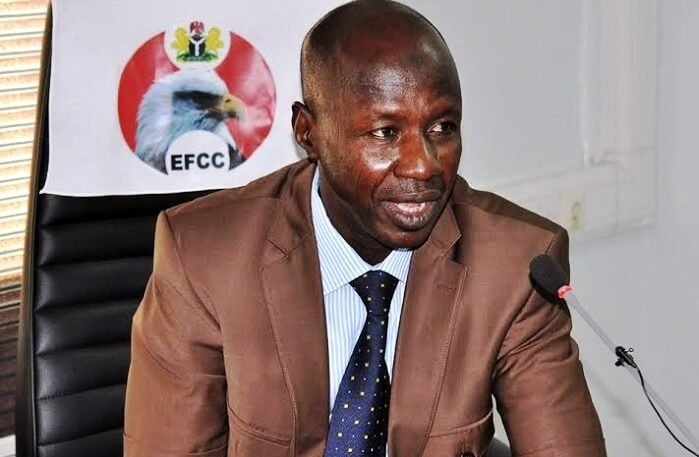
The Court of Appeal in Abuja, has declared that the prolonged tenure of Ibrahim Magu as acting chairman of the Economic and Financial Crimes Commission (EFCC) was unlawful, overturning a 2019 Federal High Court judgment that had allowed him to remain in office.
Key Highlights
- The Court of Appeal in Abuja has ruled that Ibrahim Magu’s prolonged tenure as acting EFCC chairman was unlawful, overturning a 2019 Federal High Court judgment.
- The case was brought by lawyer and activist Johnmary Jideobi, who challenged Magu’s continued stay in office after the Senate rejected his nomination twice.
- The Federal High Court had previously held that the EFCC Establishment Act did not specify a time limit for an acting chairman.
- The appeal centred on whether the President could retain an acting EFCC chairman indefinitely after the Senate rejected his substantive appointment.
- Magu served as acting EFCC chairman from 2015 until July 2020, when he was suspended by then-President Muhammadu Buhari.
The appellate court delivered the ruling on Monday, in an appeal filed by Abuja-based lawyer and activist, Johnmary Jideobi, who had challenged Magu’s continued occupation of the EFCC chairman’s office after the Senate twice rejected his nomination for substantive appointment.

The decision effectively reverses the position taken by Justice Ijeoma Ojukwu of the Federal High Court in Abuja in a judgment delivered on December 4, 2019.
Jideobi had approached the Federal High Court in 2017, arguing that Magu could not lawfully continue to serve indefinitely in an acting capacity after the Senate had rejected his nomination as substantive EFCC chairman.
Magu had served as acting chairman of the anti-graft agency from 2015 until July 2020, when he was suspended by the late President Muhammadu Buhari amid allegations of misconduct and irregularities.
Read also:
- EFCC Calls For Stronger Collaboration Between Law Enforcement Agencies, CSOs To Combat Illicit Financial Inflows
- 67.2m Nigerians Captured By Cash Transfers Amid Transparency Concerns – World Bank
- Yobe Teaching Hospital Performs 1st Total Hip Replacement Surgery In North-East
He denied the allegations and appeared before a presidential investigative panel headed by retired Justice Ayo Salami.
The latest judgment concerns the legality of the period during which Magu remained in office as acting chairman and does not affect the current leadership of the EFCC.
The legal dispute centred largely on whether the president could continue to retain an acting EFCC chairman after the Senate had rejected his nomination for substantive appointment.
Jideobi had argued that Magu’s continued stay in office became unlawful after the Senate twice refused to confirm him.
He also contended that the EFCC chairman has a four-year tenure, renewable once, and that Magu had already exceeded the permissible period without obtaining Senate confirmation.
According to the appellant, the president’s decision to keep Magu in an acting capacity could not override the statutory role assigned to the Senate in confirming the appointment of the EFCC chairman.
Jideobi further argued that Magu’s acting tenure had ended by operation of law once his nomination was rejected by the Senate.
He therefore asked the Court of Appeal to set aside the Federal High Court’s decision and grant the reliefs contained in his original suit.
In dismissing the case in 2019, Justice Ojukwu had held that the EFCC Establishment Act did not expressly prescribe a time limit for an acting chairman.
The judge found a lacuna in the law, noting that while Section 2(3) of the EFCC Establishment Act provides for the appointment of the EFCC chairman by the President subject to confirmation by the Senate, it did not stipulate how long an acting chairman could remain in office.
The judgment effectively left the duration of an acting appointment to presidential discretion.
Jideobi subsequently challenged the interpretation, arguing that the absence of an expressly stated time limit could not be used to justify an indefinite acting appointment.
The Court of Appeal has now overturned that earlier judgment.
Magu’s controversial tenure at the EFCC ended in July 2020 after Buhari suspended him following allegations of misconduct and irregularities.
Mohammed Abba, then the commission’s director of operations, subsequently assumed the role of acting chairman.
Abdulrasheed Bawa was later appointed substantive EFCC chairman in February 2021. Bawa was suspended by President Bola Tinubu in June 2023 amid allegations of abuse of office and misconduct and was subsequently replaced by Ola Olukoyede.