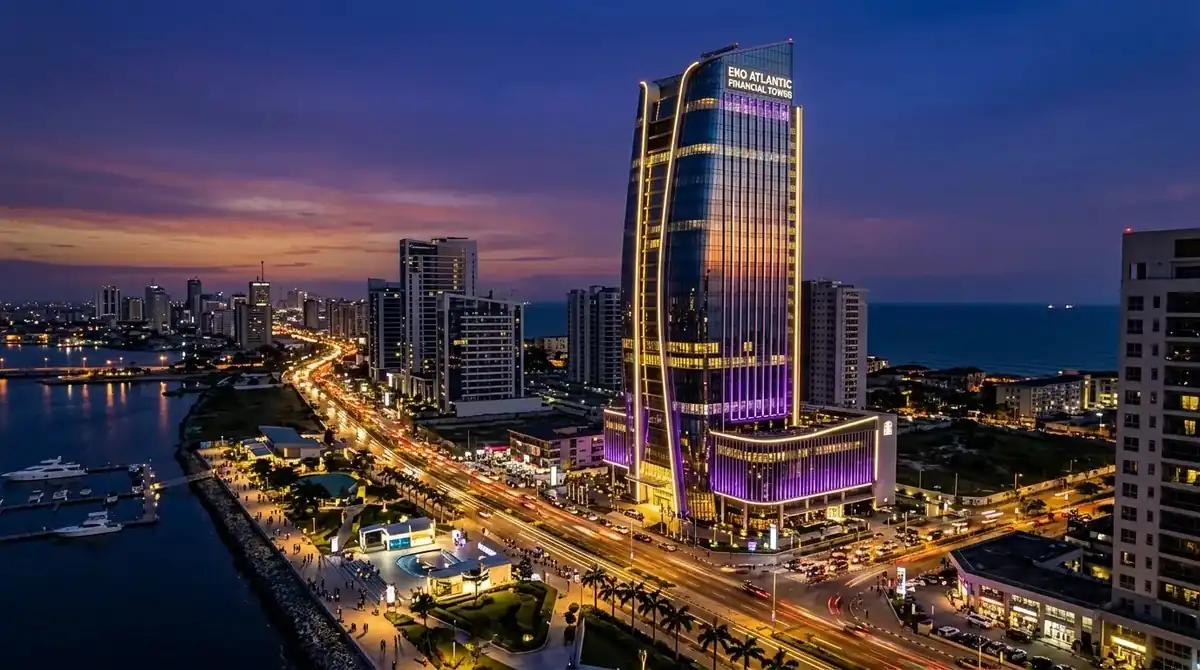
Eko Atlantic City has showcased its new power plant expansion in a promotional video released on November 17, 2026, highlighting its plan to strengthen electricity supply through an independent gas-fired power system. The project is expected to add about 56.7 megawatts (MW) of generation capacity to the city, which operates separately from Nigeria’s national grid.
Latest: Lagos news today: latest updates from Lagos State

Key Highlights
- Eko Atlantic’s new power plant expansion is expected to add approximately 56.7MW of electricity generation capacity.
- The project features Hyundai Heavy Industries gas engine generators.
- The first 10MVA gas power plant was commissioned in 2019.
- The city’s existing system includes five MTU Rolls-Royce engines running on pipeline gas.
- Eko Atlantic has developed its own underground cable network, substations and power distribution infrastructure.
- The project has renewed public discussion about electricity reliability and infrastructure development in Nigeria.
Inside Eko Atlantic’s New Power Plant
The promotional video, shared by Eko Atlantic on November 17, opens with aerial views of the facility, showing rows of cooling units, tall exhaust stacks and construction equipment around the site.
It then takes viewers inside the plant, where large blue industrial gas engines, yellow and blue pipework, pressure gauges, Danfoss control equipment and electrical switchgear are visible. Workers in protective clothing are also seen inspecting the installations.
The video closes with views of the rooftop cooling systems against the Lagos skyline, followed by night-time aerial shots of Eko Atlantic’s illuminated buildings and streets.
The footage presents the project as part of the city’s wider infrastructure development and its ambition to provide a dependable electricity supply for residents, businesses and investors.
How Eko Atlantic’s Power System Has Developed
According to information published on Eko Atlantic’s official infrastructure page, the city’s electricity system has been developed in phases.
The first power plant, commissioned in 2019, had a capacity of 10MVA and was powered by six MTU Rolls-Royce engines. It initially used compressed natural gas as fuel.
The system subsequently transitioned to pipeline gas after a supply connection from Axxela reached the city. Eko Atlantic’s infrastructure information identifies five MTU Rolls-Royce engines as part of its existing generation arrangement.
The electricity generated is distributed through approximately 48 kilometres of underground cables serving different parts of the development.
The latest video appears to showcase the next phase of the city’s power infrastructure programme.
Hyundai Gas Generators Expected to Add 56.7MW
Reports on the expansion have identified six Hyundai Heavy Industries (HHI) HiMSEN 20H35GV gas engine generator sets as the main equipment for the new facility.
The first phase has been reported to provide approximately 56.4MW of electricity generation capacity, while Eko Atlantic’s project information puts the planned addition at 56.7MW.
The longer-term development plan has also been reported to envisage expanding the city’s generation capacity to as much as 500MW as construction and occupation progress.
The project is designed to support Eko Atlantic’s independent electricity arrangement, which includes its own generation facilities, 33kV distribution network and substations.
This means the city does not depend on the national grid for its day-to-day electricity supply.
Read also:
- Gwagwalada 350MW Power Plant: Q1 2027 Commissioning Feasible as AKK Gas Supply Nears Abuja
- BEDC Demands Justice as Staff Member Is Allegedly Stabbed to Death Over Electricity Disconnection in Delta
- AKK Gas Pipeline to Boost CNG Supply Across Northern Nigeria, Abuja to Get Gas Before End of 2026, NNPC Says
Eko Atlantic Power Plant Sparks Reactions Online
Although the promotional video was intended to showcase the city’s infrastructure, reactions from viewers also reflected wider concerns about electricity supply in Nigeria.
Several commenters described the facility as massive and impressive, while others compared the prospect of reliable electricity in Eko Atlantic with the frequent outages experienced in other parts of Lagos and the country.
The discussion extended to questions about the responsibilities of federal and state governments in addressing Nigeria’s power challenges. Some viewers defended infrastructure development in the Southwest, while another commenter expressed interest in employment opportunities within the power sector.
The reactions highlighted a recurring national concern about the unequal availability of reliable electricity across communities.
Power Supply at the Centre of Eko Atlantic’s Development Plan
Eko Atlantic was conceived as a self-contained city with dedicated infrastructure covering electricity, water treatment, drainage and coastal protection.
Its power system is central to its ambition to attract businesses, investors and residents seeking a planned urban environment with dependable services.
The development already includes facilities such as Rugby School Lagos and Orca Mall, while residential and commercial towers continue to rise around its marina district.
For a development of this scale, a stable electricity supply is essential to the operation of homes, offices, commercial facilities and other services.
The planned Hyundai power plant expansion is therefore an important part of Eko Atlantic’s wider development programme. Its generation capacity is expected to increase in stages as the city grows.
Can Eko Atlantic’s Power Model Be Replicated Elsewhere?
Eko Atlantic’s approach raises questions about the role of independent power generation in addressing Nigeria’s electricity challenges.
A privately managed system with dedicated generation and distribution infrastructure offers one approach to supplying electricity within a defined development. However, extending such a model to other cities would depend on factors including investment costs, fuel supply, regulation, infrastructure and the ability of consumers to pay for the service.
For Eko Atlantic, the immediate objective is to provide the electricity needed to sustain its growth and attract investment.
For the rest of Nigeria, the wider question remains how reliable electricity can become more widely available beyond developments with dedicated power infrastructure.
Source: Eko Atlantic promotional video published on Facebook on November 17, 2026, and the company’s official power infrastructure information.
For more power sector and Lagos news, follow us on X.