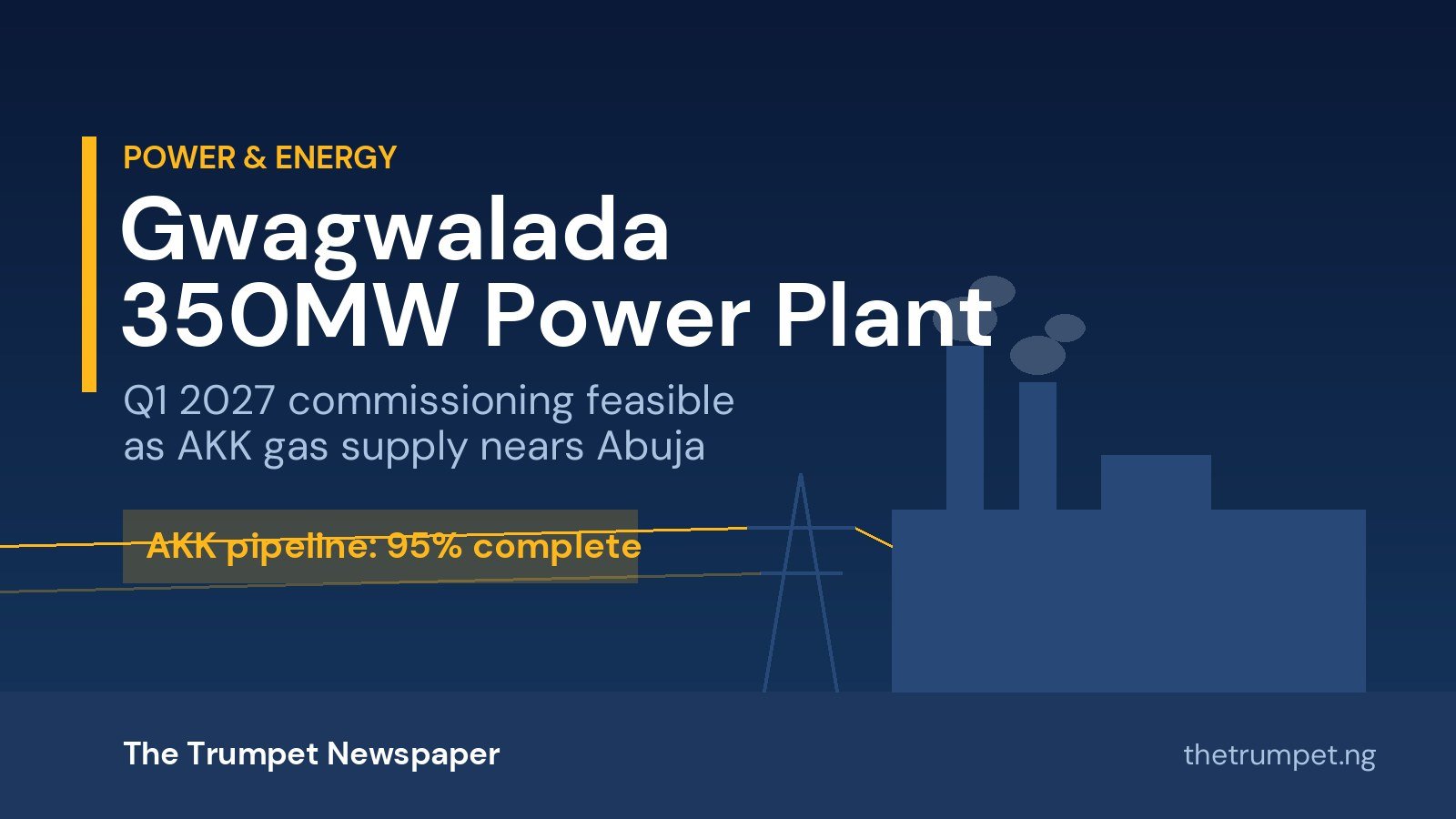
The 350-megawatt (MW) first phase of the Gwagwalada Independent Power Plant in Abuja could be commissioned in the first quarter of 2027, following progress on the Ajaokuta-Kaduna-Kano (AKK) Gas Pipeline, which is expected to begin delivering gas to Abuja before the end of December 2026.
Latest: Abuja news today: latest updates from the FCT

The project, which has experienced several delays, is approaching a critical stage as the plant’s major equipment, grid connection works and gas supply infrastructure advance towards completion. The Nigerian National Petroleum Company Limited (NNPC) has put overall execution of the AKK pipeline at 95 per cent.
Key Highlights
- NNPC says the AKK Gas Pipeline is 95 per cent complete.
- Gas delivery to Abuja is targeted before the end of December 2026.
- The Gwagwalada plant’s first phase is designed to generate 350MW.
- NNPC says the 24-inch spur line connecting the pipeline to the plant has been welded.
- Abuja Electricity Distribution Company previously identified the first quarter of 2027 as the plant’s expected completion period.
- Commissioning remains dependent on gas availability, testing and grid synchronisation.
AKK Pipeline Progress Raises Hope for Gwagwalada Plant
The Gwagwalada Independent Power Plant is part of a planned 1,350MW combined-cycle power generation project located on a 547-hectare site in Gwagwalada, Abuja.
The plant was designed to receive natural gas through the 614-kilometre AKK pipeline, which runs from Ajaokuta in Kogi State through Abuja and Kaduna to Kano.
The availability of gas has been a major factor affecting the project’s timeline. Although construction and equipment installation have progressed, the plant cannot begin generating electricity without an adequate and reliable gas supply.
Speaking in an interview with the News Agency of Nigeria in Abuja, NNPC Group Chief Executive Officer, Bashir Ojulari, said the mainline section of the AKK pipeline had been completed, while overall project execution had reached 95 per cent.
“The AKK gas pipeline, all the way from Ajaokuta, Kaduna to Kano, the main pipeline has been completed,” Ojulari said.
He explained that the remaining work involved auxiliary stations and connections to end-users.
Ojulari said NNPC was targeting the commencement of gas delivery to Abuja before the end of December 2026, while supplies to Kaduna and Kano were expected in 2027.
The first phase of gas delivery will prioritise Abuja, where the pipeline is expected to serve the Gwagwalada power plant and other gas-dependent users.
Gas Connection to Gwagwalada Plant Already Advanced
The connection between the AKK pipeline and the Gwagwalada plant has also recorded progress.
In its March 2026 operational summary, NNPC reported that it had completed welding the 24-inch spur line connecting the pipeline to the Gwagwalada Independent Power Plant.
The company also reported progress on outstanding mainline pre-commissioning activities.
This means the connection to the plant has advanced, although the main pipeline system and supporting facilities must be tested and commissioned before gas can flow reliably to the power station.
Major Power Plant Equipment Arrives at Site
Work on the power plant has continued alongside the pipeline project.
In February 2026, Wellmann Group completed the loadout and river transportation of critical equipment for the NNPC Abuja Power Plant.
The equipment included a 300-tonne generator and a GE Vernova gas turbine. They were transported from Lokoja using a self-propelled modular trailer and barge despite extremely low water levels on the River Niger.
The operation, documented by Wellmann Managing Director, Dcn. Chris Iyovwaye, addressed a major logistical challenge associated with transporting oversized equipment to the project site.
Grid connection preparations have also advanced.
In February 2026, the Transmission Company of Nigeria (TCN) inspected ongoing construction work at Phase One of the Gwagwalada project. The inspection included technical discussions with the contractor on grid synchronisation and coordination ahead of a December 2026 commissioning target.
The Nigerian Independent System Operator (NISO) had also visited the site in January 2026 and described progress as steady.
Read also:
- AKK Gas Pipeline to Boost CNG Supply Across Northern Nigeria, Abuja to Get Gas Before End of 2026, NNPC Says
- FG Commissions 3 LCNG Facilities In Kano To Expand CNG Adoption
- MAN Raises Alarm Over Poor Infrastructure, High Energy Costs, Inconsistent Policies Threatening Nigeria’s Manufacturing Sector
Why Q1 2027 Commissioning Is Possible
The first quarter of 2027 remains a possible commissioning window if the Abuja gas supply target is achieved.
However, commissioning a combined-cycle power plant involves several technical stages. These include gas availability, the first firing of the gas turbine, synchronisation with the national grid, testing of the heat recovery steam generator and steam turbine, combined-cycle testing and reliability runs.
Commercial operation can begin only after the required testing and commissioning procedures have been completed.
If gas becomes available before the end of December 2026, the project could use January to March 2027 to progress through these stages.
The Abuja Electricity Distribution Company (AEDC) had previously indicated that NNPC’s 350MW Gwagwalada plant was expected to be completed before the end of the first quarter of 2027.
In February 2026, AEDC announced plans for a bilateral power supply arrangement with the plant to improve electricity supply across the Federal Capital Territory.
The company’s projected completion date therefore aligns with NNPC’s latest gas delivery target.
AKK Pipeline’s Final 5% Remains a Major Risk
Despite the progress, the December gas delivery target is not guaranteed.
The AKK pipeline was initially expected to deliver first gas from the Ajaokuta-Gwagwalada section by July 2026, but that deadline was missed.
Outstanding terminal infrastructure, pressure-reduction stations and other supporting facilities have been cited as factors affecting the timeline. Security challenges and difficult terrain have also been reported as obstacles to construction in some sections.
An update published on November 10, 2026, indicated that gas delivery to Abuja was projected before the end of the year, subject to commissioning progress. It also referred to a phased process involving pipeline purging, testing and progressive activation of individual sections.
The distinction is important because a pipeline reported to be 95 per cent complete may still require significant work before it can safely deliver gas to end-users.
The Global Energy Monitor tracker, in an update dated November 8, 2026, listed none of the Gwagwalada plant’s units as operational. This confirms that the project had yet to begin commercial power generation at the time of the update.
What Happens If Gas Delivery Is Delayed?
The commissioning schedule depends heavily on when NNPC begins delivering gas to Abuja.
If the December 2026 target is met, the plant could proceed with initial firing, grid synchronisation and other commissioning tests during the first quarter of 2027.
However, if gas delivery slips into January or February, the remaining testing period will become shorter, increasing the possibility of a further delay into the second quarter.
The project must also complete the necessary technical and safety checks before it can begin commercial operations.
Gwagwalada Power Plant: The Outlook for 2027
The Gwagwalada Independent Power Plant is expected to strengthen electricity generation for Abuja and other parts of the country when it becomes operational.
Its progress is now closely linked to the completion and commissioning of the AKK Gas Pipeline.
For the first time in several years, the plant’s equipment, grid preparations and gas infrastructure appear to be approaching readiness within the same period.
The first quarter of 2027 remains a feasible commissioning target, provided NNPC delivers gas to Abuja before the end of December 2026 and the remaining technical tests proceed without major setbacks.
For more power and energy updates, follow us on X.