
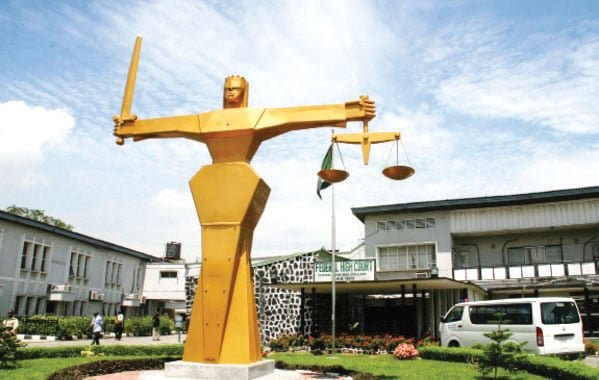
The Federal High Court in Abuja has fixed December 8, 2026, for judgment in a N10 billion fundamental rights suit filed by former Kaduna State Governor, Nasir El-Rufai, against the Independent Corrupt Practices and Other Related Offences Commission (ICPC) over the alleged restriction of access to his wife and son while he was in custody.
Latest: El-Rufai spends 226 days in detention as legal cases continue

Key Highlights
- Justice Chigozie Onah fixed December 8, 2026, for judgment in El-Rufai’s N10bn rights suit against the ICPC.
- El-Rufai alleges the ICPC stopped his wife, Aichatou Asabe, and son, Abba, from visiting him in custody.
- Both sides played CCTV footage from the ICPC premises in court for 20 minutes each.
- ICPC says Asabe breached security protocols twice and that a July 7 medical visit became a political meeting.
- The AGF urged the court to dismiss the suit, marked FHC/ABJ/CS/1852/2026.
Justice Chigozie Onah fixed the date on Wednesday, after lawyers representing El-Rufai, the ICPC and the federal government adopted their written addresses and presented their final arguments.
El-Rufai had instituted the suit against the ICPC, its chairman, Musa Aliyu, and the federal government, alleging that the commission prevented his wife, Aichatou Asabe, and son, Abba, from visiting him during his detention.
The former governor is seeking N10 billion in damages and nine other reliefs, including a declaration that his fundamental rights under Chapter IV of the 1999 Constitution, as amended, remain enforceable despite his detention.
CCTV footage played in court
During Wednesday’s proceedings, the court ordered the parties to play closed-circuit television (CCTV) footage from the ICPC premises for 20 minutes each to support their respective arguments.
The commission’s lawyer, Yetunde Mosunmola, demonstrated portions of the recordings showing incidents involving El-Rufai’s wife and son, including a July 7 visit during which Asabe reportedly arrived at about 2:37pm to deliver food to her husband.
El-Rufai’s lawyer, Ubong Akpan, asked the court to consider portions of the recordings again, arguing that the footage did not establish that his client’s wife or son breached any security protocol that justified denying them access.
Akpan questioned whether the respondents had presented verifiable evidence to justify the restrictions placed on his client’s family members.
He maintained that any decision to deny a detainee access to relatives must be supported by clear and verifiable reasons, adding that the alleged restriction violated applicable legal standards, including the Nelson Mandela Rules on the treatment of prisoners.
When Justice Onah questioned whether the Mandela Rules were enforceable in Nigeria, the lawyer described them as international standards guiding the conduct of law enforcement and custodial authorities.
ICPC: visits subject to security procedures
However, the ICPC disagreed with the argument, insisting that El-Rufai was in lawful custody and that visits to him were subject to security procedures within its facility.
Mosunmola told the court that the CCTV recordings showed that Asabe allegedly breached security protocols on two occasions.
She also alleged that Asabe was brought into the commission’s premises after official visiting hours on July 4, at about 7:35pm, with the assistance of some ICPC officers.
The lawyer argued that the commission has the responsibility to regulate access to its premises for security reasons and that restrictions imposed on Asabe followed concerns arising from the alleged breaches.
She further told the court that other members of El-Rufai’s family, including another wife, were allowed to visit him, maintaining that the commission’s actions did not amount to a violation of his fundamental rights.
The ICPC also relied on a counter-affidavit deposed to by John Uche, a Chief Anti-Corruption Assistant in its Internal Security Support Unit.
In the affidavit, Uche said El-Rufai was being held in lawful custody pursuant to an order of the Federal High Court, Kaduna Judicial Division, in charge number FHC/KD/73C/2025.
He stated that on July 7, the commission facilitated a medical visit involving El-Rufai’s personal physician, his wife and ICPC officers in compliance with a court order.
However, Uche alleged that the medical visit was subsequently turned into a political meeting, contrary to the commission’s security protocols.
He said the development raised concerns about the vulnerability of the existing access arrangements and prompted the commission to introduce temporary restrictions while reviewing its security measures.
The affidavit also alleged that El-Rufai’s son, Abba, attempted to gain access to the building on July 7 but was prevented from entering. Uche claimed that Abba subsequently lay in a gutter and repeatedly rubbed his leg against its edge.
The commission maintained that its CCTV recordings were accurate and had not been altered or tampered with.
Read also:
- El-Rufai Spends 226 Days in Detention as Legal Cases Continue
- Bello El-Rufai Thanks Peter Obi, Atiku, Amaechi, Kwankwaso For Checking On Detained Father
- Shehu Sani Says El-Rufai Is Paying Price for Misgovernance During Kaduna Tenure
- ICPC Chairman Warns Nigerian Judges Against Deepfakes, Fake Digital Evidence in Corruption Trials
AGF urges dismissal
Representing the Attorney-General of the Federation, the Director of Civil Litigation and Public Law, Maimuna Lami-Shiru, urged the court to dismiss the suit.
She argued that the ICPC and its chairman acted within the law and that the restrictions were based on alleged breaches of the commission’s security procedures.
El-Rufai’s suit, marked FHC/ABJ/CS/1852/2026, was filed on August 13 through Akpan.
The ICPC and its chairman filed a 27-paragraph counter-affidavit with four exhibits and a written address on August 31.
They subsequently filed a further counter-affidavit on September 28, while the AGF filed a seven-paragraph affidavit on September 11, alongside a written address and a reply on points of law.
With the parties having concluded their arguments, the court will determine on December 8 whether the restrictions placed on El-Rufai’s family members amounted to an unlawful interference with his fundamental rights or were justified by the commission’s security procedures.
The judgment will determine the outcome of the former governor’s N10 billion claim against the respondents.
For updates on the case and more court news, follow us on X.