Nigeria has recorded about $3.5 billion in gas projects that have reached Final Investment Decision (FID), while the country’s gas production has risen to 7.5 billion cubic feet per day (bcf/d), according to the Minister of State for Petroleum Resources (Gas), Ekperikpe Ekpo. The Federal Government is targeting 10 bcf/d of gas production by 2027 as it seeks to attract more investment into the sector.
Key Highlights
- Nigeria has recorded about $3.5 billion in gas projects that have reached FID.
- Gas production has risen from 6.86 bcf/d in 2023 to 7.5 bcf/d.
- The Federal Government is targeting 10 bcf/d by 2027.
- Four projects — Iseni, Ubeta, HI and Ima — have secured FID under the current administration.
- Nigeria’s proven 2P gas reserves increased to 215.19 trillion cubic feet (TCF).
- Domestic gas supply has risen above 2 bcf/d.
- Nigeria LNG’s capacity utilisation has increased to 87% year-to-date in 2026.
- Train 7 is targeted for completion in June 2027 and is expected to add 8 million tonnes per annum.
- The Federal Government is targeting $30 billion in gas-sector investment by 2030.
Nigeria Records $3.5bn Gas Projects
According to Ekpo, four major gas projects have secured Final Investment Decision under the current administration, representing about $3.5 billion in investment commitments.

The projects include the Iseni project, estimated at about $122 million; the Ubeta project, valued at approximately $566 million; the HI project, estimated at $2 billion; and the Ima project, with an investment value of about $800 million.
The government has also reported progress on the $3.5 billion Brass Methanol project following the resolution of issues surrounding its gas sales and purchase agreement.
Beyond the projects that have already reached FID, the Federal Government has set a broader target of attracting $30 billion in gas-sector investment by 2030.
Nigeria Gas Production Rises to 7.5 Bcf/d
Nigeria’s gas production has increased from approximately 6.86 bcf/d in 2023 to 7.5 bcf/d, according to figures presented by the Ministry of Petroleum Resources.
The government is targeting further growth to 10 bcf/d by 2027, with new projects and infrastructure expected to support the increase.
Domestic gas supply has also risen above 2 bcf/d, providing additional feedstock for power generation and industrial users.
The government has linked the increase in production to efforts to improve investment conditions, infrastructure and commercial arrangements across the gas value chain.
Nigeria’s Gas Reserves Increase
The country’s proven 2P gas reserves have also increased, rising from 208.83 trillion cubic feet in 2023 to 215.19 TCF.
The increase reinforces Nigeria’s position as one of Africa’s major gas-resource countries, while the government continues to seek investment to convert reserves into commercial production.
Officials have increasingly positioned natural gas as a key component of Nigeria’s energy transition and industrial development strategy.
NLNG Train 7 Expected to Boost Gas Exports
Nigeria LNG’s capacity utilisation has recovered significantly, rising from 59% in 2023 to 87% year-to-date in 2026, according to the figures presented by the government.
The Train 7 project, which is currently under construction, is targeted for completion in June 2027.
Once completed, Train 7 is expected to add 8 million tonnes per annum (MTPA) to Nigeria LNG’s existing 22 MTPA nameplate capacity.
The expansion is expected to strengthen Nigeria’s LNG export capacity and increase the country’s ability to generate foreign exchange from its natural gas resources.
OB3 Pipeline, AKK Pipeline Support Gas Expansion
Infrastructure development has also been highlighted as an important part of Nigeria’s gas expansion plans.
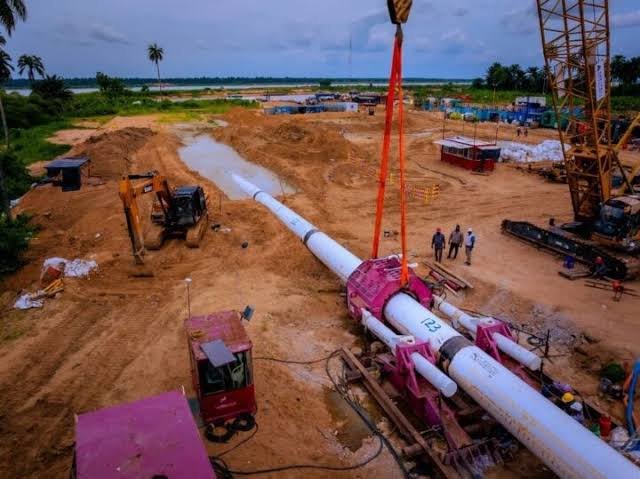
The OB3 gas pipeline has been reported as completed, with a capacity of about 2 bcf/d. The project is expected to unlock more than 500 million standard cubic feet per day (MMscf/d) of additional domestic gas supply once work on the River Niger crossing is completed.
The Ajaokuta-Kaduna-Kano (AKK) gas pipeline is also reported to be approximately 95% complete, with completion expected in 2027.
The two projects are expected to improve the movement of gas from producing areas to power plants, industries and other consumers.
Government Uses N671bn to Attract Private Gas Investment
The Federal Government has also highlighted the role of the Midstream and Downstream Gas Infrastructure Fund in financing gas infrastructure.
According to the figures presented, about N671 billion in public funds has been used to attract approximately N1.6 trillion in private capital across 31 projects and 205 assets.
The projects are projected to deliver about 475 MMscf/d of domestic gas.
The government says the investments are designed to address infrastructure bottlenecks that have historically limited the ability of Nigeria’s gas sector to supply power plants, industries and other domestic users.
Read also:
- Nigeria Domestic Gas Supply Crosses 2 Billion Cubic Feet Daily as FG Targets Power, Industry Growth
- Ogun, NNPC Move to Revive Olokola LNG Project as $7bn Coastal Corridor Takes Shape
- Group Seeks Permanent Solution To Gas Flaring In Rivers Community, Writes Tinubu, International Organizations
CNG Conversions Rise as Government Targets Gas Flare Reduction
Nigeria’s compressed natural gas programme has also recorded growth, with CNG vehicle conversions rising from approximately 11,000 in 2023 to more than 120,000.
The government is promoting CNG as a cheaper and cleaner alternative fuel for transportation as part of its broader gas utilisation strategy.
Meanwhile, 42 companies have been awarded contracts under efforts to reduce routine gas flaring, with the government maintaining a target of ending routine gas flaring by 2030.
The National Economic Council has also approved N185 billion to address legacy gas-to-power debts, another issue officials say has affected investment and reliability in the power sector.
Federal Government Links Gas Growth to Decade of Gas Initiative
Ekpo has described the investments and rising production figures as evidence of improving investor confidence in Nigeria’s gas industry.
The minister linked the developments to the Decade of Gas initiative, which was recently approved by President Bola Tinubu.
The administration says its objective is to transform Nigeria’s large gas reserves into more reliable electricity, industrial feedstock, cleaner transportation and cooking fuels, as well as increased export earnings.
The government has also highlighted discussions aimed at increasing domestic utilisation of deep-offshore gas, including initiatives involving Chevron’s LPG production.
Gas Sector Faces 2027 Delivery Challenge
Despite the investment commitments and rising production figures, achieving the government’s 10 bcf/d target by 2027 will depend on the timely completion of major projects and supporting infrastructure.
Pipeline commissioning, reliable gas offtake from power and industrial consumers, financing and commercially viable gas prices will remain important factors.
The government’s broader objective is to position natural gas as a major bridge between Nigeria’s energy needs and its industrial ambitions, supporting power generation, fertiliser and petrochemical production, LNG exports and cleaner transport.
If the listed projects are delivered on schedule, officials expect Nigeria’s gas sector to play a larger role in economic growth and energy security over the coming years.
For more business and energy news, follow us on X.