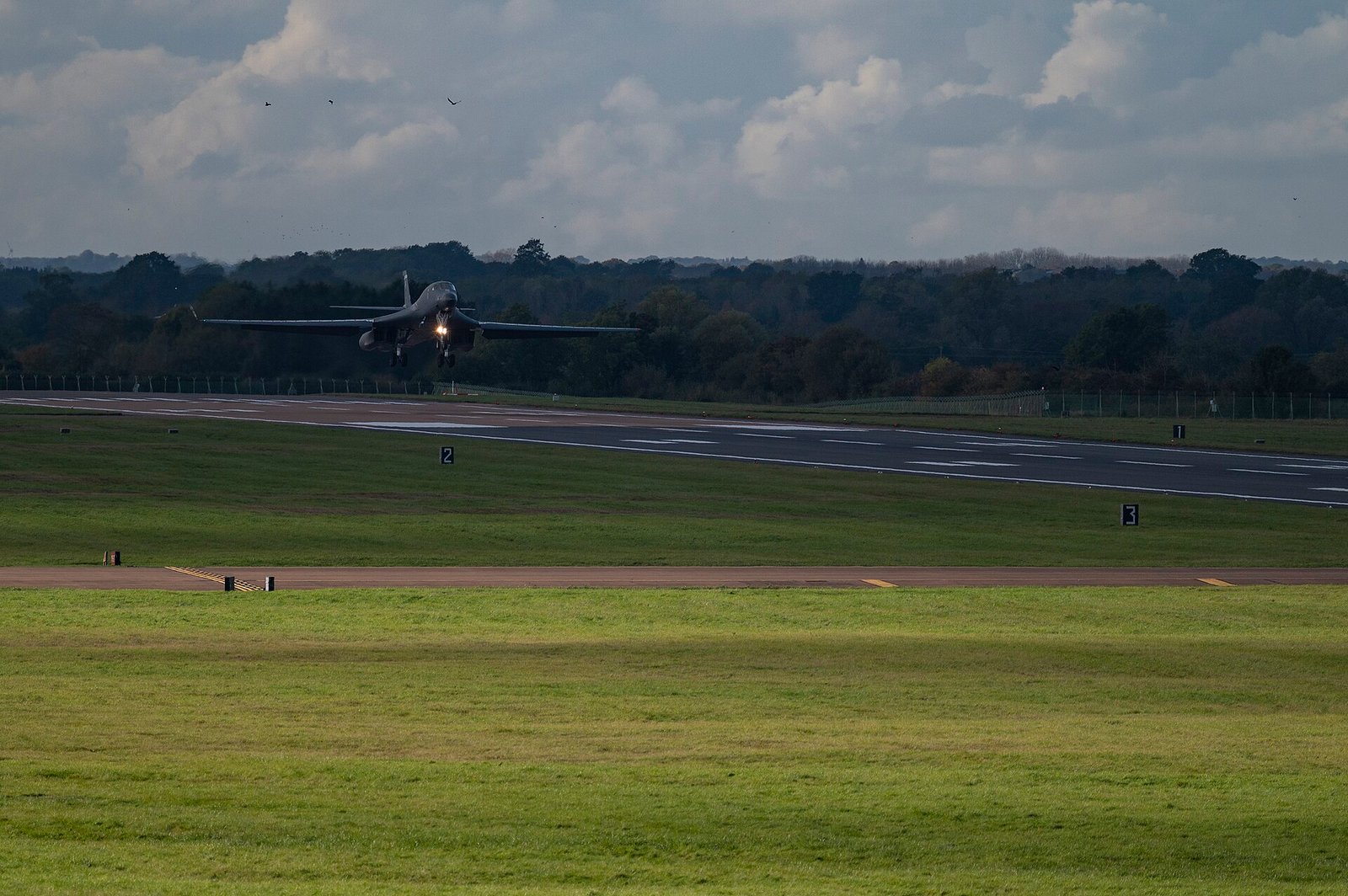
The United States has withdrawn about a dozen B-1 bombers from RAF Fairford in Gloucestershire, England, after U.S. officials received intelligence pointing to a possible Iranian drone attack on the military base. President Donald Trump confirmed that the aircraft were moved because of security threats and said the decision was taken to avoid exposing the bombers and American personnel to unnecessary danger.
Key Highlights
- The U.S. withdrew about 12 B-1 bombers from RAF Fairford in Britain.
- President Donald Trump confirmed the aircraft were moved because of threats.
- U.S. officials said intelligence indicated a possible Iranian drone attack against the base.
- Iran has denied involvement in the alleged plot.
- The Pentagon confirmed that all U.S. bombers deployed to Fairford had returned to their home bases in the United States.
- The withdrawal came after a counter-terrorism investigation near RAF Fairford.
- British police have arrested several suspects in connection with the investigation, including a 22-year-old man in London.
- U.S. officials have not publicly confirmed whether the alleged drone threat and the arrests are directly connected.
- RAF Fairford has been an important base for U.S. bomber operations during the conflict with Iran.
US B-1 Bombers Withdrawn From RAF Fairford
The withdrawal of the B-1 bombers from RAF Fairford followed new intelligence that U.S. officials reportedly considered credible enough to trigger additional force-protection measures.

Trump confirmed the move while speaking to reporters before departing the White House for Nebraska.
“There were some threats,” Trump said, explaining that the aircraft were moved rather than leaving them exposed to a potential attack.
Asked whether Iran was connected to the threat, Trump indicated that the United States believed the threat was linked to Tehran. He also warned that Iran would face severe consequences if it had brought combat drones into Britain.
The White House has not publicly released details of the intelligence behind the threat.
Pentagon Confirms Bombers Returned to US
The Pentagon confirmed that all U.S. bombers deployed at RAF Fairford had been redeployed to their home stations in the United States.
The Pentagon and U.S. European Command have declined to provide detailed information about the intelligence or specific force-protection measures taken at the base.
U.S. European Command, however, stressed that the American bomber force remains capable of conducting global operations and can deliver strikes from the continental United States.
The B-1 fleet includes some of the U.S. military’s most valuable long-range strike aircraft, making the protection of the bombers a significant security concern.
Intelligence Pointed to Possible Iranian Drone Attack
U.S. officials told international media that commanders acted after receiving information about a possible attack allegedly ordered by Iran’s Islamic Revolutionary Guard Corps.
According to the reports, the suspected plan involved short-range weaponised drones launched from a location relatively close to RAF Fairford.
Officials said the concept raised comparisons with Ukraine’s 2025 Operation Spiderweb, in which drones were used against Russian military aircraft at airfields deep inside Russia.
However, there has been no public confirmation that Iran actually prepared such an operation against RAF Fairford.
Iran has denied involvement in the alleged plot.
Trump Says Bombers Were Not Moved “By Accident”
Trump’s comments appeared to contradict earlier suggestions that the movement of the aircraft could have been part of routine military rotations.
Trump said the bombers did not leave Britain by accident and that the United States had chosen to move them rather than “tempting the enemy.”
Vice President JD Vance similarly described the decision as being made “out of an abundance of caution” to protect American personnel.
Vance accused Iran of a long history of terrorism against the United States and its allies.
RAF Fairford Terror Investigation Raises Security Concerns
The withdrawal came shortly after a counter-terrorism investigation was launched following suspicious activity near RAF Fairford on September 27.
British police were alerted to several suspicious vehicles near the base. Five men were arrested on suspicion of terrorism-related offences and were later released on bail.
A sixth suspect, described in reports as a British-Iranian national, was subsequently arrested and also released on bail.
British counter-terrorism police later arrested a 22-year-old British man in London on suspicion of preparing terrorist acts as part of the continuing investigation.
Authorities have not established publicly that the suspects are directly connected to the alleged Iranian drone threat.
UK Officials Investigate Possible Iranian Connection
British authorities have been examining whether a foreign state was involved in the suspected plot.
Prime Minister Andy Burnham previously said there were “strong indications” of Iranian involvement, although he did not disclose the evidence behind the assessment.
U.S. Secretary of State Marco Rubio has also referred to the possibility of foreign involvement.
Iran has rejected the allegations and described claims linking Tehran to the suspected plot as baseless.
The British government has nevertheless continued its investigation, while Downing Street has said RAF Fairford remains safe.
Read also:
- Trump Warns Iran Will Be ‘Hit Very Hard’ If Linked to Flydubai Attack on Israel-Bound Flight
- Two Iranian Nationals Charged Over Alleged Manchester Jewish Community Terror Plot
- Iranian Foreign Minister Says Only Negotiation Can End Conflict After Trump Rejects Hormuz Deal
RAF Fairford’s Strategic Importance
RAF Fairford has long served as an important European hub for U.S. long-range bombers.
The base became particularly significant during the conflict with Iran, with American aircraft operating from Britain as part of strikes against Iranian military targets.
Iran had previously warned that countries hosting military operations against it could be regarded as legitimate targets.
The B-1 bombers stationed at Fairford were therefore considered high-value assets, particularly because the aircraft are no longer in production and the existing fleet is limited.
Their rapid withdrawal underscores concerns about the vulnerability of major military aircraft to relatively inexpensive drone attacks.
US Can Still Strike Iran From Other Locations
Although the withdrawal removes the B-1 bombers from RAF Fairford, U.S. officials have stressed that it does not prevent Washington from conducting long-range military operations.
American B-1, B-2 and B-52 bombers can operate from bases in the United States and other locations.
The Pentagon said the bomber force remains ready to provide precision global strike capabilities.
The redeployment therefore appears to be primarily a force-protection measure rather than a suspension of U.S. military operations against Iran.
Iran Denies Plot as Investigation Continues
The removal of the B-1 bombers has increased attention on the security situation surrounding U.S. military facilities in Britain.
For Washington, the episode highlights the growing threat posed by drones and the difficulty of protecting high-value military aircraft stationed at overseas bases.
For more global news and updates, follow us on X.