By Obah Sylva
Nigeria’s domestic gas supply has crossed 2 billion cubic feet per day, as the Federal Government seeks to direct more natural gas to power generation, manufacturing and other industries. Minister of State for Petroleum Resources (Gas), Ekperikpe Ekpo, disclosed the milestone as the government pursues higher production and new investment in the sector.

Key Highlights
- Domestic gas supply has moved above 2 billion cubic feet per day, according to the minister.
- Total gas production has risen to about 7.5 billion cubic feet per day.
- Nigeria’s proven gas reserves are reported at 215.19 trillion cubic feet.
- The government targets 10 billion cubic feet daily by 2027 and 12 billion by 2030.
- The OB3 pipeline is designed to carry up to 2 billion standard cubic feet per day.
- MDGIF says its projects could add about 475 million standard cubic feet per day when fully operational.
Nigeria Domestic Gas Supply Rises Above 2 Billion Cubic Feet
Ekpo said Nigeria’s domestic gas supply has passed the 2 billion cubic feet per day mark. Total gas production has reached approximately 7.5 billion cubic feet per day, up from about 6.8 billion cubic feet per day in 2023.
The government is seeking to increase the volumes available to local consumers, including power generators and industrial users. BusinessDay reported on Ekpo’s supply and production figures alongside the government’s plan to attract about $30 billion in gas-sector investment by 2030.
Government Targets Higher Gas Production by 2030
The Federal Government is targeting production of 10 billion cubic feet per day by 2027 and 12 billion cubic feet per day by 2030. Officials say increased output could support electricity generation, manufacturing, fertiliser production, petrochemicals, liquefied natural gas, transport and exports.
Nigeria’s proven natural gas reserves are reported at 215.19 trillion cubic feet. Officials have also stressed that improving infrastructure, access and utilisation is necessary to turn those reserves into reliable supply for local consumers.
OB3 Pipeline Could Strengthen Domestic Gas Supply
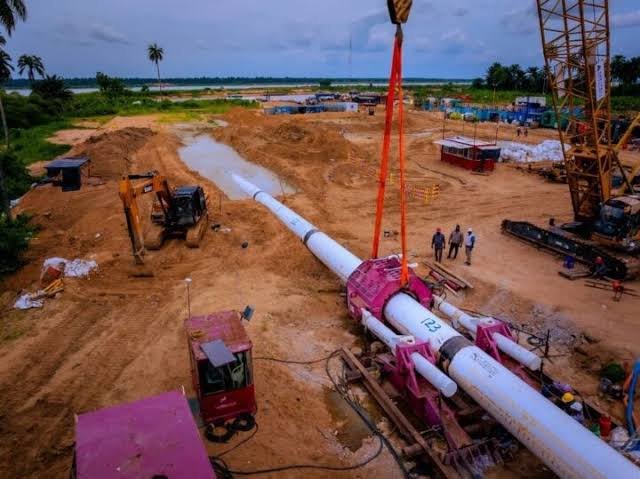
The 130-kilometre Obiafu-Obrikom-Oben (OB3) pipeline is designed to transport up to 2 billion standard cubic feet of gas per day and connect the eastern and western gas networks. NNPC said the River Niger crossing was completed in April 2026, unlocking the pipeline’s full potential. The company said the project could make more than 500 million standard cubic feet per day of additional gas available to the domestic market. NNPC’s release on the OB3 crossing describes the project’s capacity and expected supply impact.
The Ajaokuta-Kaduna-Kano (AKK) pipeline is another part of the government’s plan to expand gas transmission, carrying gas from southern producing areas towards northern Nigeria. Improved pipeline links are expected to help serve power plants and industrial users.
Gas Infrastructure Fund Seeks Private Investment
The Midstream and Downstream Gas Infrastructure Fund (MDGIF) has deployed about ₦671 billion in public capital and attracted approximately ₦1.6 trillion in private-sector investment, according to figures announced by the fund. Its portfolio covers 31 projects and 205 infrastructure assets; when fully operational, the projects are expected to contribute about 475 million standard cubic feet of gas per day to the domestic market.
Gas Supply Remains Critical to Power and Industry
Gas-fired power plants play a major role in Nigeria’s grid generation, while manufacturers and other businesses also depend on reliable fuel supplies. More dependable gas deliveries could support electricity generation and industrial activity, although the increase in domestic availability does not automatically mean lower power tariffs or production costs.
Pipeline capacity, processing facilities, distribution networks, financing and commercially viable prices will influence how much gas reaches consumers. The government’s wider utilisation plans include compressed natural gas for transport and liquefied petroleum gas for cooking, alongside supply for fertiliser and petrochemical industries.
Nigeria’s targets of 10 billion cubic feet per day by 2027 and 12 billion by 2030 will depend on investment and timely infrastructure delivery, as well as the ability to move gas from producing fields to domestic users.
Read also:
For more energy updates, follow The Trumpet on X.