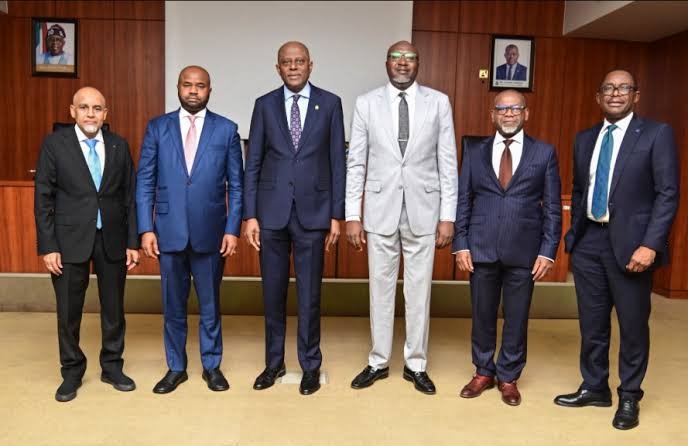
Nigeria’s top financial regulators have convened for a Financial Services Regulation Coordinating Committee (FSRCC) meeting at the Central Bank of Nigeria (CBN) headquarters in Abuja, bringing together senior officials from key financial and economic regulatory institutions.
The CBN announced the meeting on Tuesday, September 29, 2026, through its official X account, alongside a group photograph of the participating officials. However, the bank did not immediately release details of the agenda, discussions or decisions reached at the meeting.

Key Highlights
- The FSRCC meeting was held at the CBN headquarters in Abuja.
- CBN Governor Olayemi Cardoso chaired the meeting.
- Senior officials from the NRS, CAC, SEC, NDIC and PenCom attended the session.
- The meeting comes amid ongoing reforms and regulatory changes across Nigeria’s financial sector.
- Previous FSRCC meetings have focused on financial crime, cybersecurity, artificial intelligence and regulatory coordination.
- No official communiqué detailing Tuesday’s decisions had been released as of September 29, 2026.
- The committee coordinates financial regulation and information sharing among major Nigerian regulatory institutions.
CBN Governor Olayemi Cardoso Chairs FSRCC Meeting
The meeting was chaired by CBN Governor Olayemi Cardoso, who heads the Financial Services Regulation Coordinating Committee.
Other senior officials listed among the participants were Zacch Adedeji, Executive Chairman of the Nigeria Revenue Service (NRS), and Hussaini Ishaq Magaji (SAN), Registrar-General of the Corporate Affairs Commission (CAC).
Bola Ajomale, Executive Commissioner, Operations, at the Securities and Exchange Commission (SEC), also attended the meeting.
The Nigeria Deposit Insurance Corporation (NDIC) was represented by its Managing Director and Chief Executive Officer, Thompson Oludare Sunday, while Dr Abdulrahaman Muhammad Saleem represented the National Pension Commission (PenCom).
One report identified the gathering as the committee’s 81st meeting.
What Is the FSRCC?
The Financial Services Regulation Coordinating Committee is an inter-agency body established to improve coordination among regulators within Nigeria’s financial system.
Its responsibilities include promoting information sharing, coordinating regulatory activities, reducing regulatory gaps and limiting opportunities for regulatory arbitrage.
The committee also provides a platform for regulators overseeing different parts of the financial system to discuss issues that may affect financial stability and the effectiveness of supervision.
Its membership typically brings together senior representatives from institutions including the CBN, SEC, NDIC, PenCom, the National Insurance Commission (NAICOM), CAC and the Federal Ministry of Finance.
FSRCC Meeting Comes Amid Financial Sector Reforms
Tuesday’s meeting comes as Nigeria continues to implement major reforms across its financial sector.
One significant development has been the banking sector recapitalisation exercise. According to figures cited in the report, 33 banks met the revised minimum capital requirements, raising a combined N4.65 trillion.
Regulators are also strengthening oversight of fintech companies and digital financial services as technology continues to reshape Nigeria’s financial system.
The increased use of digital platforms has created new regulatory questions involving cybersecurity, consumer protection, financial crime monitoring and the supervision of emerging financial technologies.
Previous FSRCC Meetings Focused on Financial Stability
Previous FSRCC meetings have addressed several issues affecting Nigeria’s financial system.
The committee’s 80th meeting in May 2026 reportedly considered issues including illegal financial operators, cybersecurity cooperation and the use of artificial intelligence and predictive analytics in regulatory surveillance.
The committee has also discussed public awareness initiatives and measures to support financial innovation while maintaining regulatory stability.
These discussions reflect the expanding responsibilities of financial regulators as banking, capital markets, pensions, insurance and digital financial services become increasingly interconnected.
Read also:
- CBN: N4.69 Trillion outstanding limits new financial interventions as 33 Banks meet recapitalisation target
- CBN Wins NES Award As Cardoso Hails Validation of Macroeconomic Reforms
- CBN Cuts Interest Rate by 350 Basis Points to 23%, Biggest Reduction on Record
No Details of FSRCC Decisions Released
As of the evening of September 29, 2026, the CBN and FSRCC had not published a detailed communiqué on the outcome of Tuesday’s meeting.
The CBN’s announcement confirmed that the meeting took place and showed the participation of senior officials from major financial regulatory institutions, but it did not provide specific resolutions or policy decisions.
Stakeholders in Nigeria’s financial services industry are therefore expected to await further communication from the CBN or the committee.
Any subsequent communiqué could provide details of regulatory measures, policy coordination or other decisions arising from the meeting.
Why the FSRCC Meeting Matters
Regular meetings of the FSRCC provide a platform for Nigeria’s financial regulators to coordinate their activities across different segments of the economy.
Effective coordination is particularly important in a financial system involving banks, capital markets, insurance companies, pension funds, fintech businesses and other financial institutions.
The committee’s work is also relevant to financial stability, depositor and investor protection, regulatory enforcement and the development of a more coordinated financial regulatory framework.
Further details of the September 29 meeting are expected if the CBN or FSRCC issues an official communiqué.
For more updates on this and other developing stories, follow us on X.