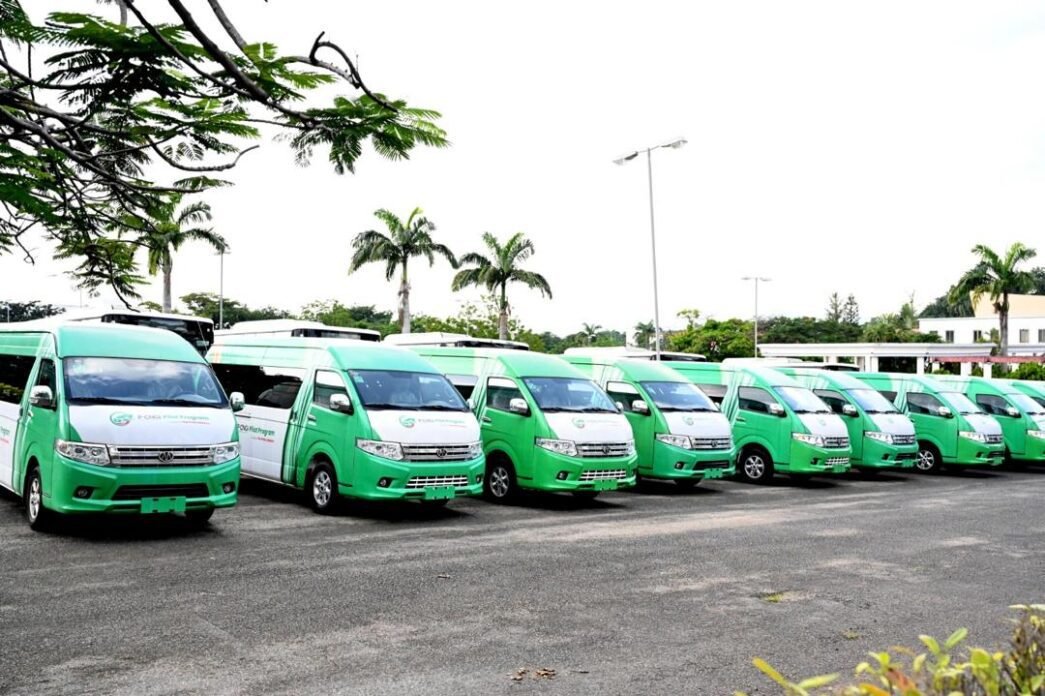
The Federal Government and state governments have less than two weeks to translate their promise of lower transportation costs into actual fare reductions for commuters across Nigeria, as the October 1 deadline for the nationwide rollout of cheaper CNG- and electric-powered transport approaches. President Bola Ahmed Tinubu said the Federal Government and the 36 state governments agreed on August 27 that more Nigerians should begin to experience measurable reductions in transportation costs from October 1.
Key Highlights
- More than 120,000 vehicles have been converted to Compressed Natural Gas (CNG), according to the Federal Government.
- Nigeria has more than 400 certified CNG conversion centres and over 90 CNG refuelling stations.
- State-level implementation remains uneven, with some states already operating subsidised CNG or electric transport services.
- Niger State had procured 200 CNG buses, but only 35 were operational as of the September 10 progress report.
- The Federal Government says several states have already recorded lower transport fares through CNG and electric-powered transport.
- President Tinubu has directed states to work with transport unions and commercial operators to ensure cheaper energy translates into lower fares.
- The central test for the October 1 programme will be whether commuters actually pay less on their regular routes.
The Federal Government says more than 120,000 vehicles have been converted to CNG, supported by more than 400 certified conversion centres and over 90 CNG refuelling stations nationwide. However, while the figures point to an expanding CNG ecosystem, state-level deployment remains uneven, with some governments already operating subsidised transport services while others are still developing the infrastructure needed for a wider rollout.

President Bola Ahmed Tinubu and the 36 state governors agreed in August to pursue measurable reductions in transportation costs from October 1. An implementation committee for the National Affordable CNG Transit Programme was subsequently established under the Nigeria Governors’ Forum and chaired by Kwara State Governor AbdulRahman AbdulRazaq.
The target goes beyond putting more CNG vehicles on Nigerian roads. The stated objective is for the lower operating costs associated with CNG and electric mobility to be reflected in the fares paid by commuters.
At a September 10 stakeholder meeting convened by the Presidential Initiative on Compressed Natural Gas and Electric Vehicles (Pi-CNG & EV), states reviewed their preparedness and identified additional infrastructure and interventions needed ahead of October 1. The initiative said states had deployed CNG and electric buses, tricycles, motorcycles, conversion centres, refuelling facilities and charging stations, while acknowledging that some locations still required additional infrastructure.
Niger State, for instance, has procured 200 CNG buses, but only 35 were operational as of the September 10 progress report. The state also had 11 electric-vehicle charging stations. Abia had deployed 40 electric buses and 20 charging stations, with plans to increase its fleet to 100 buses by December.
Ogun State had acquired 1,500 electric motorcycles and more than 20 battery-swap stations, while Cross River had rolled out 720 electric vehicles comprising buses and motorcycles. Delta reported 13 operational conversion centres and four CNG stations, with 50 CNG buses expected to join its transport system.
In other states, Adamawa signed an agreement for 2,000 electric tricycles, Anambra identified six priority transport corridors and began preparations to train 1,000 young people in vehicle conversion, while Benue trained personnel and technicians and established a conversion centre.
The figures highlight the uneven nature of the rollout. In Niger, for example, 165 of the 200 procured CNG buses were yet to become operational at the time of the progress report. In other states, the challenge is not necessarily the availability of vehicles but the supporting infrastructure required to keep them running.
Reported Fare Savings Across States
The government has already pointed to states where alternative-energy transport schemes have produced reported savings for commuters.
In Borno, the Presidency said CNG-powered and electric public transport services charge between ₦50 and ₦100 on routes where commercial operators charge between ₦300 and ₦600. In Kaduna, 100 CNG buses were providing free transportation on major routes and reportedly carried about 3.2 million passengers in their first year, saving commuters more than ₦3.5 billion.
In Oyo, the Presidency said CNG buses deployed to Pacesetter Transport reduced the Lagos-Ibadan fare from about ₦8,000 to ₦3,200 during the initial deployment. In Adamawa, alternative-energy transport services reportedly cut fares by as much as 50 per cent, from ₦8,000 to ₦4,000, while the Enugu-Nsukka fare reportedly fell from ₦2,500 to ₦1,500 following the deployment of 100 CNG buses.
The Presidency also cited Plateau, where government-supported buses reportedly carry about 13,000 commuters daily at ₦200, compared with commercial fares of more than ₦500. In Niger State, it said passengers on the Suleja-Abuja route pay ₦550 compared with about ₦800 previously. Abia, meanwhile, has deployed 40 electric buses with fares subsidised by 50 per cent.
In the Federal Capital Territory, the Presidency said a partnership with the National Union of Road Transport Workers had produced a 40 per cent fare reduction on selected routes served by CNG-converted commercial vehicles. It cited Area 1-Gwagwalada, where fares reportedly fell from ₦1,500 to ₦900; Nyanya, from ₦700 to ₦420; and Wuse, from ₦400 to ₦240.
But these examples represent different operating models. Some involve government-owned or government-supported buses, while others rely on commercial operators or subsidies. The reported reductions therefore cannot automatically be applied to every route across the country.
A broader nationwide reduction would require commercial operators to have reliable access to CNG or electricity, affordable conversion or vehicle financing, functioning infrastructure and sufficient capacity to meet passenger demand.
Read also:
- Tinubu, Governors Move to Cut Transport Fares Nationwide From October 1
- Tinubu Commissions 1st CNG Conversion Centre In Ebonyi
- Nigeria Customs Begins Duty-Free Import for Eligible CNG, Electric Vehicles, Excludes Hybrids
CNG Infrastructure Remains Critical
This is where the availability of refuelling infrastructure becomes critical.
Pi-CNG & EV currently lists more than 90 CNG stations across 23 states and more than 400 certified conversion centres. The platform says its conversion network covers 22 operational states, while the refuelling network extends across 23 states.
The Federal Government is also planning a much larger network. President Tinubu announced an additional 500 CNG refuelling stations in August, on top of 500 previously ordered through the Midstream and Downstream Gas Infrastructure Fund, bringing the planned network to 1,000 stations.
However, planned infrastructure should not be confused with facilities already available to motorists.
A September 20 report said the first batch of 500 additional stations was expected to be received by the end of October. That means part of the larger infrastructure expansion is expected to come after the October 1 fare-reduction deadline.
The infrastructure challenge is already being reported by operators. Recent reporting from Lagos and other parts of the country has highlighted long queues at existing CNG stations, while commercial drivers have complained about time lost waiting for fuel. Other operators have raised concerns about conversion costs and access to conveniently located refuelling facilities.
For commercial operators, the economics therefore go beyond simply comparing CNG and petrol prices.
A driver may spend less on fuel per kilometre but lose operating time waiting to refuel. An operator who borrows to convert a vehicle must also recover the conversion cost while meeting maintenance and other operating expenses. Where a CNG station is far from a route, the expected savings could also be reduced by additional travel and lost operating time.
The government appears to recognise these challenges. At the September stakeholder meeting, states were asked to identify their busiest transport corridors and provide data to guide additional CNG infrastructure. They were also expected to submit three priority interventions that could realistically be delivered within the October 1 timeline. Each state was to establish an implementation team involving officials responsible for transport, energy and related sectors.
States Still Facing Implementation Gaps
There are also states where the transition remains incomplete.
In Plateau, recent reporting quoted the chairman of the NTA Park, Jos, as saying commercial transport operators had not yet seen tangible benefits from the CNG programme. He also alleged that some CNG buses supplied to the state were parked because there was no station available for refuelling, while subsidised services remained concentrated on limited routes.
Rivers State provides another example of a programme being prepared for expansion rather than already operating at full capacity. A state transport official said buses that had previously operated on several routes were expected to return to the roads from October, alongside additional buses and free commuter services. The state, however, had not fully implemented the CNG initiative at the time of the report.
October 1 Test
This leaves Nigeria with two different pictures as October 1 approaches.
On one side are states such as Kaduna, Borno, Oyo, Enugu, Niger and Abia, where government-supported CNG or electric transport has already produced reported savings for commuters. On the other are states still developing their conversion centres, charging facilities, refuelling networks, vehicle fleets or implementation structures.
The Federal Government is also attempting to make conversion more accessible through financing arrangements while continuing to expand CNG infrastructure. Earlier in the year, President Tinubu commissioned four MDGIF-supported CNG projects in Lagos, Abuja and Owerri as part of efforts to increase domestic gas utilisation and reduce transportation costs.
The question now is whether the existing infrastructure and state-level interventions can be scaled quickly enough to make October 1 more than a policy deadline.
For commuters, the most meaningful measure will not be the number of conversion centres, buses or refuelling stations announced. It will be the fare displayed at the motor park, bus stop or route they use every day.
The October 1 programme therefore represents a test of the CNG strategy: whether Nigeria can move from cheaper fuel in principle to cheaper transportation in practice, and whether the savings already reported on selected routes can be extended to more commuters without relying indefinitely on government subsidies.
With the deadline approaching, the evidence shows that the foundation for cheaper transport is being built, but the rollout is not yet uniform across the country. The Federal Government and states have demonstrated that lower fares are possible where buses, fuel, infrastructure and subsidies come together. The bigger test will be whether those conditions can be replicated across enough routes and states for the October 1 promise to be felt beyond selected corridors.
Ultimately, the success of the programme will be measured not by the number of vehicles converted or stations announced, but by how many commuters actually pay less to travel and whether those reductions are sustained.
Stay with The Trumpet as this story develops — follow us on X for updates.