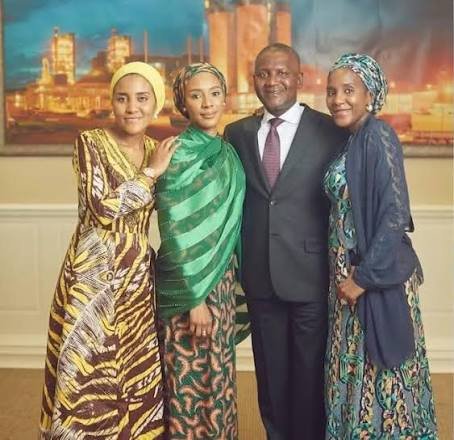
Chairman of the Dangote Group, Aliko Dangote, has said having a male heir to inherit his business empire is not a priority, stressing that any of his three daughters could eventually take charge of the conglomerate.
Key Highlights
- Aliko Dangote said having a male heir is not a priority in determining who will eventually lead the Dangote Group.
- He said any of his three daughters, Halima, Fatima and Mariya, could take over the leadership of the conglomerate.
- Dangote said all three daughters have shown strong interest in the family business and were not forced to join it.
- He expressed confidence that his daughters, whom he described as highly educated, could take the company to an even higher level.
- When asked whether all three could potentially lead the business, Dangote responded: “All of them.”
Dangote made the remarks during an interview with ARISE News on Tuesday while discussing the future leadership and succession plans of the Dangote Group.

The billionaire businessman said he could see one of his daughters eventually leading the company, noting that he has been closely observing their development and involvement in the family business.
“I think, yes, I can see one of them. I’ve been watching all of them, so I can definitely see one of the three that can actually lead,” he said.
Dangote’s daughters, Halima, Fatima and Mariya, hold senior positions within the business group and have become increasingly involved in its operations.
According to their father, their participation in the family business was driven by their own interest rather than pressure from him.
“They are very, very interested in the business. I’m not forcing them to come and be part of this business, no. They are very interested, and they enjoy it,” Dangote said.
He expressed confidence that his daughters could surpass his achievements and take the company to an even higher level.
“But I’m sure they’re highly educated, so they will be more creative. So most likely, they might be even taking the company to the next level.”
When asked whether all three daughters had the potential to lead the business, Dangote responded: “All of them.”
Dangote also addressed the traditional expectation of having a male heir, particularly in relation to his background in Kano.
He said having a son is not important to his succession plans, arguing that having a male child doesn’t automatically guarantee the preservation of a family’s name or legacy.
“Sometimes you can pray for God to give you a son, but that son might be the one to bring down the name of the family,” he said.
Dangote added that people should not force circumstances when something does not happen as expected.
“Sometimes when God doesn’t give you something, don’t push. I don’t think a son would have done something better than these three daughters that I have. That one, I think, you know, it’s not my priority,” he said.
He further maintained that he had confidence in his daughters’ ability to carry on the family’s business legacy.
“Even if I had a son, I don’t think the son would have done better than these three daughters that I have,” Dangote said.
Read also:
- Dangote Explains Why Petrol Remains Expensive in Nigeria
- Dangote Refinery Raises Petrol Price To N1,350 Per Litre
- Lagos Igbo Traders Protest Chinese Retailers Over Cheaper Goods as VeryDarkMan Reacts
- Investing In Nigeria’s Textile Industry My Biggest Mistake In Business
Beyond family succession, the businessman said his larger objective was to ensure that the Dangote Group operates under strong professional management and governance.
“I want this company to be run professionally. I want to have the highest level of governance,” he said.
Dangote cited global companies such as Microsoft and Apple as examples of businesses that have continued to grow beyond the direct involvement of their founders.
He said his succession philosophy was designed to protect the company from being undermined by family interests.
“We want to make sure that we make it very difficult for any family member to come and destroy anything,” Dangote said.
The businessman also identified the industrialisation of Africa as the central legacy he hopes to leave behind.
“What I want to leave as a legacy is to industrialise Africa,” he said. “I cannot do it alone, but I’m 100% sure that in the next two or three years, other Africans will join.”