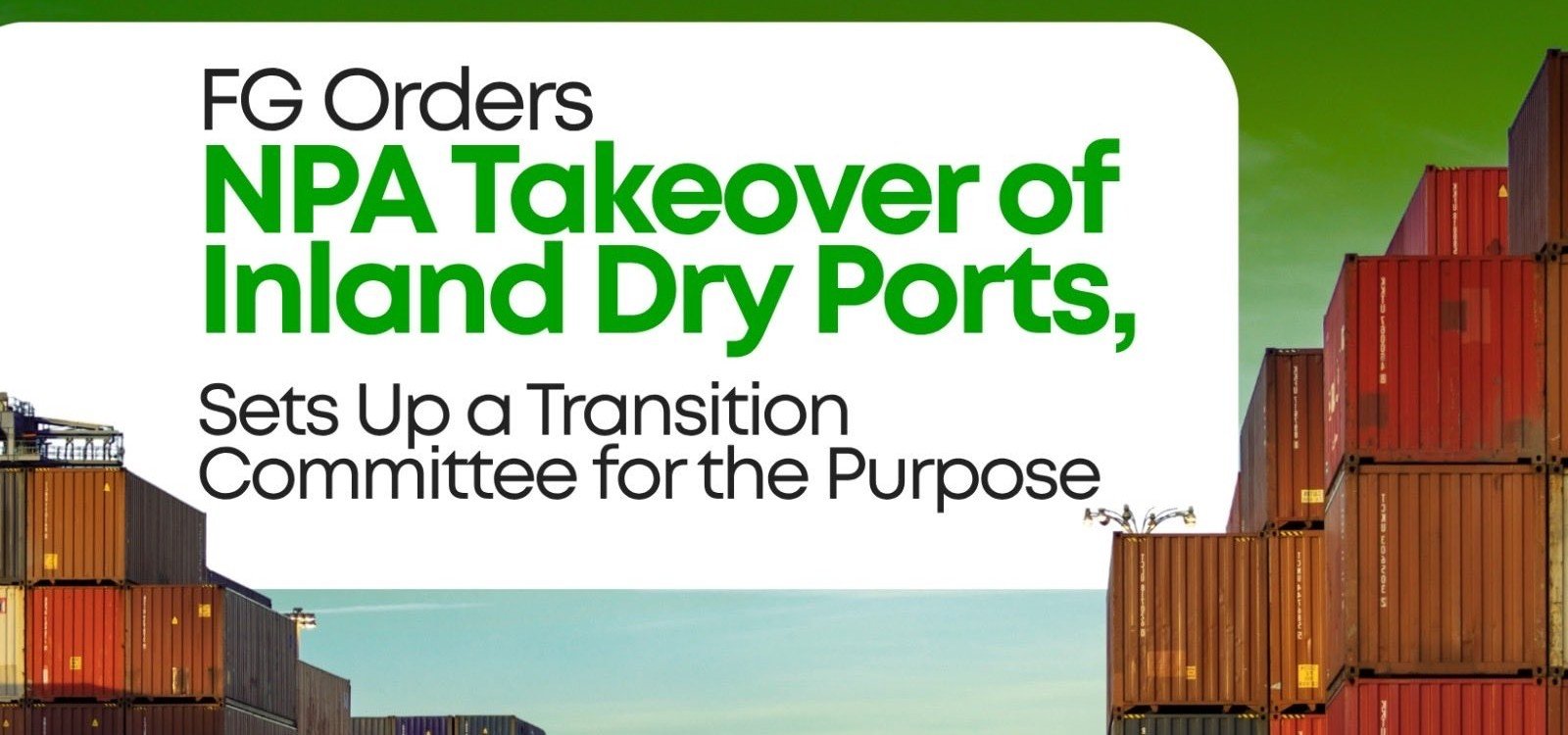
The Federal Government has directed the Nigerian Ports Authority (NPA) to take over functions relating to Inland Dry Ports (IDPs) previously handled by the Nigerian Shippers’ Council (NSC), as part of a major restructuring of Nigeria’s port sector.
The Minister of Marine and Blue Economy, Adegboyega Oyetola, announced the directive in September 2026 and ordered the immediate constitution of a Ministerial Committee to oversee the transition of the NSC into the newly established Nigeria Ports Economic Regulatory Agency (NPERA).

The development follows President Bola Ahmed Tinubu’s assent to the NPERA Act, 2026, which establishes a dedicated statutory economic regulator for Nigeria’s port sector.
Key Highlights
- FG directs the NPA to take over Inland Dry Port functions from the NSC.
- A Ministerial Committee has been set up to oversee the transition.
- The NSC will transform into the Nigeria Ports Economic Regulatory Agency.
- NPERA will focus on tariffs, competition, licensing and port service standards.
- Nigeria currently has three operational inland dry ports in Kaduna, Kano and Katsina.
- Additional dry ports are at various stages of development across the country.
NSC to Become NPERA
Under the new framework, the Nigerian Shippers’ Council, which has served as Nigeria’s interim port economic regulator since 2014, will transition into NPERA.
The new agency will have responsibility for economic regulation across the port sector, including tariffs and charges, competition, licensing, service standards, commercial dispute resolution and protection of port users.
Operational, infrastructure development and promotional responsibilities will be reassigned to other agencies under the Ministry of Marine and Blue Economy.
Oyetola said the restructuring was necessary to establish a clear separation between regulation, infrastructure development and port operations.
“A regulator cannot function as an operator and, at the same time, be expected to be perceived as an unbiased referee,” Oyetola said.
NPA to Take Over Inland Dry Port Functions
The Minister said transferring Inland Dry Port functions to the NPA would strengthen the programme by placing responsibility for its promotion and integration with an institution better positioned to connect the facilities to Nigeria’s wider port infrastructure and operational network.
The Federal Government said the move is intended to eliminate overlapping responsibilities among agencies and create a more efficient institutional structure for the maritime sector.
The Ministerial Committee will oversee the transition and ensure that responsibilities are properly redistributed among agencies under the Ministry of Marine and Blue Economy.
Read also:
- Maritime stakeholders reject Reps’ move to replace Nigerian Shippers Council through legislation
- ABER Hails Gov Diri For Hosting Rescued São Tomé Fishermen In Bayelsa
- Maritime Journalists Honour ABER Women’s Forum Secretary General For Outstanding Leadership
Nigeria’s Inland Dry Ports
Nigeria currently has three operational inland dry ports, located in Kaduna, Kano and Katsina.
They include:
- Kaduna Inland Dry Port
- Dala Inland Dry Port, Kano
- Funtua Dry Port, Katsina
Other inland dry port projects in states including Oyo, Abia, Plateau, Borno and Lagos are at different stages of planning or development.
Inland dry ports provide cargo handling, customs clearance, storage and other logistics services away from coastal seaports.
The facilities are designed to help move cargo closer to businesses and consumers inland while reducing congestion and pressure on major coastal ports, particularly those in Lagos.
FG Explains Inland Dry Port Restructuring
Oyetola assured stakeholders that the transfer of responsibilities should not be interpreted as a reduction in the government’s commitment to developing inland dry ports.
According to the Minister, the objective is to establish a more integrated port system capable of improving logistics and serving businesses across different parts of Nigeria.
The government expects the restructuring to provide clearer responsibilities for agencies operating within the maritime sector while improving coordination between inland logistics hubs and coastal ports.
Port Sector Reform Under Tinubu
The restructuring forms part of the Federal Government’s broader marine and blue economy agenda under the Tinubu administration.
The government expects the new regulatory framework to improve institutional clarity, strengthen competition and service standards, support the development of inland logistics hubs and improve the efficiency of Nigeria’s port system. More information on the ministry’s mandate is available on the Ministry of Marine and Blue Economy website.
The transition from the NSC to NPERA, alongside the transfer of Inland Dry Port functions to the NPA, is expected to mark a significant change in the way Nigeria’s port sector is regulated and managed. For more updates, follow us on X.