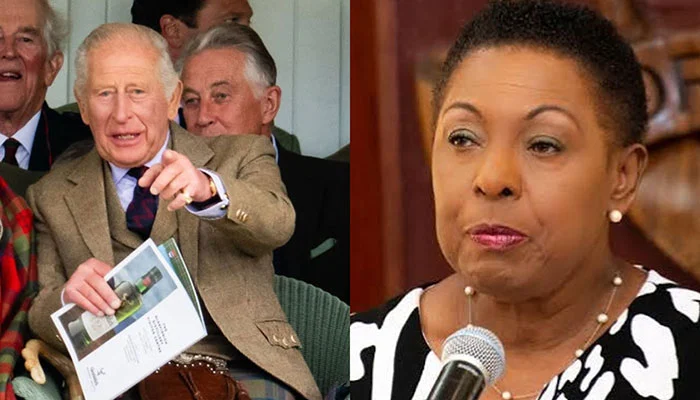
Jamaica is set to petition Britain’s King Charles III on Monday, to refer key legal questions surrounding the enslavement of Africans on the island to the Judicial Committee of the Privy Council, the country’s highest court of appeal.
The delegation presenting the petition is being led by Jamaica’s Minister of Culture, Gender, Entertainment and Sport, Olivia Grange, who is currently in the United Kingdom for the submission.

The Caribbean nation wants the court to determine whether the forced transportation and enslavement of Africans in Jamaica were lawful under fundamental principles of common law and whether the practice amounted to crimes against humanity under international law.
Jamaica is also seeking a determination on whether Britain has a legal obligation to provide a remedy for slavery and its lasting consequences.
The petition is addressed to King Charles because he remains Jamaica’s head of state, despite the country becoming an independent nation in 1962.
However, the Jamaican government has clarified that the move is not a direct request for financial compensation from the monarch.
Instead, it seeks a formal legal examination of questions relating to slavery and Britain’s responsibility for its consequences.
The petition forms part of Jamaica’s broader campaign for reparatory justice over the transatlantic slave trade and centuries of enslavement in the Caribbean.
Read Also:
- Ghanaian immigration arrest 93 Nigerians, rescue 73 others in major anti-fraud operation
- Nigeria congratulates Ghana on 69th independence anniversary
- Anambra police arrest two women over disappearance of 16-year-old girl, say victim is in Ghana
The timing of the petition is linked to the history of the Zong, a British slave ship that left West Africa for Jamaica on September 6, 1781, carrying 442 enslaved Africans.
During the voyage, 140 enslaved people were thrown overboard and killed after the vessel encountered difficulties.
The incident later became one of the most notorious legal cases associated with the transatlantic slave trade.
Jamaica’s government has highlighted the anniversary of the Zong’s departure as a symbolic moment to renew its call for reparatory justice.
The country has also drawn attention to the financial arrangements surrounding the abolition of slavery.
According to Minister Grange, Britain paid £20 million in compensation to plantation owners following emancipation, with the money raised through a loan that was not completely repaid until 2015.
Those who had been enslaved, however, received no equivalent compensation for decades of forced labour and exploitation.
Jamaica maintains that the effects of that historical injustice did not end with emancipation but continue to influence the country’s social and economic development.
Britain has historically resisted calls for financial reparations over its role in the transatlantic slave trade, but Caribbean governments have continued to demand various forms of reparatory justice.
These include formal apologies, debt relief, financial compensation and other measures aimed at addressing the legacy of slavery and colonialism.
Jamaica’s position has also received backing from other Caribbean nations through the Caribbean Community, which has supported regional efforts to pursue reparations.
Members of the Jamaican delegation are also expected to meet British cultural institutions to discuss the possible return of Jamaican artefacts currently held in the United Kingdom.
The legal initiative is particularly significant because Jamaica is seeking to use an institution inherited from Britain’s colonial constitutional system to examine legal questions arising from that same colonial history.
The next step will depend on whether King Charles agrees to refer the questions to the Judicial Committee of the Privy Council and, if referred, how the court interprets the legal issues.
For Jamaica, the petition represents another attempt to shift the reparations debate beyond political demands and towards a formal legal examination of Britain’s responsibility for slavery and its enduring consequences.