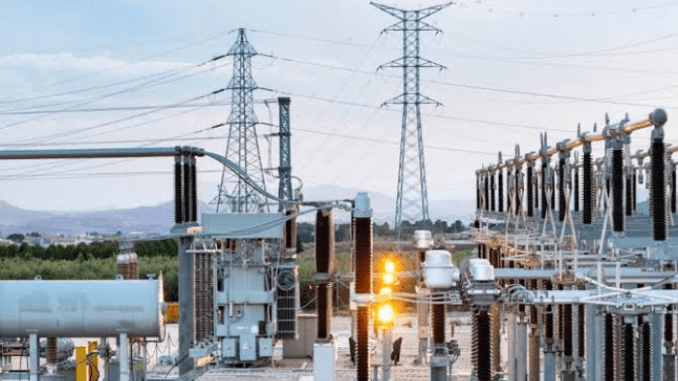
Delta State says it is pursuing reforms in the power sector to attract private investment, expand electricity supply and reduce the state’s dependence on the national grid.
The Commissioner for Works (Rural Roads) and Public Information, Mr. Charles Aniagwu, disclosed this during a press conference in Asaba.

Aniagwu said the state government is not seeking to return to an era when government alone controlled and operated businesses, stressing that the ongoing reforms were designed to create room for greater private-sector participation through liberalisation and public-private partnerships.
According to him, the state government is exploring opportunities to harness Delta’s abundant gas resources for electricity generation, particularly within the Kwale Free Trade Zone, which forms part of the state’s special economic zone.
Read also:
- How Gas Turbines Project Ushers In New Era of Electricity Supply in Yenagoa
- Ughelli Community Raises Alarm Over Alleged N500,000 Electricity Bills
- NERC Hosts Zanzibar Electricity Regulators On Study Tour To Strengthen Cooperation
He said investors have been taken to the zone during the state’s economic summit to demonstrate the availability of gas as a raw material for power generation.
Aniagwu explained that increased local power generation would reduce pressure on the national grid and make more electricity available to other users.
He cited the 8.5-megawatt independent power plant behind the state secretariat in Asaba as an example, noting that the facility has enabled the secretariat complex to operate independently of the national grid.
The commissioner also disclosed that the state has entered into partnership with Supply Power to generate an additional 120 megawatts of electricity for the national grid.
He said the initiative is part of the state government’s broader strategy to improve electricity supply and support small and medium-sized businesses whose operations depend heavily on reliable power.
Aniagwu said the state government has also intervened in areas traditionally regarded as the responsibility of electricity distribution companies because it is determined not to allow poor power supply to undermine economic growth.
He cited the extension of the electricity grid from Abraka towards the Ndokwa axis as one of such interventions, saying the objective is to ensure that more communities were connected to electricity.
He, however, expressed concern over the practice of residents and communities being required to provide transformers and other infrastructure, only for electricity distribution companies to subsequently collect bills without adequately accounting for the investments made by the communities.
According to him, the state government is willing to continue supporting efforts to energise communities because improved electricity supply would stimulate economic activity, create opportunities and potentially reduce security challenges associated with unemployment and idleness.
Aniagwu said the state government is also working with the Ministry of Energy and a committee established to fine-tune the state’s energy regulatory framework.
He explained that the proposed energy commission would play a crucial role in regulating new power producers, determining appropriate pricing and overseeing distribution networks.
The commissioner noted that electricity distribution requires careful planning, including decisions on whether to deploy overhead, underground or other forms of power lines, depending on the peculiarities of each location.
He stressed that proper regulation is necessary to ensure that electricity expansion does not expose residents to electrocution or other hazards, while also ensuring fair pricing and protection of power infrastructure.
Aniagwu said the ultimate objective of the reforms is to create a more efficient and sustainable power sector capable of supporting businesses, communities and households across Delta State.